
24/7 Customer Support

Free returns

Same-day & Next-day Delivery

Quality Guaranteed

Unlock Your Welcome Offers: FREE Delivery | Up to 80% OFF | Free 30-day JoyPlus trial
Download the APP
A portable handheld fan can make crowded trains, warm offices, outdoor events and summer holidays more comfortable. However, product listings often focus on impressive figures without explaining what they mean in everyday use. A high RPM number does not automatically guarantee useful airflow, and a long battery-life claim may only apply at the lowest setting.
The right choice depends on how you plan to use the fan, how often you can recharge it and whether you need hands-free operation. This guide covers the main buying traps, practical specifications and suitable options for different UK lifestyles.
A rechargeable handheld fan may advertise 18, 22 or even 40 hours of use. These figures generally refer to the lowest airflow setting. Running a high-speed handheld fan continuously can use considerably more power.
Before buying, check whether the listing explains the operating range at different speeds. A stated runtime such as 3–22 hours depending on speed provides more useful context than a single maximum figure. Battery capacity is another helpful comparison point: a 5,000mAh battery generally offers more reserve than a smaller cell, although motor power and airflow design also affect runtime.
Motor speed is only one part of the airflow system. Blade design, air intake, outlet shape and motor efficiency all influence the breeze you feel. A fan with a high RPM figure may also be louder or use more energy at full power.
Look for practical specifications such as maximum air speed, adjustable settings and noise information where available. For example, some compact models list airflow of up to 9–10m/s, while simpler mini portable fans may prioritise low weight and quieter everyday use.
A battery-operated fan is only convenient if it fits your existing charging routine. Check whether it uses USB-C or another USB connection, and whether your power bank, laptop or travel adapter can supply the required input.
Also consider accidental activation inside a bag. A safety lock, protective grille and included wrist strap or lanyard can make a noticeable difference. Keep fingers, loose hair and jewellery away from moving parts, and do not use a lithium-battery fan in heavy rain or immerse it in water.
For flexible use, choose a fan with several settings rather than a single high-output mode. A 5-speed portable fan can provide a gentler breeze in an office or during make-up application, then increase airflow outdoors. Fans with 100-level adjustment offer finer control, but a scroll wheel or multi-step button system may be simpler when you are walking or travelling.
A concentrated outlet can direct air towards your face or neck, while a broader grille may feel less intense but cover a wider area. Consider whether you want a pocket fan for short bursts or a stronger personal cooling fan for concerts, camping and warm commutes.
For occasional use, a smaller rechargeable battery may keep the fan lighter. For full-day travel, a 5,000mAh USB rechargeable fan offers a more substantial reserve. Some models list charging times of two to five hours, depending on the charger and input power.
Always distinguish between:
If you are flying, travelling by coach or taking a cruise, check the carrier’s current rules for lithium-battery devices before packing.
Dimensions and weight affect whether a fan is genuinely portable. A device around 128–180g is generally easier to hold for longer periods than a heavier metal-bodied model. A lanyard can help at a festival or market, while a foldable design can convert a handheld fan into a desk fan.
Some models include a table stand, phone stand or neck-wear option. These features are useful in an office, bedroom or dressing area, but check that the stand is stable on a flat surface. For commuting, a compact shape, lock switch and secure strap may matter more than additional functions.
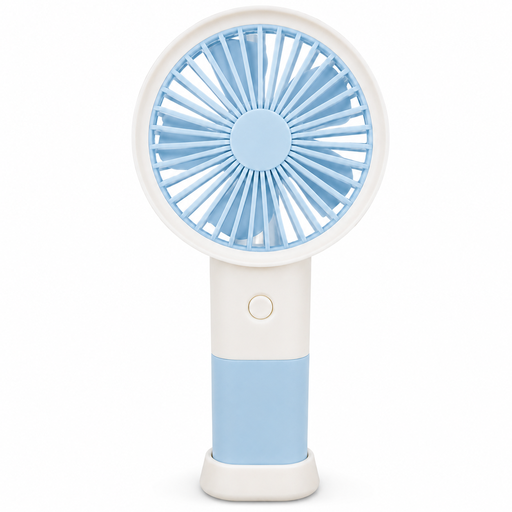
Why This Fits Their Persona: A straightforward choice for first-time buyers who want an everyday mini portable fan for work, commuting or use at home without adding unnecessary functions.
Its three speed settings provide clearer control than a single fixed output, while Type-C charging avoids relying on a proprietary charging connection.
Three adjustable speeds; integrated table stand for hands-free desk or bedside use; USB Type-C charging.
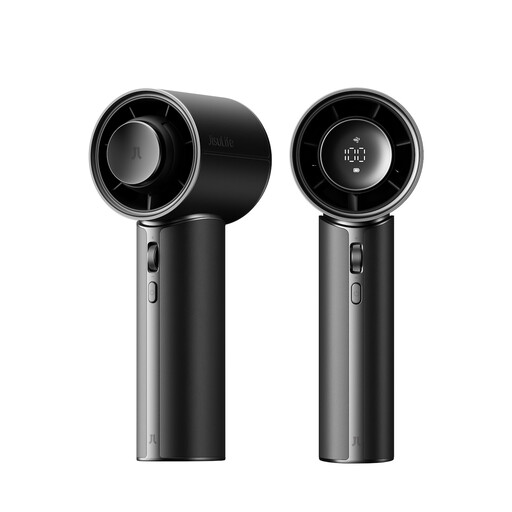
Why This Fits Their Persona: Suitable for shoppers who value refined presentation and detailed airflow control for offices, weddings, travel or gifting.
The LED display shows wind speed and battery status, while the retractable lanyard and safety lock address storage and carrying concerns.
100 wind-speed levels; 4,250mAh battery; digital display; storage pouch and retractable lanyard included.
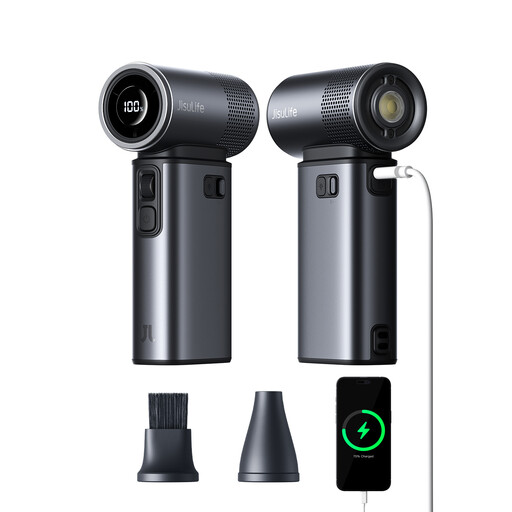
Why This Fits Their Persona: A practical match for camping, cruises, festivals and long outdoor days where extra battery capacity and additional functions are useful.
Its display shows battery and speed in real time, helping users plan charging instead of relying on an unclear maximum-runtime statement.
9,000mAh battery; 1–100 speed adjustment; 18W charging and power-bank function; rear flashlight.
We have compiled a complete, real-time list of products that fully satisfy these strict selection criteria and UK safety regulations.
Charging time varies by battery size and input power. Compact models may take around three hours, while larger 5,000mAh fans can take four to five hours. Fast-charging models may require a compatible USB-C PD or QC adapter; using a lower-power adapter can extend charging time.
A USB rechargeable fan generally uses relatively little electricity compared with larger room fans, but running cost depends on battery capacity, charging frequency and local electricity rates. Charging from a laptop or power bank may be convenient, though it still uses stored energy that must be replenished.
Yes, if it includes a stable table stand, foldable base, neck lanyard or phone-stand design. Check the product details carefully, as a wrist strap is intended for carrying rather than supporting the fan during operation.