
24/7 Customer Support

Free returns

Same-day & Next-day Delivery

Quality Guaranteed

Unlock Your Welcome Offers: FREE Delivery | Up to 80% OFF | Free 30-day JoyPlus trial
Download the APP
A compact fan can make a commute, office day, festival or warm bedroom more comfortable. However, choosing between portable handheld fans is not simply a case of selecting the model with the highest speed count. Marketing descriptions can make similar products appear very different, while important details such as battery capacity, charging type and stability may be harder to find.
As the Joybuy Product Recommendation Officer, I focus on practical differences that affect everyday use. Here are the main pitfalls to avoid before buying a rechargeable handheld fan in the UK.
A stated runtime is usually linked to the lowest speed setting. A fan advertised as running for 18 or 22 hours may operate for considerably less at high speed. Check whether the description explains the runtime by speed level, rather than relying on a single headline figure.
A fan with several modes is not automatically more suitable. Three clearly separated speeds may be easier to operate than many closely spaced settings. For office use or travel, low-speed control and quiet operation may matter more than maximum airflow.
A handheld fan is less useful if it cannot be placed securely on a desk or carried without taking up too much space. Look for a handheld fan with stand, foldable design, wrist strap or lanyard if you need hands-free flexibility. A neck fan may suit outdoor activities, but it is a different format from a pocket fan and may feel less suitable for desk use.
Rechargeable fans commonly use lithium-ion batteries, with capacities listed in mAh. A higher mAh figure generally indicates more stored capacity, but motor power, blade design and selected speed also affect runtime.
For occasional use on a train or during a short walk, a lightweight handheld fan with a smaller battery may be convenient. For festivals, camping or long outdoor shifts, consider a model with a 3,000mAh or 5,000mAh battery and a clearly stated operating range.
Treat figures such as “up to 18 hours” as a low-speed reference. If the product provides separate low, medium and high-speed estimates, that is more useful for planning.
A USB rechargeable fan can usually be powered from a laptop, power bank, car adapter or mains USB plug. USB-C is increasingly convenient because it uses a reversible connector and may match other devices in your bag.
Check whether the listing includes a cable and whether charging can take place while the fan is operating. Do not assume that every USB-C port supports fast charging. Use compatible charging equipment and stop using the fan if the battery becomes unusually hot, swollen or damaged.
A lightweight handheld fan is easier to carry, but a very small body may have limited battery capacity or a narrower airflow outlet. Weight is particularly important if you plan to hold the fan for long periods.
For a portable desk fan, check the base or stand rather than just the fan’s dimensions. Place it on a flat, stable surface and keep air vents clear. Fans with rotating blades should be kept away from fingers, loose hair and foreign objects. A bladeless neck fan avoids exposed fan blades, but still contains a rechargeable battery and should be kept away from water and excessive heat.
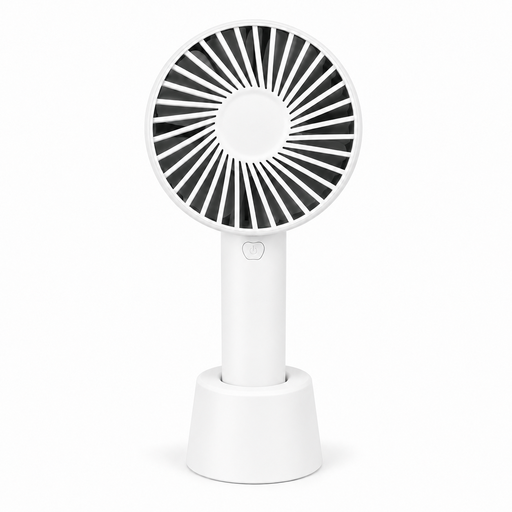
Why This Fits Their Persona: A straightforward choice for commuters, office workers and first-time buyers who want one fan for everyday use without carrying a separate desk fan.
The included stand addresses the stability issue, while USB recharging avoids routine battery replacement.
Lightweight design, USB-rechargeable battery, desktop stand and wrist strap.
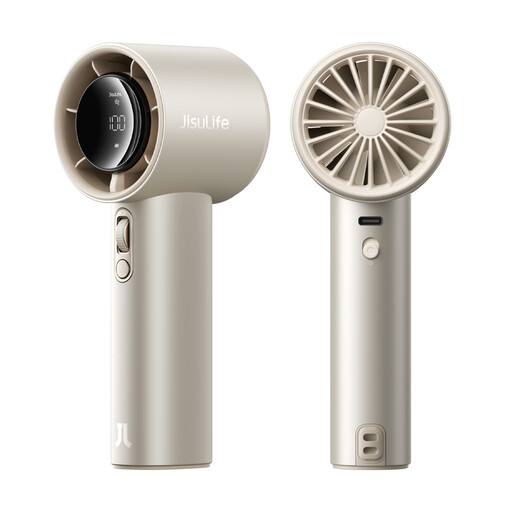
Why This Fits Their Persona: Suitable for users who want detailed control and battery information during travel, concerts or extended outdoor use.
The LED display shows wind speed and battery level, helping avoid uncertainty around remaining charge.
5,000mAh battery, 100 wind-speed levels and USB charging; stated operating time varies by setting.
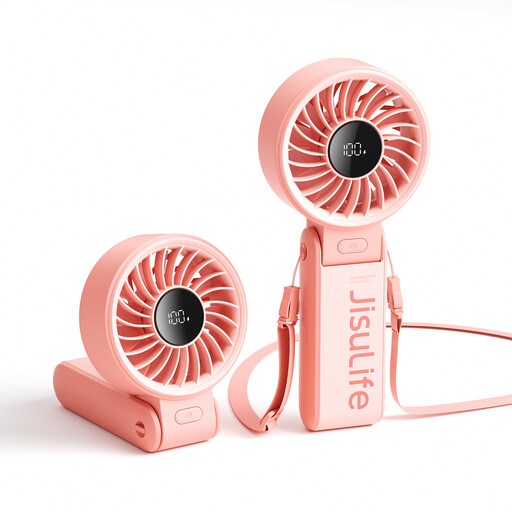
Why This Fits Their Persona: A flexible option for people moving between commuting, desk work, outdoor events and hands-free activities.
Its foldable 3-in-1 format is designed for handheld, desk and neck-worn use rather than a single fixed position.
5 speed settings, 5,000mAh battery, LED display and stated operating time of 3.5–19 hours depending on use.
A USB rechargeable fan uses electricity only while charging, so its running cost depends on battery capacity, charging frequency and your electricity tariff. The amount is generally small compared with running a mains-powered room fan, but the exact cost cannot be calculated without the device’s charging energy and your tariff.
To help extend service life:
We have compiled a complete, real-time list of products that fully satisfy these strict selection criteria and UK safety regulations.
A small personal fan is generally convenient for commuting, but transport operators can have their own rules regarding lithium batteries and electrical devices. Keep the fan switched off when not needed, avoid blocking other passengers and follow the operator’s guidance for events, aircraft and public transport.
Battery runtime varies by capacity, motor and speed. The products listed above state different ranges, from several hours at higher settings to longer periods on low speed. Treat the published maximum as a low-speed estimate and recharge before extended trips.
A handheld fan gives you direct control and can often stand on a desk. A neck fan leaves both hands free, which may help during walking, exercise or outdoor work. Compare weight, speed settings, battery capacity and comfort, and remember that neither type should be treated as waterproof unless the product specifically states an appropriate rating.