Two-pan family-meal cooks
If curry and rice or a side dish need cooking together, look for two usable zones rather than choosing solely for a small footprint. Check that both pans fit and that the hob can run both zones as needed.


Choose a two-zone induction hob if you need to cook curry and rice in separate pans at the same time, provided both pans are induction-compatible and fit the chosen zones. A portable single induction hob suits one-pot curry or use alongside an existing cooker. If keeping non-magnetic pans matters more, consider a conventional double hot plate, allowing for its hot cooking surface and fixed ring sizes.
If curry and rice or a side dish need cooking together, look for two usable zones rather than choosing solely for a small footprint. Check that both pans fit and that the hob can run both zones as needed.
A portable single induction hob can provide another cooking position beside a main cooker. Check the curry pan’s magnetic base and its diameter against the chosen hob’s requirements.
If your existing pans are aluminium, copper or non-magnetic stainless steel, a conventional electric hot plate is an alternative to replacing them for induction use. Match the pan bases to the hot plate’s rings.
Choose when: Curry and rice need separate pans cooking at the same time.
Allow for: Both pans must work with induction; check each zone’s pan limits and power behaviour when both are active.
Choose when: You need one cooking position for curry, with another appliance or cooking stage available for rice.
Allow for: One zone cannot heat the curry and rice pans simultaneously.
Choose when: Keeping existing non-magnetic pans is a deciding factor.
Allow for: The plates become hot, and their fixed ring sizes need to suit your pan bases.
| Concern | What to check | Who this matters to |
|---|---|---|
| Cooking two pans | Check that two zones can operate together and that each accepts its intended pan. | I want the curry to simmer while rice or a side cooks, without waiting for a zone to become free. Around 42% of consumers put two-pan cooking first. |
| Keeping existing pans | Check induction compatibility and permitted pan-base sizes, or compare the ring sizes on a conventional hot plate. | If my curry pan has a non-magnetic base, I want to keep using it rather than change cookware. Keeping existing pans is the primary need for around 33% of consumers. |
| Compact extra zone | Compare storage dimensions, pan-base limits and available heat settings. | When another cooker handles the rest of the meal, I need a portable position for one curry pan. For around 25% of consumers, that compact one-pot use comes first. |
Induction needs a suitable magnetic base. Judge’s JEA92 manual says glass, ceramic, aluminium and copper pans are unsuitable unless they have a specially constructed induction base; a pan must also fit the chosen hob’s stated size range.
Check each curry and rice pan for an induction symbol or a base that attracts a magnet, then compare its base diameter with the exact model’s requirements.
Pans that fail either check may need replacing if you choose induction.
A single-zone hob cannot cook curry and rice in separate pans simultaneously. Preparing one after the other adds a cooking stage.
If both pans routinely need heat together, choose a model with two usable zones. Otherwise, plan how an existing cooker, rice cooker or staged cooking will cover the second pan.
Induction heats suitable cookware directly, while conventional electric plates become hot. The VonShef Double Hot Plate accepts several non-magnetic cookware types, but its rings have fixed diameters of 16cm and 19cm.
If you choose a hot plate to keep your pans, check their base sizes against the rings and allow for the hot surface during and after cooking.
Tefal states that the boil programme on its IH201840 is set around 1.5 litres of water in a 20cm pan. A smaller quantity can boil sooner and may boil dry if left unattended.
For curry sauce or small liquid quantities, use an appropriate manual or stew setting and stay nearby while it heats or reduces.
Tefal’s portable single-zone induction models are relevant when you need an extra cooking position rather than two pans running together.
VonShef lists both portable induction hobs and a conventional double hot plate, giving cooks different routes according to their pans and the number of zones needed.
Judge’s JEA92 is a plug-in dual-zone induction option for cooks comparing two-zone appliances and stated temperature settings.
These portable induction hobs are choices to consider for a curry pan or an extra cooking position. If curry and rice must cook simultaneously, confirm the number of zones on the exact model before choosing either one.
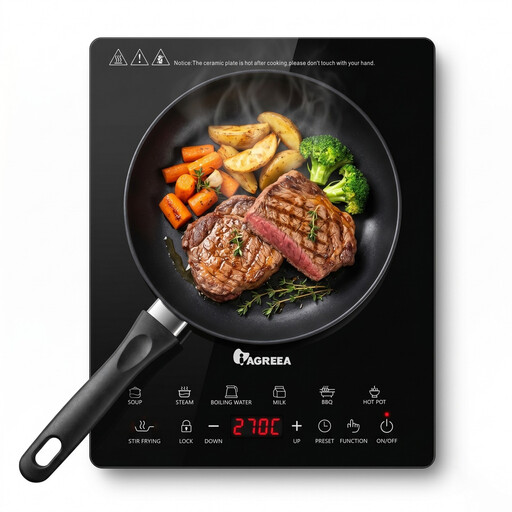 Image unavailable
Consider this for a curry pan or an extra cooking position if your cookware suits induction; check its zone count if you also need to cook rice at the same time.
The product name states eight power levels, a 60–270°C temperature-control range, seven preset functions, a 3-hour timer and a 12–26cm suitable-cookware range. Check that your pan meets the model’s cookware requirements.
 Image unavailable
Consider this for a curry pan or an extra cooking position if you have compatible cookware; check its zone count before planning a simultaneous rice pan.
The product name states 10 power settings, six functions, touch controls and a safety lock. Confirm that your pan-base diameter suits the exact model.
Yes: induction requires cookware with a suitable magnetic base. Judge’s JEA92 manual identifies enamelled steel, cast iron and induction-designed stainless steel as suitable, while glass, ceramic, aluminium and copper need a specially constructed induction base. Check the pan with a magnet or its induction symbol, then confirm the hob’s permitted base diameter.
Choose two zones when curry and rice or a side need heat at the same time. VonShef states that its double induction model has two 1,400W plates; before choosing a particular hob, check that both pans fit and how its zones operate together.
Stop using it and turn off the power immediately. Tefal’s induction-cooker manual identifies an electric-shock risk from a cracked surface and directs users to contact an approved service centre.
Check the exact model’s instructions before using it outdoors. Tefal specifies indoor domestic household use for its portable induction cooker; that restriction should not be assumed to describe every portable hob.
Check the exact brand and model against current Office for Product Safety and Standards recall information. Electrical Safety First directs consumers to that information for current UK product recalls.