What matters when choosing?
Start with the saucepan and the shared-kitchen setup, then compare the hob's lower controls. A single induction hob suits a compatible pan; a conventional electric hotplate is an option if you need to retain a non-compatible pan, while the existing cooker avoids adding another appliance when placement or household rules are uncertain.
| Concern |
What to check |
Who this matters to |
| Adjustable heat |
Compare the documented lower power or temperature settings and how readily you can change them while stirring. Maximum wattage does not establish gentle-heat performance. |
If I need to adjust the heat as my curd thickens, several usable lower settings matter more than fast boiling. Around 40% of consumers put controlled heat first. |
| Shared-space use |
Check for a dry, stable location, a sound lead and a suitable socket; confirm the appliance rules and space needed for use and storage. |
When I share a worktop, I need to cook without leaving a trailing cable or blocking someone else's preparation space. Roughly 30% of consumers place safe shared-space use first. |
| Saucepan compatibility |
For induction, check whether the flat base is magnetic and falls within the chosen hob's stated pan-base range. |
If I want to keep using my saucepan, I need to know it will work before choosing induction. About 30% of consumers prioritise keeping their existing pan. |
Portable induction hobs on Joybuy
These single portable induction hobs are options for making lemon curd when your saucepan is compatible and your shared kitchen has a suitable place to use one. Compare their stated controls, then check the manual for your pan and setup before buying.
 No image available
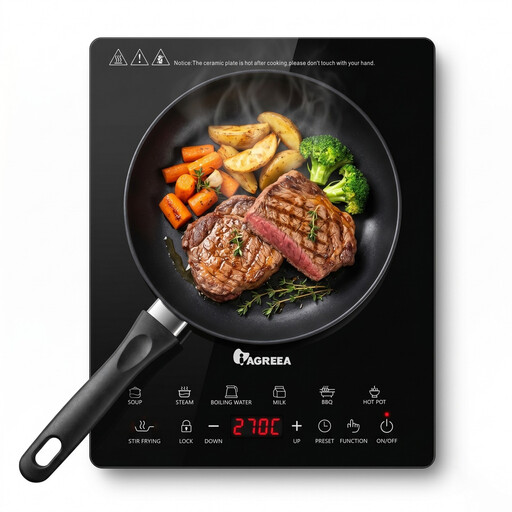
IAGREEA DF200-14V10 portable induction hob
Consider this model if you want several stated adjustment points while stirring curd and have a suitable induction pan. Its name specifies a 2,000W maximum, eight power levels, a 60–270°C temperature range, seven preset functions, a three-hour timer and a child lock.
The stated 12–26cm cookware range still calls for a compatible flat magnetic base. Check the manual for low-setting behaviour, placement requirements and the electrical connection suitable for your kitchen.
Joybuy
 No image available
ochama 2,000W portable induction hob
Consider this single hob if selectable controls and a slim design suit your shared-worktop plans. Its name specifies a 2,000W maximum, 10 power settings, six functions, touch controls and a safety lock.
Check the manual for the lower setting range, the accepted magnetic pan-base size, placement requirements and the electrical connection suitable for your kitchen before relying on it for curd.
Joybuy
Frequently asked questions
Can I make lemon curd on a portable induction hob?
Yes, provided you use a compatible saucepan and can adjust the heat while stirring. Identified portable models offer multiple settings, but those specifications do not establish a particular setting or result for your recipe; start gently and stay with the pan.
How can I check whether my saucepan will work on induction?
Check for an induction symbol or whether a magnet is attracted to the flat base, then compare that base's diameter with the chosen hob's instructions. Prestige explains that the magnetic flat base matters more than the pan's overall rim diameter.
Can I put a portable hob beside the sink?
Choose a dry, stable location away from sink water and follow the hob's placement instructions rather than assuming the nearest socket is suitable. Electrical Safety First advises care around water, cables, hot surfaces and electrical appliances in kitchens.
Can a timer watch the lemon curd while I step away?
No. Buckinghamshire Fire & Rescue Service advises staying with your cooking and turning off the heat if you leave the room; a timer does not replace supervision or the frequent stirring curd needs.
Do the eggs used for lemon curd need particular care?
Follow your recipe's handling and cooking instructions, especially if the curd may remain runny. The Food Standards Agency's 2023 risk profile describes its 2017 advice on raw or runny eggs from recognised assurance schemes; that advice has specific egg-source conditions and is not a reason to assume every lightly cooked egg has the same risk.


