Hosts needing another indoor cooking zone
If the main cooker is occupied, a portable hob gives your shakshuka pan its own position for frying the vegetables and simmering the sauce before serving.


For an indoor dinner party, a single portable induction hob is a practical extra cooking zone if your shakshuka pan is induction-compatible and its base fits the hob’s stated range. Choose a conventional electric hot plate if keeping a non-induction pan is the priority. A camping gas stove belongs in an outdoor setup that follows its manufacturer’s fuel and use instructions, not as an indoor workaround.
If the main cooker is occupied, a portable hob gives your shakshuka pan its own position for frying the vegetables and simmering the sauce before serving.
If your usual skillet is not induction-compatible, a conventional electric hot plate may let you keep using it. Check the plate’s cookware and surface instructions for the exact model.
For an outdoor gathering, a camping stove may be an option if you can follow its instructions for the cartridge, ventilation, pan and stable setup.
Decide where you will cook and whether you want to keep your existing pan. For shakshuka, also check that the hob lets you move from frying to a gentler simmer without leaving the pan unattended.
Choose it when: You need one extra indoor zone and have a flat-based, induction-compatible pan within the model’s permitted size range.
Trade-off: It cannot use a non-induction pan, and a single-zone model holds only one pan at a time.
Choose it when: Keeping a non-induction shakshuka pan matters most; an Amazon UK listing describes one CUSIMAX cast-iron-ring model as working with all cookware.
Trade-off: Its heating ring remains hot after cooking, so it needs space to cool away from guests.
Choose it when: You are cooking outdoors without mains electricity and can meet the stove maker’s fuel and setup requirements.
Trade-off: Cartridge compatibility and fuel-burning safety need attention; an outdoor camping stove is not an indoor extra hob.
| Concern | What to check | Who this matters to |
|---|---|---|
| Frying and simmering control | Look for manually selectable heat levels so you can lower the setting after frying, rather than relying solely on presets. | I need to fry the vegetables, then keep the tomato sauce at a gentle simmer while the eggs set. Around 46% of consumers would put that heat-control need first. |
| Existing-pan fit | For induction, check the pan’s magnetic base and measure its base diameter against the hob’s permitted range. | If I want to use the skillet I already own, changing cookware could determine which hob I choose. Around 27% of consumers would prioritise keeping their existing pan. |
| Worktop and storage space | Check the appliance’s intended setting, stable placement, footprint and space to store it after use. | With guests and serving dishes nearby, I need room to use the extra hob safely and put it away later. For around 27% of consumers, that setup is the primary concern. |
An induction hob will not heat a pan that lacks an induction-compatible base, and an otherwise suitable pan may fall outside a model’s permitted base-size range.
Check for an induction marking or test whether a magnet sticks to the base, as Tefal advises. Measure the base rather than the rim and compare it with the hob’s instructions.
If the pan does not fit, using that induction hob would require another compatible pan.
UK Health Security Agency guidance identifies inappropriate use of fuel-burning appliances as a carbon-monoxide exposure risk. Camping stoves also have model-specific cartridge and setup instructions.
For an indoor dinner party, use an appliance intended for indoor domestic use. Keep an outdoor stove outdoors and follow its manufacturer’s fuel, ventilation and stability instructions.
Once the vegetables are fried, the tomato sauce needs closer heat control; a timer does not watch the pan or prevent it from cooking dry.
Lower the manual setting for the simmer and keep the pan attended. Treat a timer as a reminder, not a substitute for supervision.
A conventional hot plate’s cast-iron ring stays hot after cooking, which matters on a worktop shared with guests and serving dishes.
Use a stable, heat-safe surface, keep the cable and pan handle away from the edge, and let the ring cool before cleaning or storing it.
Tefal’s Everyday portable induction models offer an indoor extra-zone option.
A conventional electric hot-plate option for cooks who want to keep using a non-induction pan.
An outdoor camping-stove route for cooking away from mains electricity, rather than an indoor dinner-party substitute.
These single-zone induction hobs suit the extra indoor cooking-zone route if your skillet fits and the exact model’s instructions permit your intended setup. Check the plug and electrical supply requirements before ordering; neither product replaces the need to supervise the simmer.
 No image available
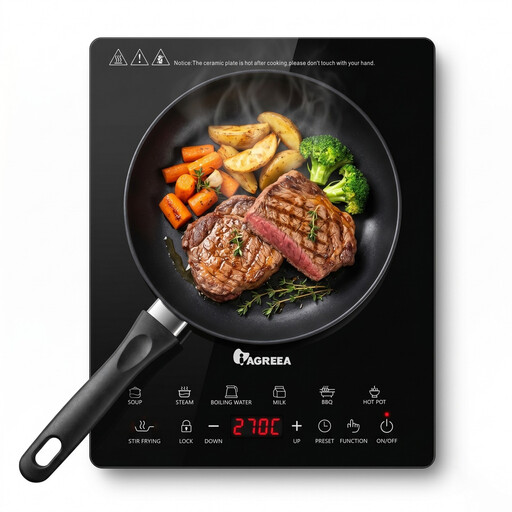
Consider this model if you want selectable settings for frying and then lowering the heat for sauce.
The product title states 2000 W, eight power levels, a 60–270°C temperature-control range and a three-hour timer.
It specifies cookware from 12–26 cm; check that your pan is induction-compatible and that its base fits. Confirm the model’s indoor-use instructions and UK plug and supply requirements before buying.
 No image available
Consider this slim model if you need a movable extra zone with settings for the higher-heat and lower-heat stages of shakshuka.
The product title states 2000 W, ten power settings, six functions and touch controls.
Use induction-compatible cookware and confirm the permitted pan-base diameter against your skillet. Check the model’s indoor-use instructions and UK plug and supply requirements before buying.
A single induction hob is a practical choice if your skillet is induction-compatible and fits the model’s pan-base range. Look for selectable lower settings for the tomato-and-egg simmer; if you need to keep a non-induction pan, consider a conventional electric hot plate instead.
It will work only if its base is induction-compatible and within the hob’s stated size range. Check the pan’s induction marking or whether a magnet sticks to its base, as Tefal advises, then measure the base rather than the wider rim.
Do not use an outdoor camping stove as an indoor extra hob. Use only equipment intended by its manufacturer for indoor use and follow its instructions; UK Health Security Agency guidance identifies inappropriate use of fuel-burning appliances as a carbon-monoxide exposure risk.
Stop using the hob and consult its instructions or the manufacturer about repair. The Tefal induction-hob guidance warns against using an appliance with a cracked ceramic surface because of electric-shock risk; do not continue cooking on a visibly damaged unit.