For a one-pan community-room demonstration, a portable induction hob is a practical choice if the venue’s electrical supply suits the exact appliance and your pans are induction-compatible. A compact model around 2 kW suits occasional sessions where carrying and storage matter; a commercial-style 3 kW model is worth considering for frequent sessions or larger pans, provided its weight, pan range and electrical requirements suit the venue.
Who is this for?
Demonstrators planning around venue safety
You cook near attendees and need to agree which electrical supply to use, where to place the hob and how to keep its cable out of the way. The Health and Safety Executive advises checking that electrical equipment suits the supply it will use.
One-pan teachers with limited storage
You make one recipe component at a time and want a hob that is straightforward to carry and put away. A timer or pause control may be useful while you explain a step, but check those controls and your pan sizes against the particular model.
Frequent demonstrators using larger pans
You regularly cook with a larger saucepan or want more manual power settings. Compare the stated pan range and handling weight as well as the output rating; the room’s electrical supply still needs checking before you commit to a higher-powered unit.
What matters when choosing?
Start with the venue’s electrical supply and the pans you will use, then decide how much cooking control and carrying convenience the sessions require.
| Concern |
What to check |
Who this matters to |
| Electrical and attendee safety |
Check the exact appliance rating with the venue, inspect the plug and cable, and plan a stable position with an accessible way to disconnect power. |
If I am cooking near attendees, I need to know the hob suits the room’s supply and can be set up without creating a cable hazard. Around 33% of consumers put venue supply and safe setup first. |
| Cookware and heat control |
Check induction compatibility and the stated pan-base range; compare the manual settings and any timer or pause control you will use. |
When I talk through a recipe while cooking, I need my existing pan to work and the heat to be easy to adjust. For around 27% of consumers, cookware fit and control are the primary concern. |
| Larger-pan cooking |
Match the output rating and stated pan range to your recipes, while checking that the venue can accommodate the exact unit. |
A larger saucepan or a demanding one-pan step can shape my choice more than a slim design. Around 20% of consumers chiefly prioritise larger-pan cooking and output. |
| Transport and storage |
Compare the model’s dimensions and weight with your journey, cupboard space and available work surface. |
If I move the equipment between sessions, I need a hob I can carry and store without awkward handling. Ease of transport is the main concern for around 20% of consumers. |
Mistakes to avoid
-
Choosing a high-power hob before speaking to the venue
A 3 kW rating describes the appliance, not the suitability of a particular socket or room setup. The Health and Safety Executive advises using electrical equipment that suits its supply.
Ask the venue about the supply available for the exact model before buying. Plan cable routing, keep the means of disconnecting power accessible and do not use damaged equipment.
-
Assuming every demonstration pan works on induction
Induction requires compatible cookware, and the stated pan range varies by model. Tefal lists 12–26 cm induction pans for the IH210840, HENDI lists 120–220 mm pan bottoms for the 239391, and Buffalo lists 120–280 mm pans for the CE208.
Check the base of each pan you plan to use against the exact hob’s requirements, and test your demonstration cookware before the event.
Unsuitable pans may need replacing before an induction demonstration can go ahead as planned.
-
Treating annual PAT testing as the only safety check
The Health and Safety Executive says it is a myth that every portable appliance in a low-risk environment needs a portable appliance test every year. A test schedule does not replace attention to the appliance’s condition between tests.
Follow the venue’s maintenance arrangements and inspect the plug, cable and casing before use. Take equipment with visible damage or signs of overheating out of service.
-
Planning the cooking but not the food samples
Giving prepared food to attendees raises food-safety questions separate from hob selection. GOV.UK states that food supplied at community or charity events must comply with food law and be safe to eat; Food Standards Scotland also advises organisers to consider the food-safety implications of community events.
Decide whether attendees will receive samples, plan safe handling and check the applicable allergen-information and registration requirements for the activity and location. Seek advice from the relevant local authority where the activity may be a food business.
Portable-hob brands for reference
Tefal
The IH210840 is a consumer-oriented induction option for occasional, single-pan demonstrations where slim storage and guided controls matter.
- Tefal specifies a 45 mm body, seven manual power levels from 300 W to 2100 W, six automatic functions, a timer and a pause function for the IH210840.
- This single-zone model is specified for induction pans from 12 cm to 26 cm; check that range against the pans used in your recipes.
Buffalo
The CE208 is a commercial-style option to assess for frequent, single-pan demonstrations using larger pans.
- Buffalo specifies 3 kW, 230 V, 13 A, 26 power settings and a 120–280 mm compatible-pan range for the CE208.
- At a stated 5.6 kg, it requires more thought about carrying and storage. Confirm the venue’s supply for the exact unit; it still provides only one cooking zone.
HENDI
The 239391 is a professional catering model described by HENDI for live cooking, with a flat, single-zone setup.
- HENDI specifies 2000 W, nine power steps, a 60°C–240°C temperature range, a 0–180 minute timer and 120–220 mm pan-bottom compatibility.
- Check the exact UK offer for its plug configuration, availability and after-sales terms rather than assuming they match the manufacturer’s product information.
Portable induction hobs on Joybuy
These portable induction hobs offer adjustable controls for recipe demonstrations. Choose between them only after checking your pans against the exact model and confirming that the venue’s electrical supply suits it.
 No image available
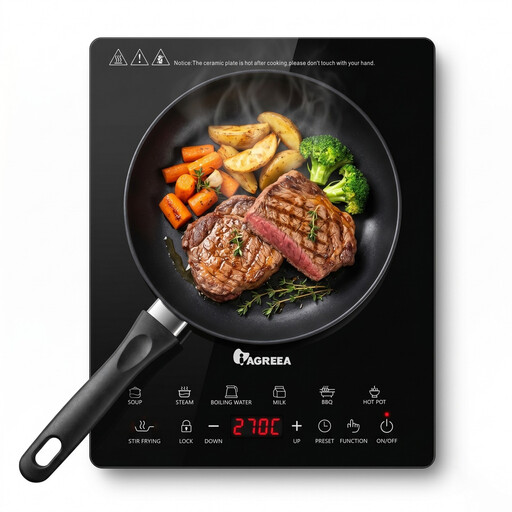
IAGREEA DF200-14V10 2000 W portable induction hob
Consider this model if your demonstration uses compatible pans and you want a timer and preset functions while presenting recipe steps.
- Eight power levels, 60°C–270°C temperature control, seven preset functions and a three-hour timer are stated in the product name.
- The stated cookware range is 12–26 cm; confirm that your pans have suitable induction bases.
- Check the supplied plug and cable details against the venue’s electrical supply before use.
View on Joybuy
 No image available
ochama 2000 W portable induction hob, 10 power settings
Consider this model if adjustable heat and preset functions are useful while you explain cooking steps.
- The product name states 10 power settings, six functions and touch controls.
- Confirm the compatible pan-base range with the exact product offer and test the pans you intend to use.
- Check the unit’s voltage, supplied plug and cable against the venue’s electrical supply before use.
View on Joybuy
Frequently asked questions
Does a community-room hob need a PAT test every year?
Not necessarily: the Health and Safety Executive says an annual portable appliance test is not a universal requirement for every appliance in a low-risk environment. Follow the venue’s maintenance arrangements and check the hob, plug and cable for damage before use.
What should I ask the venue before plugging in a portable hob?
Ask whether the available electrical supply suits the exact hob and where it can be positioned without creating a hazard for attendees. The Health and Safety Executive advises checking that powered equipment is suitable for its supply; also agree how cables will be routed and how power can be disconnected.
Can I use my existing pans on a portable induction hob?
You can use them only if they meet the chosen model’s induction-cookware and pan-size requirements. For example, Tefal specifies 12–26 cm induction pans for the IH210840, while HENDI specifies 120–220 mm pan bottoms for the 239391. Check and test the actual pans before demonstrating a recipe.
Does serving samples change what I need to plan?
Yes: serving food brings food-safety considerations beyond the choice of hob. GOV.UK says food provided at community or charity events must comply with food law and be safe to eat, while Food Standards Scotland advises organisers to consider the event’s food-safety implications. Check the allergen-information and any business-registration requirements applicable to your activity and location with the relevant local authority.


