Space-limited one-pot cooks
If your soup pan needs one cooking zone and the hob must be put away afterwards, compare the appliance footprint with the space available for the pan, handle and lead.


Choose a single-zone portable induction hob if your soup saucepan has a magnetic base, fits the hob’s permitted pan size and you want controls for moving from boiling to simmering. If you want to keep a non-induction saucepan, consider a portable ceramic hotplate only after checking that model’s cookware instructions; its surface can remain hot after switch-off. For either type, check the space needed for the pan and lead as well as the electrical setup before ordering.
If your soup pan needs one cooking zone and the hob must be put away afterwards, compare the appliance footprint with the space available for the pan, handle and lead.
If your saucepan has a magnetic base, a portable induction hob is an option for boiling and simmering soup. Check the permitted pan diameter and the exact model’s controls before choosing.
If your preferred soup pan fails the magnet test, check whether a portable ceramic hotplate’s instructions permit its use rather than assuming it will work on induction.
For carrot soup on a small worktop, establish whether your pan can be used on induction, then assess the complete cooking setup rather than the hob’s size alone.
| Concern | What to check | Who this matters to |
|---|---|---|
| Worktop fit and storage | Measure the hob’s full footprint and allow stable space for the saucepan and its handle; check where the lead will run. | When worktop space is tight, I need to cook without crowding the edge or sink and put the hob away afterwards. Around 36% of consumers would put fit and storage first. |
| Saucepan compatibility | For induction, test the pan base with a magnet and compare its base diameter with the model’s permitted range. | I want to keep using my soup saucepan, so whether it works with the hob determines which type I can choose; around 29% of consumers would make compatibility their primary concern. |
| Boiling and simmering | Compare manual heat settings and timer controls on the exact model, rather than relying on a soup-labelled programme alone. | To bring soup to the boil and then hold a gentler simmer, I need controls I can adjust during cooking. For around 21% of consumers, that control would come first. |
| Electrical and heat safety | Check the hob’s rating against the socket or extension arrangement, route the lead away from water and allow for residual surface heat. | If sockets are limited or the hob must be moved after cooking, I need a safe lead arrangement and time for the surface to cool; roughly 14% of consumers would prioritise this setup. |
Induction needs a magnetic-based saucepan. A pan without a suitable base will not work on an induction hob.
Test the base with a magnet and check its diameter against the chosen hob’s stated pan range.
Keeping an incompatible pan may mean choosing another hob type or getting an induction-compatible saucepan.
Overloading an extension lead or adaptor can cause overheating and fire. Electrical Safety First advises checking a lead’s maximum rating and fully unwinding cable reels; the London Fire Brigade warns against putting several power-hungry appliances on the same extension.
Use a suitable wall socket where possible. If an extension is unavoidable, check its rating and the combined load, and do not daisy-chain leads.
The Cooks Professional ceramic-hotplate listing warns that its cooking surface becomes extremely hot and remains hot after switch-off.
Keep hands and children away from the surface and let it cool before cleaning, moving or storing the hob.
The saucepan, handle and cable need space as well as the hob. IKEA calls for a flat, stable surface for its TILLREDA hob, while Electrical Safety First advises keeping electrical fittings safely away from the sink.
Check the planned position with the actual pan in place, including handle clearance and a lead route away from water.
The IH210840 is a slim, single-zone induction option to compare if storage and adjustable cooking controls matter.
TILLREDA provides stated dimensions for checking a small worktop before choosing induction.
The SDA2771GE listing is relevant if named soup and boil functions are on your checklist.
The ProSlim is another single-zone induction model with dimensions that can be compared against your available space.
Its single ceramic hotplate is a route to investigate if you want to keep a saucepan unsuitable for induction.
These single-zone induction options are relevant if your carrot-soup saucepan is induction-compatible. Compare their stated controls with your cooking needs, and check the complete footprint and lead arrangement for your worktop.
 No image available
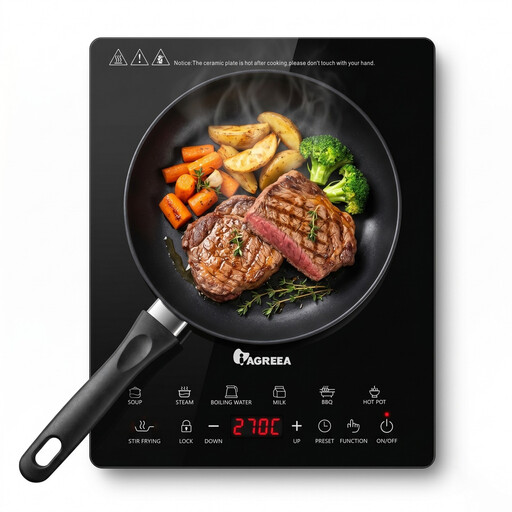
For one-pot soup if you have an induction-compatible saucepan; check that its base fits the stated 12–26 cm cookware range.
The product name lists eight power levels, 60–270°C temperature control, seven preset functions, a three-hour timer and a child safety lock. Check the exact control settings before relying on a particular simmer setting.
Measure the space available for the full hob and confirm the lead arrangement before ordering.
 No image available
For one-pot soup when you have an induction-compatible pan; confirm that your pan size suits this hob before choosing it.
The product name lists ten power settings, six functions, touch control and a safety lock. Compare the actual lower settings with the simmering control you need.
Check the full dimensions and lead arrangement for your worktop. Allow the panel to cool before cleaning or moving the hob.
It will work only if its base is magnetic and fits the particular hob’s permitted pan size. Test the base with a magnet, then measure the base rather than the pan’s top rim; Tefal UK, for example, specifies 12–26 cm pans for its IH210840.
Look for manual control that lets you move from boiling to a gentler simmer, and consider whether a timer would help your cooking routine. Check the exact model’s settings rather than assuming a soup-labelled preset provides the control you want.
Do not assume any extension lead is suitable: check the hob’s rating, the lead’s marked rating and every appliance that would run on it at the same time. Electrical Safety First advises against daisy-chaining leads and says cable reels should be fully unwound; use a suitable wall socket where possible.
Put it on a flat, stable worktop with room for the saucepan and handle, and route its lead away from water. IKEA gives the flat-surface instruction for TILLREDA, while Electrical Safety First advises keeping sockets and switches a safe distance from the sink.