
24/7 Customer Support

Free returns

Same-day & Next-day Delivery

Quality Guaranteed

Unlock Your Welcome Offers: FREE Delivery | Up to 80% OFF | Free 30-day JoyPlus trial
Download the APP
A portable induction hob can add useful cooking capacity without taking up the space or installation time of a full cooker. It may suit a student flat, rented home, office kitchen, garden room or camping setup. However, compact appliances are not automatically interchangeable, and attractive feature lists can hide important limitations.
Before buying, check the power rating, cookware compatibility, controls, safety functions and whether the appliance is genuinely portable or intended for built-in installation. The right choice depends on how and where you plan to cook.
Induction heating requires a magnetic base. Aluminium, copper, glass and many non-magnetic stainless-steel pans will not heat unless they have a compatible magnetic layer. A simple check is to place a magnet against the underside of the pan: if it attaches firmly, the pan may be suitable, although the appliance manual remains the final reference.
Also check the supported diameter. A cooker designed for pans between 12 and 26 cm may not heat very small saucepans or oversized cookware evenly.
A 2000W induction cooker can provide strong heating from a standard domestic supply, but wattage alone does not tell you how convenient it will be. Look for adjustable power levels, temperature settings and pan detection. A cooker with only a high and low setting may be less manageable for simmering, melting or keeping food warm.
A higher-rated built-in model can support two cooking zones, but it may require a suitable circuit, ventilation and professional installation. It is not a direct replacement for a portable induction hob.
Although induction heats the pan rather than producing a naked flame, the glass surface can become hot from contact with the cookware. Useful features include automatic shut-off, overheat protection, no-pan detection, residual heat indicators and a child lock.
A timer is also practical, but it should not be treated as a substitute for supervision. Always follow the manual and avoid leaving cooking unattended.
For everyday meals, an adjustable range is more useful than a single maximum setting. The IAGREEA portable model, for example, offers 100W to 2000W power adjustment, 8 power levels and temperature control from 60°C to 270°C. This covers lower-heat tasks such as warming or simmering as well as boiling and stir-frying.
A temperature control induction cooker can be easier to manage than a power-only model, but the actual result also depends on the pan, food volume and cooking method. Presets can simplify common tasks, though they should not replace manual adjustment when a recipe needs precise control.
An ultra-thin induction hob is easier to store in a cupboard or carry between rooms. Check its full dimensions, thickness and weight rather than relying on the word “portable”. A flat, stable, heat-resistant surface is required during use, with clear space around ventilation openings.
For a small kitchen, a single induction hob may provide useful additional capacity. For camping, confirm that the site or power source can support the appliance’s rating. A 2000W appliance draws substantial power, so avoid unsuitable extension leads or overloaded sockets.
Look for a clearly stated cookware range and a flat base requirement. A timer covering up to three hours may be useful for soups and stews, while shorter individual timers can suit everyday hob cooking.
Before purchase, check that the product information describes the intended UK voltage and plug arrangement. For built-in appliances, review the 220–240V supply requirements, fuse rating, cut-out dimensions and ventilation instructions. A qualified electrician should handle permanent installation where required.

Why This Fits Their Persona: A practical single induction hob for students, renters, office workers and households needing an extra cooking surface without permanent installation.
Its stated 12–26cm cookware range, no-pot detection and adjustable controls make the compatibility and safety requirements clearer than a basic hotplate with limited information.
44.5mm-thick design; 8 power levels; 60–270°C temperature range; 7 preset functions; 3-hour timer and child safety lock.
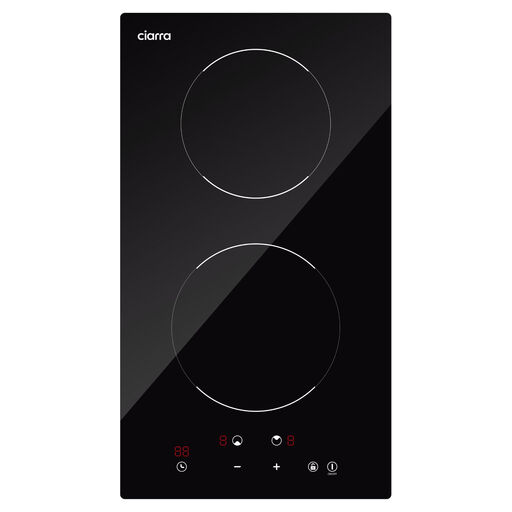
Why This Fits Their Persona: Suitable for homeowners or renters with permission for a permanent installation who want two cooking zones in a compact 29cm format.
The listing specifies the 260 × 490mm cut-out, 16A rated fuse, individual 99-minute timers and 12–26cm pan references, helping buyers plan installation before ordering.
Two independent zones; 2900W total power; 9 power levels; touch controls; automatic pan detection and child lock.
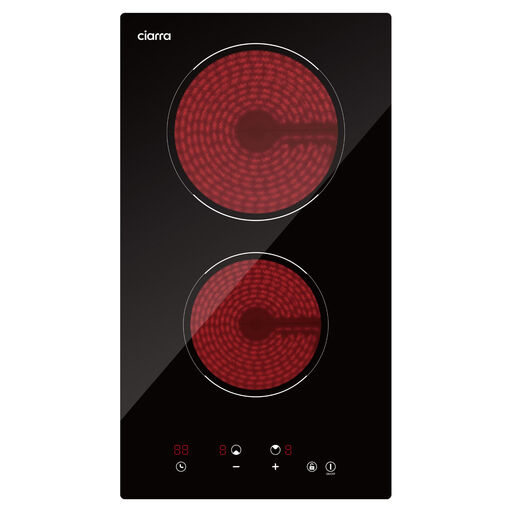
Why This Fits Their Persona: A non-induction alternative for frequent cooks who use mixed cookware, including aluminium, glass or ceramic pans, and need two built-in zones.
It avoids the magnetic-pan restriction altogether, while still providing stated zone sizes, 9 power levels, a timer and automatic shut-off features.
Works with a broad range of cookware; two zones; 2900W total power; child lock; residual heat indicator; overheat and overflow protection.
We have compiled a complete, real-time list of products that fully satisfy these strict selection criteria and UK safety regulations.
Place a portable induction hob on a flat, stable, heat-resistant surface and keep its air vents unobstructed. Use cookware centred on the marked area, with a flat base and a compatible diameter. Wipe the black glass surface with a soft, damp cloth after it has cooled; avoid abrasive products and do not spray water directly onto the appliance.
Running cost depends on the appliance’s actual power draw, cooking duration and your electricity tariff. A 2000W cooker uses 2kWh if it runs at full power for one hour, although thermostatic controls may cycle rather than draw maximum power continuously. Comparing usage habits is more useful than relying on wattage alone.
Yes, provided the product is intended for the UK supply and is connected according to its instructions. Check the plug, voltage, ventilation and socket requirements. Do not use a damaged cable, cracked glass surface or overloaded extension arrangement.
Lifespan depends on construction, frequency of use, cleaning and ventilation. Keep liquids away from the controls, avoid dragging heavy pans across the glass and allow the appliance to cool as instructed. A product with clear operating instructions, safety cut-outs and accessible support information can make ownership easier.
A camping induction cooker can work where a reliable mains electricity supply is available and the campsite permits the appliance. Check the site’s power limit before connecting a 2000W model. It is not suitable for every outdoor setup, particularly where only low-power or battery-based supplies are available.