One-pot cooks with limited space
If you usually simmer one tagine pot and put the hob away between meals, a compact single-zone model fits that routine—provided your cookware works with induction.


For a chickpea tagine in a small kitchen, a single-zone portable induction hob suits a one-pot routine if your cooking vessel has a magnetic base within the hob’s supported pan-size range. Consider a double-zone model when you regularly cook a side dish at the same time and have room for two pans; check its combined power limit rather than assuming both zones can run at their individual maximums together.
If you usually simmer one tagine pot and put the hob away between meals, a compact single-zone model fits that routine—provided your cookware works with induction.
If you own a clay, ceramic, aluminium or stainless-steel vessel, establish whether its actual base is magnetic and fits the hob’s pan-size limits before choosing an induction model. Judge’s JEA90 manual specifies magnetisable cookware.
If the tagine and a side dish need heat at the same time, a double-zone hob offers two cooking positions. Allow worktop space for both pans and check the appliance’s combined power rating.
Check your pot and available worktop space before deciding whether a second cooking zone would change how you prepare the meal.
| Concern | What to check | Who this matters to |
|---|---|---|
| Worktop and storage space | Measure the usable worktop and storage space, allowing room for the pot handles and cable; compare each hob’s width, depth and thickness. | If I have to clear the worktop after cooking, I need a hob that fits while in use and has somewhere to go afterwards. Around 31% of consumers would put space first. |
| Pot compatibility | Test the pot’s base with a magnet and compare its flat-base diameter with the exact hob model’s stated limits. | Before choosing a hob, I need to know whether the tagine I already own will heat on it. Roughly 31% of consumers would make cookware compatibility their primary concern. |
| Simmer control | Compare the model’s adjustable heat settings and timer with the way you cook; do not judge simmer control from maximum wattage alone. | Once the pot is hot, I want to adjust the heat as the tagine simmers without relying on a high-power setting. About 25% of consumers would prioritise cooking control. |
| Electrical setup and two-pan cooking | Check the appliance’s rating, the capacity of the socket or extension device, and any combined-power limit when two zones are in use. | If I cook a side dish alongside the tagine, I need to know whether the hob and electrical setup can accommodate both pans safely. Around 13% of consumers would put that planning first. |
Induction needs a suitable magnetic base. Judge’s JEA90 manual says ceramic and earthenware vessels are unsuitable unless they have a purpose-made induction base.
Test the base of the vessel you intend to use with a magnet, then check its flat-base diameter against the hob manual.
If that vessel is unsuitable, cooking on an induction hob may require a different induction-compatible pot.
A high-wattage single-zone hob still heats only one pan at a time. Preparing couscous or vegetables separately may change the order in which you cook the meal.
Choose one zone for a one-pot routine; consider two only if simultaneous pans matter and both will fit on your worktop.
CIARRA states that its CUTIH2-OW has a 2800W maximum combined rating, even though an individual zone can reach up to 2000W.
Check the double hob’s power-sharing instructions if you expect to use both pans at high heat together.
Electrical Safety First gives about 3000W as the maximum load for a single 13A socket and warns against overloading extension devices. Portable cooking still needs attention while the pan is heating.
Check the rating of any extension device and the total connected load; do not daisy-chain leads. Keep cables clear of water and heat, and do not leave cooking unattended.
Tefal’s IH210840 is a portable single-zone option for a one-pot setup where storage space matters.
The PIC01BLMUK is a single-zone model for cooks interested in probe-led controls as well as ordinary hob use.
Judge’s portable JEA90 offers useful model-specific guidance for checking an existing pot.
The CUTIH2-OW is a portable double-zone option for cooking a tagine and another pan together.
These portable induction hobs are options to check against your tagine pot and available worktop space. If you need to cook a side dish at the same time, confirm the number of independently usable zones before choosing either model.
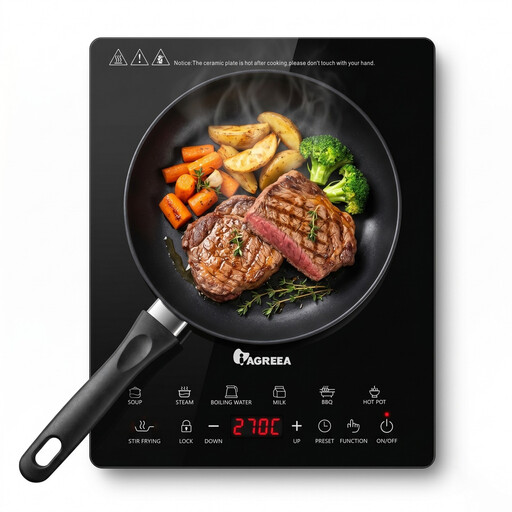 Image unavailable
For a chickpea tagine, consider this model if your pot has a suitable magnetic base within its stated 12–26 cm cookware range.
The product name specifies eight power levels, 60–270°C temperature settings, seven preset functions and a three-hour timer. Check the full worktop footprint and cooking-zone layout if space or a second pan is important to you.
 Image unavailable
This model is an option if you want a portable induction hob and can confirm that your tagine pot has a compatible magnetic base.
Its product name specifies ten power settings, six functions, touch controls and a safety lock. Check the supported pan-base diameter, worktop footprint and cooking-zone layout against your own routine.
Only if its cooking base is suitable for induction. Judge’s JEA90 manual says cookware must be magnetisable; a traditional clay or ceramic tagine should not be assumed compatible unless it has a purpose-made induction base. Test the actual vessel and check the hob’s pan-size limits.
Measure the flat base that sits on the hob, rather than relying on the pot’s rim diameter. Tefal states a 12–26 cm compatible-pan range for its IH210840, and CIARRA states the same range for its CUTIH2-OW; follow the limits for the exact model you choose.
Check the lead’s marked rating and the combined load of everything connected before using one. Electrical Safety First warns that some older leads and cable reels are rated below 13A; do not overload or daisy-chain extension devices, and follow its guidance on unwinding a cable reel when supplying a high load.
No. A timer does not replace supervision while cooking. Electrical Safety First advises against leaving electrical appliances on and unattended, while Cambridgeshire Fire and Rescue Service advises against leaving pans unattended.