Long-simmer stock cooks
If you make one pot of vegetable stock at a time, look for low-heat control you can adjust after the stock reaches a boil. A timer can help you manage the cooking session, but it does not replace supervision.


For one stockpot at a time, start with a portable induction hob whose low settings give you control over a gentle simmer—but check that your pot has an induction-compatible base within the hob’s stated size range. A larger single-zone hob makes more sense for a wide stockpot, while a double-zone model earns its extra worktop space only if you regularly cook with a second pan alongside the stock.
If you make one pot of vegetable stock at a time, look for low-heat control you can adjust after the stock reaches a boil. A timer can help you manage the cooking session, but it does not replace supervision.
If you use a wide stockpot, its flat base needs to fit the hob’s stated cookware range. Buffalo Appliances lists a 120–320 mm compatible pan range for its CP799; the unit’s size and weight also need room in your kitchen.
A portable single-zone hob can provide an occasional cooking position and be put away between uses. Check your available worktop and storage space, as well as whether the stockpot you already own works with induction.
Check your stockpot and the hob’s low settings before deciding how much worktop space to give up for a wider cooking surface or a second zone. The concerns below distinguish consumers by the need they would put first.
| Concern | What to check | Who this matters to |
|---|---|---|
| Gentle simmering | Compare the lowest manual setting and timer controls; follow the manual’s cooking and supervision instructions. Tefal UK lists a 300–2100 W manual range for its Everyday Slim IH210840. | If I cook stock for several hours, I want to turn down the heat after boiling rather than rely on a preset that may not suit my pot. Around 37% of consumers would put simmer control first. |
| Stockpot fit | Check that the pot is induction-compatible and compare its flat base with the exact hob’s supported diameter range. Tefal UK states 12–26 cm for the Everyday Slim IH210840; Buffalo Appliances states 120–320 mm for the CP799. | My wide stockpot is useful only if the hob accepts its base, so I would settle compatibility before looking at other controls. For around 27% of consumers, pot fit would be the primary concern. |
| Space and storage | Measure both the clear worktop area and the storage space, then compare the hob’s dimensions and weight. Tefal UK describes the Everyday Slim IH210840 as 45 mm thick; Buffalo Appliances lists the CP799 at 390 × 490 mm and 7.25 kg. | When the hob comes out only for stock-making, I need somewhere practical to use and store it. Space would come first for around 18% of consumers. |
| A second pan | Decide whether two independently usable zones are necessary, and check the appliance’s total rated load and dimensions. Judge specifies 3100 W for its double induction hob. | If I simmer stock while cooking another component, a second zone changes what I can do in the same session. Around 18% of consumers would prioritise that two-pan workflow. |
An induction hob needs suitable cookware, and the pot’s flat base must also fall within the particular model’s supported size range.
Use a magnet as an initial check on the base, then confirm both cookware compatibility and base diameter against the hob’s product information.
You may need a different stockpot if your existing one is unsuitable.
An overloaded extension lead, adaptor or wall plug can overheat. Electrical Safety First also warns that a cable reel must be fully unwound to achieve its marked rating.
Prefer a suitable wall socket. If an extension is unavoidable, check its marked rating against the total connected load and do not daisy-chain extension devices.
A small hob’s stated cookware range may exclude a wide stockpot even when that pot is induction-compatible. Tefal UK states an upper pan diameter of 26 cm for the Everyday Slim IH210840, while Buffalo Appliances states 320 mm for the larger CP799.
Measure the stockpot’s flat contact base rather than its rim, then compare it with the exact model’s guidance before deciding how compact the hob can be.
A second zone lets you use another pan alongside the stock, but it does not by itself improve your stockpot’s fit or remove the need for induction-compatible cookware.
If you normally make stock in one pot, prioritise that pot’s fit and the controls you need for a simmer. Consider two zones when simultaneous cooking is part of your routine.
A double-zone unit also needs more worktop space.
These product lines illustrate different ways to handle a stockpot; compare the exact model rather than assuming every hob from a brand has the same controls or cookware range.
Tefal’s domestic portable induction range includes the Everyday Slim IH210840 for a compact, single-pot setup.
Judge offers portable single- and double-zone induction options for cooks deciding whether stock preparation needs a second pan.
Buffalo’s CP799 is a larger, commercial-style countertop induction hob to consider when a wide stockpot drives the choice.
These single-zone portable induction hobs suit a one-pot stock setup when your cookware fits and you have suitable worktop space. Compare their stated controls, then check any pot-size or electrical details that matter to your kitchen before ordering.
 No image available
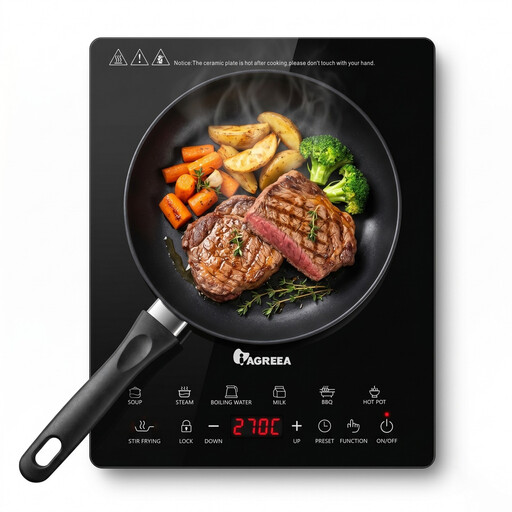
Consider this single-zone hob for a stockpot with an induction-compatible base within its stated 12–26 cm cookware range.
The product title specifies eight power levels, 60–270°C temperature control, seven preset functions and a three-hour timer. A timer does not replace supervising the stock while it cooks.
Check your pot’s flat base against the stated range, and confirm the plug and electrical details for your intended setup before ordering.
 No image available
This single-zone option is worth considering if you want an induction hob that can be put away between stock-making sessions.
Its product title specifies ten power settings, six functions, touch controls and a safety lock. If a particular low setting or timed shut-off is important to your simmer, confirm those controls for the exact model.
Check that your stockpot has a suitable magnetic base, confirm the supported pot-base diameter, and check the plug and electrical details for your intended setup. Keep the hob supervised during cooking.
It will work only if its base is induction-compatible and falls within the chosen hob’s supported pan range. Measure the flat base, not just the rim: Tefal UK states 12–26 cm for the Everyday Slim IH210840, while Buffalo Appliances states 120–320 mm for the CP799.
No—a timer can help manage cooking, but it does not replace supervision or the appliance manual’s instructions. Tefal’s IH201840 documentation warns that smaller quantities of liquid may boil dry if left unattended.
Use one only if its marked rating can safely accommodate the hob and everything else connected to it. Electrical Safety First warns against exceeding an extension device’s rating or daisy-chaining devices, and says cable reels must be fully unwound to achieve their marked rating. A suitable wall socket is the simpler arrangement where available.
For a hob supplied in Great Britain, check the product’s marking and manufacturer information against the applicable electrical-equipment requirements. GOV.UK guidance identifies the Electrical Equipment (Safety) Regulations 2016 as governing electrical equipment placed on the Great Britain market, while Business Companion explains manufacturer marking, conformity and traceability requirements. Northern Ireland has separate provisions, so check the requirements applicable to a delivery there rather than assuming the Great Britain position applies unchanged.