Small-kitchen soup cooks
You need space for the hob while cooking and somewhere to put it away afterwards. Compare its stated length, width and height with both spaces.


Choose a single-zone portable induction hob that fits your usable worktop and works with your soup saucepan. For carrot soup, check the lower heat settings and timer as well as the maximum power, then confirm the cookware requirements and electrical setup for the exact model.
You need space for the hob while cooking and somewhere to put it away afterwards. Compare its stated length, width and height with both spaces.
You want to keep using your carrot-soup saucepan. Check that its base is induction-compatible and meets the exact hob model’s cookware requirements.
You want to turn the heat down after the initial boil and keep track of cooking time. Lower settings and a timer deserve more attention than maximum power alone.
Measure your usable worktop and saucepan base first; then compare the cooking controls and where the hob can be plugged in.
| Concern | What to check | Who this matters to |
|---|---|---|
| Worktop and storage fit | Compare the stated length, width and height with the clear worktop area and storage space. | If the hob must share a crowded worktop with soup preparation, I need to know it will physically fit. Around 33% of consumers put worktop fit first. |
| Saucepan compatibility | Check the induction-compatible base and measure the part that rests on the hob against the exact model’s stated requirements. | When I already own a soup saucepan, I want to keep using it rather than discover it cannot heat on the hob. Around 20% of consumers make pan compatibility their primary concern. |
| Simmer control | Look at the stated lower power or temperature settings and whether a timer is provided. | After bringing the soup to the boil, I need a setting I can adjust while the carrots cook. Gentle-heat control comes first for around 27% of consumers. |
| Electrical setup | Check the model’s plug, voltage and instructions; if using an extension lead, check its marked rating and the total connected load. | If the convenient worktop position is away from a suitable socket, I need a safe way to power the hob without overloading a lead. Around 20% of consumers prioritise the electrical arrangement. |
A maximum rating of 2000W or 2100W does not tell you whether the hob fits your worktop, accepts your saucepan or has the lower settings you want for soup.
Compare dimensions, cookware requirements and cooking controls before using maximum power to distinguish models.
The rim can be wider than the base that rests on the hob. Tefal gives pan-size ranges for its named Everyday models, while Innoteck specifies ferromagnetic induction-compatible cookware for the DS-5503.
Check the induction-compatible base and compare its measurement with the instructions for the exact hob.
If your current saucepan is unsuitable, you may need another induction-compatible pan.
Electrical Safety First warns that exceeding a lead’s current rating or connecting extension leads in series can overheat the plug and create a fire risk.
Use a suitable wall socket where possible. If a lead is necessary, check its marked rating and every appliance connected to it; do not chain leads together.
Electrical requirements need checking for the exact model, particularly when a small kitchen limits where you can position the hob.
Before ordering, check the plug and voltage information, the manufacturer’s instructions and the seller’s product identification.
These named portable models illustrate different checks for a small worktop; the specifications do not establish that any particular saucepan will work.
Tefal’s Everyday IH201840 and Everyday Slim IH210840 provide stated pan ranges and cooking controls to compare with your saucepan and soup routine.
The Judge JEA90 offers stated external dimensions and selectable temperatures for buyers assessing worktop fit and cooking controls.
The single-zone DS-5503 may interest cooks who want a long preset timer and a child lock, provided its dimensions suit their worktop.
These single-zone portable hobs offer cooking controls relevant to carrot soup. Check each model’s full footprint, saucepan requirements and electrical instructions against your kitchen before ordering.
 No image available
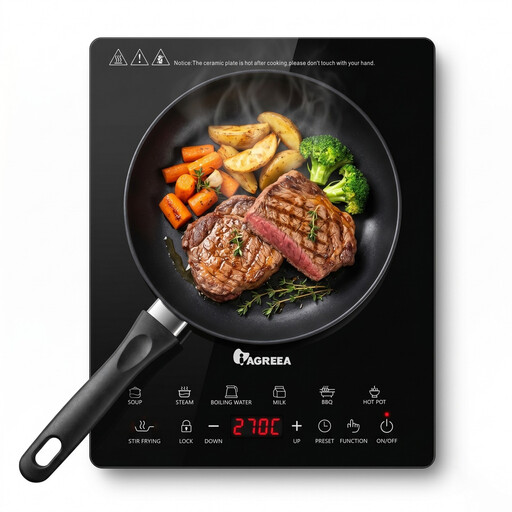
Consider this model if you want temperature adjustment and a timer while making soup. Its product name states a 60–270°C temperature range and a three-hour timer.
Check the hob’s length and width against your worktop, and confirm how its stated 12–26 cm cookware range applies to your saucepan base. Check the plug and electrical instructions for your intended location.
 No image available
Consider this model if selectable settings and a safety lock matter to you while cooking soup. Its product name states 10 power settings and six functions.
Check the overall dimensions and supported saucepan-base size before ordering. If precise low-heat control or timed cooking matters, confirm those details in the product instructions, along with the plug and electrical requirements.
It will need an induction-compatible base and must meet the chosen model’s cookware requirements. Tefal states a 12 cm to 25 cm pan-base range for the IH201840 and a 12 cm to 26 cm pan range for the IH210840; measure the base and check the instructions for the exact model.
No. A high setting can help bring liquid to the boil, but you also need to adjust the heat while the carrots cook. Compare the lower settings you can select: Tefal states power ranges of 450W to 2100W for the IH201840 and 300W to 2100W for the IH210840, while Judge lists selectable temperatures for the JEA90.
Only if the lead and the complete connected load are within their rated limits and the hob’s instructions permit the arrangement. Electrical Safety First says most extension leads are rated at 13A, but some are rated at 10A or less; check the marking and never connect one extension lead to another.
Do not assume the installation requirements from the word portable alone. Check the exact model’s plug, voltage and manufacturer instructions before deciding where and how it can be used.