Mobile interview-note editors
If you correct notes at client sites, in classrooms or while travelling, consider whether a keyboard will fit the bag you actually carry and be practical to set up at each stop.


Choose a compact keyboard with a familiar layout if you mainly correct notes while travelling; a built-in cover matters more if it will often travel in a bag with a tablet or phone. Check explicit device-switching and operating-system support if you work across several devices. For longer laptop sessions, plan how you will position a separate keyboard and raised screen, rather than choosing on thinness alone.
If you correct notes at client sites, in classrooms or while travelling, consider whether a keyboard will fit the bag you actually carry and be practical to set up at each stop.
If a draft moves between your laptop, tablet and phone, check support for each operating system and how the keyboard switches between paired devices.
If a quick edit regularly becomes a long laptop session, think about the whole workstation. The Health and Safety Executive advises using a separate keyboard and mouse so the laptop screen can be raised.
For a portable keyboard used to edit interview notes, settle the carry format and familiar key layout first, then check how it connects to your devices and where you will type for longer sessions.
| Concern | What to check | Who this matters to |
|---|---|---|
| Carrying and protection | Compare packed size and weight; check whether a protective cover is built in. | If I move between locations with a tablet or phone, exposed keys and a bulky board make packing less convenient. Around 29% of consumers put carrying or key protection first. |
| Quiet typing | Look for a specific quiet-key description and consider whether the key feel suits you. | When I tidy notes near colleagues or interview participants, I want typing to cause less distraction. For around 21% of consumers, quieter typing is the primary need. |
| Device switching | Confirm operating-system compatibility, paired-device capacity and the switching method. | My notes may start on a phone or tablet before I edit them on a laptop, so changing devices without repeated pairing matters. Around 21% of consumers prioritise that workflow. |
| Long-session setup | Check that the keyboard can sit separately while the laptop screen is raised, with a layout you can use accurately. | If note clean-up takes hours, I need a workable screen and keyboard position, not merely the thinnest board. That setup is the main concern for around 29% of consumers. |
US and UK key layouts can put punctuation and symbols in different places, which matters when correcting quotations and notes.
Check the exact variant in the title, configuration selector and product photographs. Choose British English or UK-ISO if that matches the layout you normally use.
A travel keyboard does not, by itself, arrange the screen and input devices for prolonged laptop work. The Health and Safety Executive advises a separate keyboard and mouse so the screen can be elevated.
Plan where the screen and keyboard will sit when a short correction turns into a longer session.
That setup may also call for a laptop riser, a mouse or a different keyboard for desk use.
Bluetooth support alone does not establish how many devices a keyboard remembers or which operating systems it supports. A 2.4 GHz receiver also needs a suitable port or adapter.
Check the supported devices, pairing and switching instructions, and whether any receiver you intend to use is included.
Its Pebble Keys 2 K380s and Keys-To-Go 2 illustrate two compact Bluetooth formats for mobile note editing.
Its UK-ISO options include the B1 Pro and the low-profile mechanical K3 Max.
The British English Magic Keyboard is an option to examine if your note-editing devices are primarily Apple products.
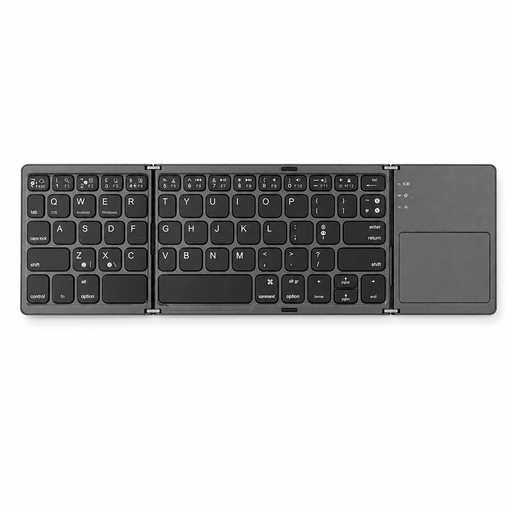
These keyboards cover different approaches to editing notes away from a fixed desk, from a folding board to full-size and compact mechanical layouts. Check the exact key layout and carrying size against your own setup before choosing.
 No image available
Consider this if you want a full-size keyboard for moving between work locations rather than the smallest travel format.
Check its packed size and the exact key legends before relying on it for bag travel or familiar UK punctuation.
 No image available
This Bluetooth keyboard may suit note editing across locations if a larger board fits your bag and working surface.
Check the exact key layout before ordering; a UK designation alone does not show where every punctuation key sits.
 No image available
Consider this for notes edited on the move if a smaller keyboard is your priority.
Check its key arrangement for quotation marks and other punctuation, and confirm how it pairs and switches if you intend to use several devices.
 No image available
This 96% mechanical keyboard is worth considering if you want many keys in a layout smaller than a full-size board.
Its title specifies wired, Bluetooth and 2.4 GHz modes and a US layout. Check the punctuation placement and physical size before choosing it for travel.
 No image available
A 65% layout may appeal if you want a smaller keyboard for temporary note-editing spaces.
The title specifies 68 keys and Bluetooth or wired operation. Check the US key arrangement, carrying size and device-switching method; confirm whether a mouse is included if that affects your choice.
Choose a UK or British English layout if its punctuation, symbols and key legends match what you normally type. Check the exact variant rather than assuming that a keyboard listed in the UK has that layout: Apple labels its relevant Magic Keyboard British English, while Keychron identifies UK-ISO versions separately.
Yes, if the specific keyboard supports each device's operating system and the number of connections you need. Logitech UK states that Pebble Keys 2 and Keys-To-Go 2 can connect to up to three devices; Keychron UK lists three Bluetooth connections and a dedicated 2.4 GHz dongle for the B1 Pro. Check the switching method and any port needed for a receiver.
For prolonged laptop work, position the external keyboard separately so you can raise the screen. The Health and Safety Executive advises keeping the keyboard central and just below elbow height. Consider the desk, screen support and mouse alongside the keyboard; no single keyboard determines the whole setup.