Quiet-space training planners
If you draft agendas, slides, handouts or notes in a shared library, key noise and a keyboard you can carry easily are likely to shape your choice.


Choose a compact standalone Bluetooth keyboard if you plan training materials on several devices or want to carry the keyboard separately from the screen. An iPad keyboard case makes more sense when a compatible iPad is your main planning device and you want an integrated stand and trackpad; consider a compact mechanical keyboard if its layout and connection options matter to you, but check the exact switch noise before using it in a shared quiet space.
If you draft agendas, slides, handouts or notes in a shared library, key noise and a keyboard you can carry easily are likely to shape your choice.
If you move between a laptop, tablet and phone while preparing materials, check both operating-system compatibility and how the keyboard switches between devices.
If you do most of your planning on an iPad, a compatible keyboard case can keep the keyboard, viewing stand, trackpad and protective cover together.
Choose it when: You want one keyboard to travel separately from a laptop, tablet or phone.
Trade-off: A standalone keyboard does not also serve as a tablet stand or protective case.
Choose it when: You value its layout, connection options or configurable keys for longer planning documents.
Trade-off: A low-profile mechanical design alone does not establish that its switches will suit a quiet library.
Choose it when: A compatible iPad is your main planning device and you want a keyboard and stand in one unit.
Trade-off: The case must fit the specific iPad model, rather than serving as a general keyboard for your other devices.
| Concern | What to check | Who this matters to |
|---|---|---|
| Quiet typing | Look for a specific quiet-key claim; for a mechanical model, check the exact switch option and its sound. | If I will draft and revise materials beside other library users, I want keys that cause little distraction. Around 38% of consumers would put quiet typing first. |
| Carrying and protection | Check packed dimensions, bag fit and whether a cover or case protects the keys. | When I carry handouts and a device to the library, I need the keyboard to fit alongside them without exposed keys. Carrying and protection would be the main concern for around 31% of consumers. |
| Device workflow | Confirm operating-system compatibility, the required number of paired devices and whether you need an integrated trackpad. | If I edit a plan on a laptop but review messages or materials on a tablet or phone, switching devices matters more than keeping everything in one case. Around 31% of consumers would prioritise that workflow. |
The Keychron K3 Max has a low-profile mechanical design, but that description does not establish the sound of every switch option in a shared library.
Check the exact switch variant and look for a clear noise description or an opportunity to hear it before choosing it for a quiet space.
Apple lists model-specific compatibility for its Magic Keyboard for iPad Pro, including an iPadOS 17.4 or later requirement for the cited version. A similar screen size does not establish that a different iPad will fit.
Match your iPad model and generation, screen size and operating system against the particular case listing.
Some keyboards specify switching among three devices, while an iPad keyboard case is built around a compatible iPad. Bluetooth support alone does not tell you how many devices can be paired or how you move between them.
Count the devices you use to prepare a session, then check the supported systems and switching controls.
GOV.UK’s guidance on the UK waste electrical and electronic equipment framework explains its role in reducing electrical waste sent to landfill.
Check current retailer or local authority collection options for your old keyboard rather than assuming it belongs in general waste.
Its portable Bluetooth models are relevant if you prepare training materials across tablets, phones and laptops.
The K3 Max UK-ISO is relevant if you want a compact mechanical layout and a choice of connection methods.
Apple’s keyboard options are relevant if your planning centres on compatible Apple devices, particularly an iPad used as a single portable setup.
These keyboards cover standalone wireless, mechanical and iPad-case approaches to planning in a library. For any option you intend to use in a quiet area, check key sound as well as device fit before deciding.
 No image available
For planning across several devices, this standalone model lists support for up to four devices. It has a 78-key US QWERTY layout and lists Bluetooth 5.0/4.0 and 2.4 GHz wireless connections. Check whether its layout suits your shortcuts and confirm compatibility before using it with an iPad or iPhone.
 No image available
For planners considering a compact mechanical layout, the listing names wired, Bluetooth and 2.4G connection modes, PBT keycaps and a US QWERTY layout. Check the selected switch sound before taking it into a quiet library, and confirm the paired-device support and packed size you need.
 No image available
This UK-version wireless model is an option to consider if you want a separate keyboard for planning documents. Before choosing it for library use, check its key sound, packed size and compatibility with the devices you will bring.
 No image available
If you prefer a full-size layout for drafting materials, consider whether this 108-key US-layout model will fit in your bag. Its title specifies tri-mode wireless operation, an 8000mAh battery and a Silent Tactile Switches variant; check the actual typing sound before using it in a quiet library.
 No image available
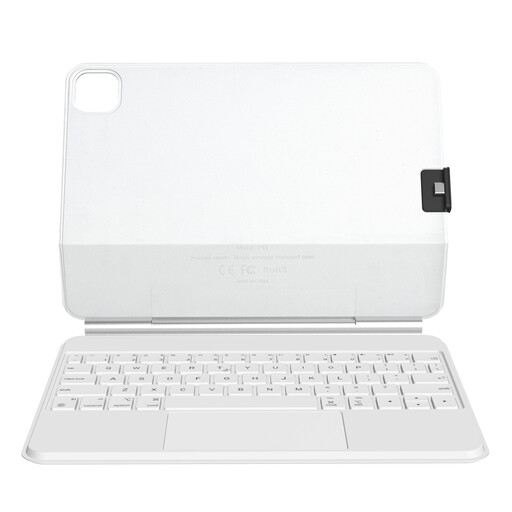
For planning mainly on an iPad, this model combines a keyboard, trackpad and detachable protective cover. The title names iPad Pro 11-inch and iPad Air 10.9-inch or 11-inch versions; match your exact iPad model and generation to the case before buying, and check key sound if you will type in a shared library.
Turn on the keyboard and put it in pairing mode, then select it in your computer’s, tablet’s or phone’s Bluetooth settings. Complete any pairing-code prompt and try the connection before you start preparing materials; the pairing control can vary by model.
Choose a separate keyboard if your planning moves between devices; choose an iPad keyboard case if a compatible iPad is your main device and an integrated stand and trackpad matter more. Check the case’s exact iPad compatibility before buying.
No. Apple lists specific iPad Pro compatibility and an iPadOS 17.4 or later requirement for its cited Magic Keyboard version. Check the exact model, generation and operating-system requirements for whichever case you choose.
Check a current retailer or local authority collection option for electrical equipment. GOV.UK’s guidance on the UK waste electrical and electronic equipment framework describes its aim of reducing electrical waste sent to landfill; the available collection route depends on where and how you dispose of the keyboard.