For library field notes, start with a portable keyboard whose maker explicitly describes its keys as quiet or noise-reducing, then check the exact layout and compatibility with your writing device. A covered tablet keyboard may be easier to carry, while a more substantial compact keyboard may suit longer sessions; neither compact size nor a mechanical design establishes that a keyboard will be unobtrusive in a silent area.
Who needs which keyboard?
Quiet-zone field-note writer
If you type near other readers, key noise and considerate use matter more than mechanical feel or extensive shortcuts. The University of Reading requires silence in its designated silent study areas; check the rules for the area you use.
Tablet-and-phone note taker
If your notes travel with a tablet or phone, look for a keyboard that fits your bag, protects its keys in transit and connects to your particular device. Logitech describes its Keys-To-Go 2 as slim and light, with a built-in cover.
Long-session mobile writer
If you write substantial notes, compare key shape, stability, visibility and layout alongside carry size. Logitech describes shaped keys and illumination on the MX Keys Mini; Keychron offers a UK-ISO option and remapping on the K3 Max.
What matters when choosing?
For library field notes, decide which concern takes priority before comparing features: disturbance, bag space, device connection or comfort during longer writing.
| Concern | What to check | Who this matters to |
|---|
| Typing disturbance |
Look for a quiet-key claim for the exact model and check the rules of your library area. A manufacturer claim is not a promise of silence. |
If I write beside other readers, I need my typing to cause as little disturbance as possible. Around 33% of consumers put this need first. |
| Carry size and protection |
Check the selected keyboard’s dimensions and whether a cover is built in or supplied. |
When my notes and tablet share a bag, I want a keyboard I can carry without leaving its keys exposed; around 27% of consumers prioritise this. |
| Device compatibility |
Confirm your device’s operating system, the keyboard’s connection method and its exact layout variant. |
If I move between a tablet and laptop, both must accept the keyboard’s intended connection. For around 20% of consumers, compatibility comes first. |
| Long-session typing |
Compare key shape, layout and any illumination you need; consider the retailer’s return terms if you cannot try the keyboard. |
For lengthy observation notes, I care more about a layout I can keep using comfortably than the smallest footprint. Around 20% of consumers make sustained typing their priority. |
Buying pitfalls
-
Assuming compact means quiet
A small keyboard can still be noticeable to people nearby. The University of Reading requires silence in its silent study areas, while manufacturers’ quiet-key descriptions vary by model.
If you will type near other readers, check the exact model’s key-noise description and follow the rules of your library zone.
-
Choosing by product family rather than variant
Layouts and connection options can differ. Keychron, for instance, lists a UK-ISO selection and several connection methods for its K3 Max collection.
Before ordering, confirm the selected variant’s layout, device support, pairing method and any accessories needed for your intended connection.
-
Equating the smallest keyboard with comfortable writing
A slim tablet-first design addresses carrying needs, but key shape, stability and layout also matter when notes become lengthy.
For frequent long sessions, compare the typing arrangement with more substantial compact options rather than choosing on folded or packed size alone.
-
Putting an unwanted keyboard in household rubbish
GOV.UK guidance from the Office for Product Safety and Standards says electrical products and batteries should be collected for recycling rather than discarded with household rubbish.
Use an appropriate electrical-waste or battery collection route; treat a keyboard with a non-removable battery as an electrical product.
Brands to consider for library keyboards
Logitech
Its Pebble Keys 2 K380s, Keys-To-Go 2 and MX Keys Mini represent different compact-keyboard priorities.
- Logitech describes quiet low-profile keys on Pebble Keys 2, a built-in cover on Keys-To-Go 2, and shaped keys and illumination on MX Keys Mini.
- Those model-specific descriptions are not comparable independent noise measurements; check the precise keyboard and library area before choosing.
Keychron
The K3 Max collection is relevant if you specifically want a compact, low-profile mechanical keyboard.
- Keychron lists a 75% design, a UK-ISO selection, Bluetooth, 2.4 GHz and wired connection options, and QMK/VIA remapping for the K3 Max.
- Its listed switch options do not establish how quietly the selected keyboard will type in a library.
Apple
The British English Magic Keyboard is an Apple-device option for readers seeking that layout and Bluetooth pairing.
- Apple lists USB-C charging and compatibility with selected Mac, iPad and iPhone models; check your particular device against its listing.
- Do not infer quiet-library suitability from its low-profile appearance: Apple does not make a quiet-typing claim on the cited product page.
Portable keyboard options on Joybuy
This option is relevant to notes written on a tablet or phone when a portable Bluetooth keyboard matters. Check its layout and suitability for your library area before choosing it.
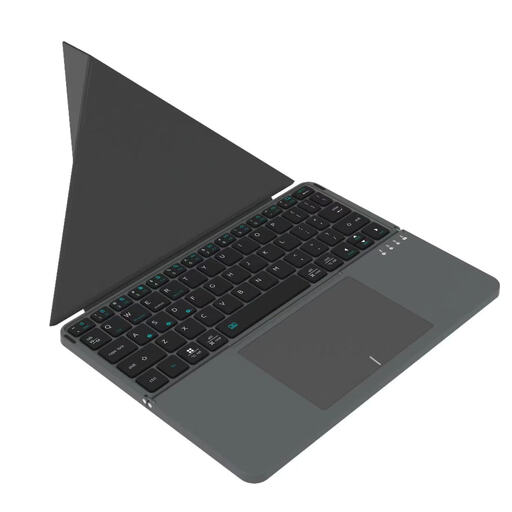 Image unavailable
VoxorAI BOX1 Black Bluetooth Keyboard
Consider this for notes on an iPad or smartphone when Bluetooth connection and portability are priorities. Confirm the key layout and whether its typing noise is acceptable in your library area before ordering.
View on Joybuy
Common questions
Can I use a mechanical keyboard in a silent library area?
A mechanical keyboard is not automatically suitable for a silent area. The University of Reading requires silence in its silent study areas, and Keychron’s K3 Max information does not establish how its switches compare for noise; follow your library’s rules and consider a model whose maker explicitly describes its keys as quiet.
What should I check for both tablet and laptop use?
Check compatibility with each device’s operating system and connection method, plus the keyboard’s layout and device-switching options. Logitech describes support for up to three devices on Pebble Keys 2 K380s and Keys-To-Go 2; confirm that the exact version suits your devices.
Must a portable keyboard sold in Great Britain carry UKCA rather than CE marking?
Not necessarily: August 2026 guidance from the Department for Business and Trade says Great Britain continues to recognise CE marking alongside or in place of UKCA marking where the relevant requirements are met. Check the product-specific requirements; that guidance covers England, Scotland and Wales, not Northern Ireland’s separate route.
How should I dispose of a battery-powered keyboard?
Use an appropriate electrical-waste collection route rather than household rubbish. GOV.UK guidance from the Office for Product Safety and Standards advises separate collection of electrical products and batteries; if the battery cannot be removed, treat the keyboard as an electrical product.


