Between-visit renovation planner
You update schedules, measurements, supplier messages and client emails away from a fixed desk. A keyboard that fits your bag and a reliable way to position the screen matter when each work session is brief.


For short updates to renovation notes, schedules and messages between client visits, choose a slim standalone Bluetooth keyboard if you need to work across a phone, tablet and laptop. A compact keyboard may suit longer writing sessions, while an iPad keyboard case makes more sense when one compatible iPad is your main device and you want its stand, trackpad and cover together. Check the exact key layout, device compatibility and screen support before choosing the format.
The useful format depends less on the job title than on which device you open during a gap between appointments and what you need to type.
You update schedules, measurements, supplier messages and client emails away from a fixed desk. A keyboard that fits your bag and a reliable way to position the screen matter when each work session is brief.
You read messages on a phone, review plans on a tablet and prepare documents on a laptop. Check that a keyboard supports each device and lets you switch between them in a way that suits your working day.
You do most of your planning on one iPad and would rather carry an attached keyboard, stand and trackpad than separate accessories. The case must match your exact iPad model and size.
Decide whether the keyboard must travel between several devices or work chiefly with one iPad. Then weigh bag space and setup time against the typing surface you need for longer notes and documents.
| Concern | What to check | Who this matters to |
|---|---|---|
| Carrying and setup | Check the packed size, whether the keys have a cover and how you will prop up the screen. | When I only have a short gap to update site notes, I want a keyboard I can take out and use without arranging several loose items. Around 36% of consumers put easy carrying and setup first. |
| Device switching | Confirm the supported operating systems, number of paired devices and switching controls. | If I move from phone messages to tablet plans and then a laptop document, repeatedly pairing the keyboard would interrupt my work. For around 29% of consumers, switching between devices is the primary need. |
| Longer typing sessions | Consider the key arrangement, required shortcuts and whether illuminated keys would help where you work. | For a longer client email or schedule revision, I need keys I can use accurately at my temporary work surface. Typing comfort and visibility come first for around 21% of consumers. |
| iPad integration | Match the case to the iPad model and size; check the stand, trackpad and cover features of that exact variant. | When one iPad holds my plans and records, I would prefer its keyboard and screen support in one attached setup. Around 14% of consumers primarily want that iPad-centred arrangement. |
A standalone keyboard and an iPad keyboard case solve different carrying problems. Logitech’s Keys-To-Go 2 has a built-in keyboard cover, but that does not make it a tablet stand; Apple’s compatible iPad keyboard cases combine typing with screen support.
Picture where your phone or tablet will sit during a client visit. If you already have a stable stand and tablet protection, a standalone keyboard may be sufficient.
A standalone setup may also mean carrying a separate tablet stand, sleeve or case.
Connection methods and switching controls vary by model. Logitech lists three-device switching for Keys-To-Go 2 and Pebble Keys 2 K380s, while Keychron lists Bluetooth, 2.4 GHz and wired connections for the B1 Pro; these are not interchangeable feature sets.
List the phone, tablet and computer you intend to use, then check their operating systems, the keyboard’s pairing capacity and how you change devices.
Apple specifies compatible iPad families and generations for its keyboard accessories. A similar screen-size description does not establish that a case fits a different iPad.
Find your iPad’s exact model and generation in Settings, then compare them with the case’s compatibility list. Check the named keyboard-layout variant as well.
For Great Britain, GOV.UK describes UKCA and CE markings as indicating that the manufacturer believes the product meets relevant requirements. A marking does not tell you whether a keyboard fits your devices or working setup.
Check the product and seller identity, read the supplied instructions and inspect the keyboard when it arrives. If a safety concern arises, consult GOV.UK product safety alerts and recalls.
These manufacturers illustrate different formats and connection choices; the features below belong to the named product lines, not every keyboard bearing the brand.
Logitech offers standalone options spanning a covered, tablet-oriented keyboard, a compact multi-device keyboard and a compact model with illuminated keys.
Apple’s Magic Keyboard accessories serve compatible iPads rather than a mixed phone, tablet and computer setup.
The B1 Pro is an option to examine when connection choice and a named UK-ISO layout matter.
These options include an iPad keyboard case, standalone Bluetooth keyboards and a compact multi-device model. Compare each one with the devices you carry, the space available in your bag and the surface where you will type between visits.
 No image available
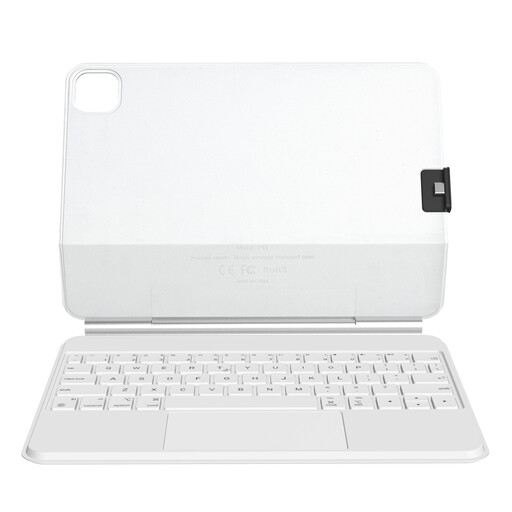
Consider this attached setup if a compatible iPad is your main device for plans and notes between visits. The product title specifies a detachable protective cover and trackpad, with iPad Pro 11-inch and iPad Air 10.9-inch and 11-inch variants named. Match your exact iPad model and generation to the case’s compatibility details before ordering; it is not a standalone keyboard for your phone or laptop.
 No image available
This standalone option is worth considering for short updates across a computer, iPad or smartphone. Its title specifies Bluetooth connectivity for those device types. Check the exact key layout and the pairing procedure for each device you plan to use.
 No image available
Consider a full-size keyboard if longer schedules and documents matter more to you than a small packed footprint. This is a wireless, full-size model labelled UK. Check its exact key arrangement and whether its size fits both your bag and temporary work surface.
 No image available
This Bluetooth option may suit planning sessions where you can set up a separate keyboard beside your laptop or tablet. The named variant is white and labelled UK. Confirm its exact key layout, device compatibility and fit on the work surface you normally have available.
 No image available
Consider this compact model if switching among work computers is a priority and a US key layout suits you. Its title specifies 78 keys, 2.4 GHz and Bluetooth connections, support for four devices, and Windows, Mac, Linux and Chrome compatibility. Confirm support for your particular phone or tablet before planning to use it with either.
Choose a standalone Bluetooth keyboard if you need to type across several devices, provided the exact model supports each one. An iPad case is more appropriate when a compatible iPad is your principal planning device and you want its keyboard and screen support together; Apple specifies case compatibility by iPad model and size.
Put the keyboard into its model-specific pairing mode, then select it in the new device’s Bluetooth settings, following any on-screen instructions. Logitech’s setup guidance covers the device-side Bluetooth step; consult the keyboard’s own instructions for its controls and switching procedure.
Check the exact layout if familiar punctuation and pound-sign placement matter when you write quotes and messages. A UK label alone is less useful than the stated variant and key arrangement: Keychron, for example, names a UK-ISO version of its B1 Pro, while the Rapoo E9050L product title specifies a US layout.
Check that the product and seller are clearly identified, read the instructions and inspect the keyboard on arrival. GOV.UK explains that UKCA and CE markings indicate a manufacturer’s belief that applicable requirements are met; they are not a measure of typing quality or device compatibility. If you have a safety concern, check GOV.UK product safety alerts and recalls.