Choose a compact Bluetooth keyboard if you regularly make revision cards on more than one device, but confirm compatibility and key layout before buying. A slim keyboard with a cover makes more sense when bag space is the priority; an iPad keyboard case is worth considering only if it fits your exact iPad and you want its integrated stand, trackpad and protection. Check your library’s study-zone rules before relying on any keyboard in a silent area.
Who needs which setup?
Quiet-zone revision writer
You type cards or summaries where other people are studying. Key sound and device alerts matter alongside typing comfort; the University of Reading Library distinguishes between quiet areas and silent study areas in its conduct guidance.
Tablet-first card maker
You make cards mainly on a tablet or phone and need to check both keyboard pairing and how the screen will stay in a comfortable viewing position. A keyboard case is an option only when it fits the specific tablet.
Multi-device student
You switch between a laptop, tablet and phone during revision. Confirm support for each device and its operating system, as well as whether the keyboard can switch between paired devices.
What matters when choosing?
For revision cards in a library, start with the rules for your study zone, then decide whether easier carrying, switching devices or an integrated iPad setup matters most.
| Concern |
What to check |
Who this matters to |
| Typing disturbance |
Look for a quiet-key description, and check your library’s zone rules. Mute device alerts too. |
If I make cards in a quiet study area, I want to disturb others as little as possible; around 29% of consumers put low-disturbance typing first. |
| Carrying and protection |
Compare the exact dimensions and weight, whether the keys have a cover, and whether you need to carry a stand. |
When my study bag is already full, I want the keyboard to pack away easily without leaving its keys exposed; roughly 24% of consumers prioritise carrying and protection. |
| Device compatibility |
Confirm operating-system support, Bluetooth availability, switching capability and the physical key layout. |
If I draft cards on a laptop and edit them on a tablet or phone, I need the keyboard to work with each device; about 29% of consumers make cross-device use their main concern. |
| iPad writing setup |
Match the exact iPad model and any software requirement; decide whether an integrated stand, trackpad and case justify the extra bulk. |
If I make most cards on one iPad, I would rather set up a supported keyboard case than arrange separate accessories; around 18% of consumers put an integrated iPad setup first. |
Buying pitfalls
-
Assuming every library allows the same keyboard noise
Study-zone rules differ. The University of Reading Library asks users to minimise noise in quiet areas and maintain silence in silent study areas.
Read your library’s signage and conduct rules before planning to type there. Choose keys with a quiet-key description where appropriate, and mute device alerts.
-
Choosing an iPad case by screen size alone
Keyboard cases can be limited to particular iPad models and generations. Apple’s Magic Keyboard for iPad Air also has an iPadOS 18.3 or later requirement.
Match your exact iPad model and software version against the case’s compatibility list before ordering.
-
Assuming Bluetooth means automatic compatibility
A Windows device needs Bluetooth to pair directly with a Bluetooth keyboard. The keyboard’s supported operating systems and physical layout also affect whether it suits your setup.
Check Bluetooth capability, operating-system support and key layout for every device you intend to use.
A computer without Bluetooth may need a separate USB Bluetooth adapter.
-
Expecting a standalone keyboard to hold the tablet
A portable keyboard and a stable screen position are separate parts of a tablet writing setup. An iPad keyboard case can combine them, but only for compatible models.
Check what your existing tablet stand and case already provide before choosing between a standalone keyboard and a keyboard case.
With a standalone keyboard, you may also need to carry a tablet stand or protective case.
Brands to consider
Logitech
Logitech offers several distinct portable-keyboard formats, from standalone Bluetooth models to a slim covered keyboard.
- Logitech describes Pebble Keys 2 K380s as compact and quiet, with switching between three supported devices. Keys-To-Go 2 has a built-in cover.
- Check the exact model’s key layout, dimensions and device support rather than assuming these features apply across Logitech keyboards.
Apple
Apple’s Magic Keyboard for iPad Air is an integrated case route for someone making cards on a compatible iPad Air.
- The specified case combines a keyboard with an adjustable stand, trackpad, USB-C pass-through charging and protection.
- It fits only listed iPad Air models and requires iPadOS 18.3 or later; it is not a general-purpose Bluetooth keyboard.
Microsoft
Microsoft’s Designer Compact Keyboard is a compact Bluetooth option for a compatible Windows setup.
- Microsoft Support says it can pair with up to three devices.
- Check the Windows and Bluetooth requirements and the exact key layout. This model uses four CR2032 coin-cell batteries rather than built-in charging.
Joybuy keyboard choices
These choices cover standalone wireless keyboards and an iPad keyboard case for making revision cards. Decide first whether you need a keyboard that moves between devices or a case for a specific iPad, then check key layout, carrying size and suitability for your library’s study zone.
 No image available
Targus EcoSmart Full Size Wireless Keyboard (UK)
Consider this if you prefer a full-size keyboard for writing cards at a library desk. Check that its carrying size and key sound suit your bag and study zone.
View on Joybuy
 No image available
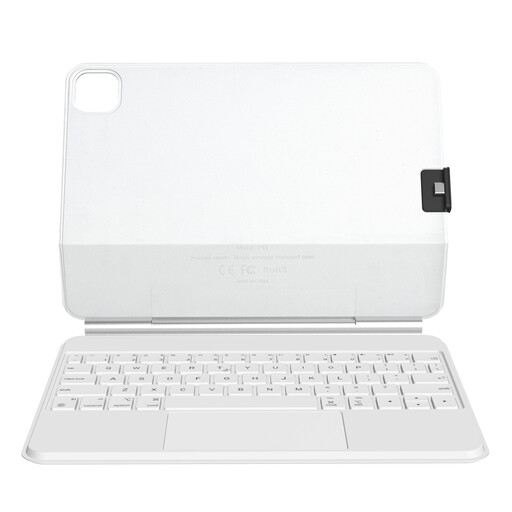
Rexsun P11-2 Floating iPad Keyboard Case, White
Consider this for revision cards on a compatible iPad when a case and trackpad would simplify your desk setup. The title lists iPad Pro 11-inch and iPad Air 10.9-inch or 11-inch sizes; confirm your exact model and generation before ordering, and check the typing sound against your library’s rules.
View on Joybuy
 No image available
AULA F99 Mechanical Wireless Keyboard, US QWERTY, Light Blue/Reaper Switch
Consider this if you want a mechanical keyboard for card writing and can accommodate its US QWERTY layout. The title specifies wired, Bluetooth and 2.4G modes; check compatibility with your devices, physical carrying size and key sound before using it in a quiet study area.
View on Joybuy
 No image available
VoxorAI BOX1 Bluetooth Keyboard, Black
Consider this when carrying space is a priority for library revision. Its title identifies Bluetooth connectivity and use with computers, laptops, iPads and smartphones; check the exact key layout, device compatibility and typing sound for your setup.
View on Joybuy
 No image available
Hyper HyperSpace Next Bluetooth Wireless Keyboard (UK), White
Consider this Bluetooth option if you make revision cards on more than one device. Check compatibility with each device, how much room it takes in your bag and its typing sound before relying on it in a quiet library zone.
View on Joybuy
Common questions
Should I use a mechanical keyboard for revision cards in a library?
Check the keyboard’s typing sound and your library’s rules before using one in a quiet or silent zone. The University of Reading Library asks users to minimise noise in quiet areas and maintain silence in silent study areas; a keyboard described as quiet is not an exemption from local rules.
How do I connect a Bluetooth keyboard to a Windows laptop?
Confirm that the laptop supports Bluetooth, turn it on, put the keyboard into pairing mode and select it from the available devices. Microsoft Support says a USB Bluetooth adapter can add Bluetooth to a PC that lacks it.
Will an iPad keyboard case fit every iPad?
No: match the case to your exact iPad model and generation, not just its screen size. Apple’s Magic Keyboard for iPad Air supports listed iPad Air models and requires iPadOS 18.3 or later; check a different case against its own compatibility list.
What should I check about returns before ordering a keyboard?
Check the retailer’s change-of-mind return terms and keep your order details. Treat a faulty or misdescribed keyboard as a separate issue rather than assuming the same change-of-mind terms determine the remedy.


