Shared-space note organisers
If you type summaries or revision notes near other people, key noise matters alongside having a layout you can use comfortably for writing.


For study notes in a shared workspace, start with a compact keyboard whose manufacturer specifically describes its keys as quiet or reduced-noise. If you move between devices, check compatibility with each one and how the keyboard switches between them. A tablet keyboard case makes more sense when one compatible tablet is your main device and you want an integrated trackpad or cover; a larger desk keyboard trades easier carrying for features such as a fuller layout or wrist support.
If you type summaries or revision notes near other people, key noise matters alongside having a layout you can use comfortably for writing.
If your notes move between a laptop and tablet, or occasionally a phone, check support for each device and whether you can switch without pairing the keyboard again each time.
If you mainly work on one tablet, an integrated trackpad, adjustable viewing position or protective cover may matter more than using the keyboard with other devices.
For shared-space note-taking, decide which requirement would determine your choice: less disruptive typing, switching between devices or a setup built around one tablet. Then check the UK key layout and compatibility of the particular model.
| Concern | What to check | Who this matters to |
|---|---|---|
| Typing noise | Look for a model-specific quiet or reduced-noise key claim. Check the return terms if typing feel is important; Bluetooth and compact size alone do not establish how a keyboard sounds. | I type notes beside people who are reading or studying, so I want keys that cause less disruption. Around 40% of consumers would put quiet typing first. |
| Device switching | Check support for your exact devices and operating-system versions, the number of saved connections and how you move between them. | My notes move between a laptop and tablet, and repeatedly setting up a connection would interrupt the work. Roughly 30% of consumers would make device switching their primary concern. |
| Tablet setup | Choose between a standalone keyboard and a keyboard case. For a case, match the tablet model and required software version; for a standalone model, check whether you need a separate stand. | I mainly study on one tablet and want to decide whether a keyboard should travel with it as a case. Around 30% of consumers would prioritise that tablet-focused setup. |
A small footprint and wireless connection say nothing definite about key noise. Logitech describes quiet keys on Pebble Keys 2 K380s and reduced noise on MX Keys Mini, but those are claims about particular models, not a noise rating for compact keyboards generally.
Look for a specific claim about the keys on the model you want, and check the retailer’s change-of-mind return terms if typing feel could decide whether you keep it.
Integrated cases can require a particular tablet model and software version. Apple’s Magic Keyboard for iPad Pro, for example, is intended for compatible iPad Pro hardware and requires iPadOS 17.4 or later.
Match your full tablet model and its software version against the case maker’s compatibility list before ordering.
A keyboard’s ability to remember several connections does not establish that its layout, shortcuts and features work as expected on every operating system.
List the devices you will actually use, then check their supported systems and the model’s pairing and switching instructions.
GOV.UK advises against putting electrical products and batteries in household rubbish when they no longer work.
Use an appropriate electrical-waste collection or recycling route, and recycle removable batteries separately where they can be removed safely.
Logitech has compact multi-device and desk-oriented ergonomic models relevant to this choice, but their layouts and features differ.
Apple offers a standalone Magic Keyboard for an Apple-centred setup and a separate, tablet-specific Magic Keyboard case.
Microsoft’s Surface Keyboard (2nd Edition) is a full-layout option to consider if note-taking usually happens at a desk.
These keyboards offer different approaches to the same study setup, from smaller layouts for changing workspaces to a split layout for a regular desk. Check key layout, device support and switching behaviour for the particular model before choosing.
 No image available
Consider this smaller layout if you move your note-taking setup between shared workspaces. The named variant has 78 keys, a QWERTY US layout, 2.4GHz and Bluetooth 5.0/4.0 connectivity. Check that the US layout suits your typing and confirm compatibility and switching with the devices you use.
 No image available
This 75% keyboard is an option when desk space matters but you prefer a mechanical model. Its name specifies wired, Bluetooth and 2.4G connections, PBT keycaps and a QWERTY US layout. Check whether its typing sound suits your shared space, and confirm operating-system support and device-switching behaviour if you need them.
 No image available
Consider its fuller layout if you usually work at a desk rather than carrying the smallest possible keyboard. The title specifies wired, Bluetooth and 2.4G connections and a QWERTY US layout. Confirm the switch variant before ordering: the title names Reaper Switch, while the accompanying description names LEOBOG Greywood V3. Check device compatibility and typing sound for your setup.
 No image available
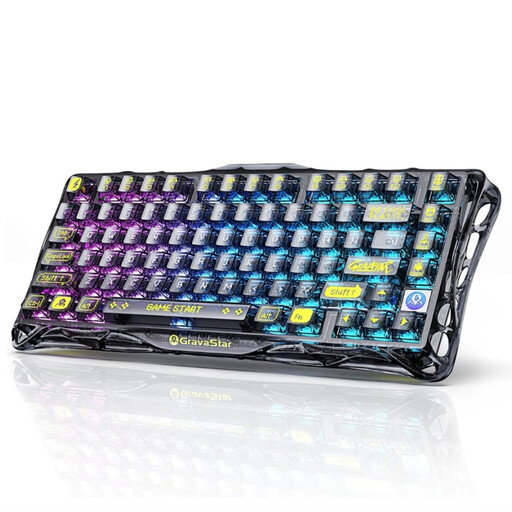
This 75% model suits a space-conscious desk setup if its typing feel works for the people around you. Its name specifies a QWERTY US layout, hot-swap mechanical design and Bluetooth 5.0, 2.4G and USB-C connections. Check supported devices, switching behaviour and the claimed noise reduction before choosing it for shared-space use.
 No image available
Consider this split-layout keyboard if you usually organise notes at a regular desk and want a padded wrist rest. That arrangement is less convenient for daily bag carry than a compact standalone keyboard. Check the key layout, supported operating systems and typing sound against your shared-workspace needs.
Look for a quiet or reduced-noise claim about the specific model’s keys, rather than assuming that wireless or compact means quiet. Logitech describes quiet low-profile keys on Pebble Keys 2 K380s and reduced noise from increased key stability on MX Keys Mini; neither claim establishes how every keyboard will sound in your workspace.
Follow the pairing and switching procedure for your chosen model. Logitech’s Easy-Switch guidance says to select a channel, hold its key until the indicator blinks, select the keyboard in the device’s Bluetooth settings and enter a code if prompted. Check separately how many devices your model remembers and whether each device is supported.
Choose a standalone keyboard when you need to use it across a laptop, tablet or phone; consider a case when one compatible tablet is your main study device and an integrated trackpad or cover matters more. Apple’s cited Magic Keyboard case requires compatible iPad Pro hardware and iPadOS 17.4 or later, so match the exact tablet before ordering.
Check the retailer’s change-of-mind return period, required product condition and any return-postage arrangements before ordering, particularly if key feel or sound may decide whether you keep the keyboard. A retailer’s voluntary return policy is distinct from remedies for goods that are faulty, damaged or misdescribed.
Use an appropriate electrical-waste recycling route rather than putting it in household rubbish. GOV.UK advises that electrical products and batteries should not go in household rubbish; recycle removable batteries separately where you can remove them safely.