Small-desk survey reviewers
You need space for a laptop or tablet, survey notes and perhaps a mouse, while keeping filtering, comments and short written analysis practical.


Choose a compact standalone keyboard if you review survey results across a laptop, tablet or phone; check its layout and device compatibility before deciding whether its small footprint works for your typing and navigation needs. If you mainly use one compatible iPad, a keyboard case with a trackpad can keep typing and pointer control together, but it is tied to specific tablet models. For longer laptop sessions, leave room for a workable screen position and pointing device too.
You need space for a laptop or tablet, survey notes and perhaps a mouse, while keeping filtering, comments and short written analysis practical.
You move between a laptop, tablet or phone and need a keyboard that works with the devices you actually use, rather than a case dedicated to one tablet.
You mainly annotate results on an iPad and want to consider a keyboard case with a trackpad and adjustable viewing position, provided it fits your exact model.
For survey review on a small desk, decide whether the keyboard must move between devices or stay with one tablet. Then check the space left for your screen, survey materials and pointer control.
Choose when: You want to use the keyboard separately from a laptop, tablet or phone, particularly if you switch devices.
Trade-off: You may still need a separate stand and pointing device.
Choose when: You mainly work on one compatible iPad and want keyboard and trackpad control in the case.
Trade-off: The case must match the specified iPad size and generation; it is less flexible across devices.
| Concern | What to check | Who this matters to |
|---|---|---|
| Desk space and storage | Check the keyboard’s width and depth with your screen, notes and any mouse in place. | If I need to spread out survey notes, I want a keyboard I can use without crowding the desk and put away afterwards. Around 42% of consumers put that space-saving need first. |
| Devices and key layout | Match the stated operating systems and connection methods to your devices; check the selected UK or US physical layout. | When I move results between devices, I need the keyboard to connect to each one and its keys to be familiar. For around 25% of consumers, compatibility and layout are the primary concern. |
| Typing and control | Consider key and navigation layout, pointer control and screen position for longer sessions. | Repeated comments and text selection make me care about workable keys and control without compromising my screen position. Around 33% of consumers prioritise that longer-session need. |
A compact keyboard may leave more desk space, but it does not necessarily provide pointer control or raise the screen. The Health and Safety Executive advises using a separate keyboard and mouse to allow a laptop screen to be elevated during prolonged use.
Plan the position of the screen, keyboard, survey materials and any pointing device together before ordering.
A separate mouse, trackpad, stand or laptop riser may still be needed.
Supported operating systems, connection methods and device switching differ between keyboards. An iPad keyboard case also needs to fit the specified tablet model.
Check the compatibility list against each device you intend to use and confirm whether your chosen connection needs Bluetooth, a receiver or a cable.
A product family can include different physical key arrangements, which matters if you rely on familiar punctuation and shortcuts while reviewing data.
Check the selected variant’s layout designation and key image for British English or UK-ISO if you need that arrangement.
A keyboard is only one part of a longer screen-work setup. The Health and Safety Executive’s guidance also addresses screen and input-device position.
For longer review sessions, arrange the screen and keyboard so both can be used comfortably rather than choosing solely on how easily the keyboard packs away.
Its Keys-To-Go 2 and Pebble Keys 2 K380s are relevant if you want a compact standalone keyboard for more than one device.
The B1 Pro is relevant if you want a compact keyboard with alternatives to Bluetooth.
Its keyboards offer different routes for a Mac desk setup and an iPad-centred setup.
These choices include compact standalone keyboards with different layouts and connection options, followed by a keyboard case for an iPad-centred setup. Compare the selected variant with your device and the space available on your desk.
 No image available
Consider this standalone keyboard if a 75% format appeals for your survey-review desk. Check its physical key arrangement, device compatibility and dimensions against your setup.
 No image available
Consider the 78-key layout if you want a compact standalone keyboard for switching between devices. The listed modes are Bluetooth 5.0/4.0 and 2.4 GHz, with support stated for up to four devices; the physical layout is QWERTY US rather than UK. Check its dimensions and compatibility with your particular devices.
 No image available
Consider this compact format if you want to choose between connection methods. The product title specifies wired, Bluetooth and 2.4G modes, plus PBT keycaps; it also specifies a QWERTY US layout. Check device compatibility and the keyboard’s dimensions before choosing it for a small desk.
 No image available
The 68-key format is worth considering when a small standalone keyboard is the priority. The title specifies Bluetooth 5.1 and wired modes, a QWERTY US layout and Jellyfish switches. Check the desk fit and confirm the mouse offer’s contents before ordering.
 No image available
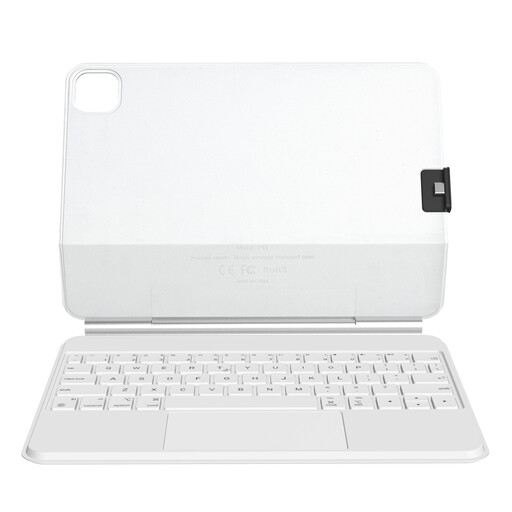
Consider a keyboard case if you mainly review results on a compatible iPad and want its trackpad alongside the keyboard. This model’s title specifies a magnetic floating design, detachable protective cover and trackpad. Match the exact iPad model and generation to the case’s compatibility list, and check the selected key layout.
Choose a standalone keyboard if you review survey results across devices or want to position the keyboard independently of the screen. An iPad keyboard case makes more sense if you mainly use one iPad, want integrated trackpad control and can confirm an exact model match.
Choose a British English or UK-ISO variant if you depend on that physical key arrangement for punctuation and shortcuts. Check the selected variant rather than assuming every version of a keyboard uses the same layout; Keychron, for example, identifies a UK-ISO B1 Pro variant.
Put the keyboard into pairing mode, then select it in your computer, tablet or phone’s Bluetooth settings and follow any pairing prompt. The keys used to enter pairing mode vary by model, so follow the instructions supplied with your keyboard.