What matters when choosing?
Start with the device you use to transcribe, then decide which constraint is hardest to accommodate: typing near others, carrying the keyboard, switching devices or setting up for longer sessions.
| Concern |
What to check |
Who this matters to |
| Quiet typing |
Look for an explicit quiet-key claim and check whether the physical layout suits your typing. |
If I am transcribing beside other customers, I want keys that draw less attention without making my notes awkward to enter. Around 33% of consumers put quiet shared-space typing first. |
| Carry bulk |
Check packed size, device compatibility and whether a cover or separate stand is needed. |
When I travel between observation sites with a tablet or phone, I want a keyboard I am willing to carry. Roughly 27% of consumers prioritise minimum carry bulk. |
| Device switching |
Check supported operating systems, switching controls and any wired or receiver-based mode you need. |
If I record notes on a phone but edit them on a laptop, reconnecting should not interrupt the work. Around 27% of consumers place device switching first. |
| Longer-session setup |
Consider screen position, seating and table space; check exact iPad compatibility if choosing a keyboard case. |
For regular transcription, I need a workable position for the screen as well as the keys. About 13% of consumers make the wider setup their primary concern. |
Portable keyboards on Joybuy
These keyboards offer different starting points for café field-note transcription: a UK-labelled full-size model, a Bluetooth model for mobile devices and a UK-labelled Bluetooth model. Check the physical layout, typing sound and space each one needs against your own setup.
 No image available
Targus EcoSmart Full Size Wireless Keyboard (UK)
Consider this full-size wireless model if a larger typing layout matters more to you than minimum carry bulk. Check that it fits your café table and bag, and confirm its physical key arrangement and typing sound.
View on Joybuy
 No image available
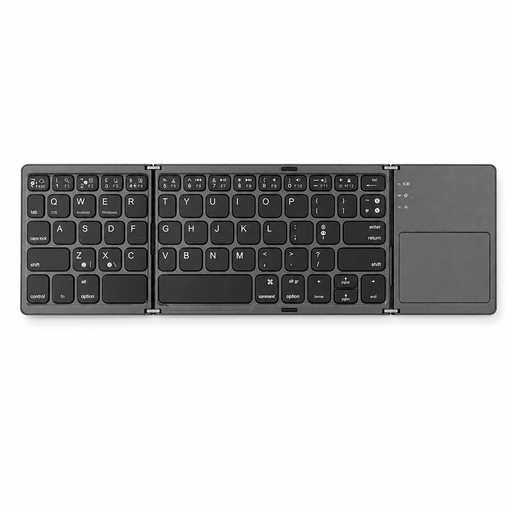
VoxorAI B033 Black Bluetooth Keyboard
For transcription on an iPad, smartphone or laptop, this Bluetooth keyboard lists those device types among its compatible uses. Confirm the physical key layout and typing sound if UK punctuation placement or quiet café use is important to you.
View on Joybuy
 No image available
Hyper HyperSpace Next Bluetooth Keyboard (UK), White
If you transcribe across devices, check that this Bluetooth keyboard supports each one and that its switching method suits your routine. Its title identifies a UK-labelled white variant; confirm the physical key arrangement, typing sound and table footprint before choosing it for café work.
View on Joybuy
Common questions
Should I prioritise quiet keys for café transcription?
Yes, if you expect to type near other customers, but do not judge noise from keyboard size alone. Logitech describes the Pebble Keys 2 K380s as having quiet low-profile keys; that is a manufacturer description rather than an independently measured noise rating.
Can one keyboard work with my phone, tablet and laptop?
It can if the specific keyboard supports all three devices and their operating systems. Logitech lists Android, ChromeOS, Windows, iPadOS, iOS and macOS compatibility for Keys-To-Go 2, with switching among up to three devices; check the connection method you need on every device.
Is an iPad keyboard case better than a separate keyboard?
An iPad keyboard case makes sense if it fits your exact iPad generation and you want its integrated viewing position and trackpad. A separate keyboard is worth considering if you also need to type on a phone, laptop or non-Apple tablet; verify compatibility with each device.
What should I consider if café transcription is regular work?
Consider the whole workstation, not just the keyboard. The Health and Safety Executive says employers must assess workstations when workers use display screen equipment daily as part of normal work, continuously for an hour or more; its guidance covers the equipment, furniture, work conditions and task.


