Tablet-first café writer
You draft questions on an iPad, Android tablet or phone and want a keyboard that is easy to protect and pack alongside it.


For drafting seminar questions in a café, choose a slim, covered tablet keyboard when bag space matters most, or a quiet multi-device keyboard when you switch devices and sit near other people. A compact mechanical model suits a preference for switch feel and programmable keys, but check its sound, layout and compatibility before relying on it in a shared space.
You draft questions on an iPad, Android tablet or phone and want a keyboard that is easy to protect and pack alongside it.
You may move between a laptop, tablet and phone, while keeping typing unobtrusive around other café customers.
You are willing to consider a more configurable compact board because switch feel, remapping or key layout affects how comfortably you draft and revise questions.
Choose it when: You mainly write on a tablet or phone and want a protected keyboard that takes little bag space; Logitech UK describes the Keys-To-Go 2 as slim and fitted with a built-in cover.
Trade-off: Check whether its smaller key arrangement works for your usual punctuation and shortcuts.
Choose it when: You switch writing devices and share close seating; Logitech UK says the Pebble Keys 2 K380s has quiet low-profile keys and switches between three devices.
Trade-off: Tech Advisor notes that this model’s compact shape may not suit every hand size and that it has no adjustable feet.
Choose it when: Key feel and remapping matter more than the simplest travel setup; Keychron UK specifies a 75% layout and VIA customisation for the K3 Max.
Trade-off: Check the exact switch configuration and typing sound before using a mechanical board near other people.
| Concern | What to check | Who this matters to |
|---|---|---|
| Typing noise | Look for a model-specific quiet-typing description; check the switch variant and whether you can assess its sound before committing. | When I write beside other people, I want to draft questions without distracting them. Around 33% of consumers would put discreet typing first. |
| Carry size and protection | Compare the chosen model’s dimensions and weight, and check whether a cover is built in. | If I write on a tablet, I need a keyboard I will actually bring in the same bag. Roughly 27% of consumers would make easy, protected carrying their primary concern. |
| Device compatibility | Confirm the exact operating systems and connection methods for the device you will use. | I may draft on one device and revise on another, so the keyboard needs to work with my actual setup. About 20% of consumers would prioritise device fit above the other factors. |
| Layout and key feel | Check the precise British English, UK-ISO or other layout variant, plus the keys and shortcuts you use for editing. | When I revise several questions, unfamiliar symbol positions or an awkward key arrangement slow me down. Around 20% of consumers would place drafting comfort and layout control first. |
A keyboard’s size does not tell you how its keys will sound in close café seating. Mechanical switch choices can also change the typing experience.
Look for a quiet-typing description for the exact model; for a mechanical keyboard, check the switch variant and its sound rather than relying on the product family name.
Symbol positions and operating-system support can vary by variant. Apple UK describes automatic Mac pairing for its cited Magic Keyboard, which does not establish the same behaviour with other devices.
Check the keyboard’s precise layout, supported operating systems and connection method against the device on which you will write.
A small footprint does not guarantee comfortable drafting. Tech Advisor notes that the Logitech Pebble Keys 2 K380s may not suit every hand size and has no adjustable feet.
If you regularly write for longer stretches, check the dimensions and key arrangement against your usual typing position before choosing on size alone.
Its cited portable models address two different café needs: compact multi-device typing and covered tablet travel.
The cited K3 Max is a compact mechanical option for writers who want more control over connections and keys.
The cited Magic Keyboard (USB-C) is a British English option for a Mac-focused setup.
These choices include Bluetooth keyboards for mobile-device writing, full-size wireless layouts and mechanical models. For café use, compare carrying space, key layout and sound alongside compatibility with your writing device.
 No image available
Consider this UK wireless model if a full-size layout matters more to you than minimum bag bulk. Check its dimensions and typing sound against the space available at your café table.
 No image available
This Bluetooth model is an option if you want a wireless keyboard for café drafting. Confirm its exact key layout, compatibility with your writing device and typing sound before choosing it for close seating.
 No image available
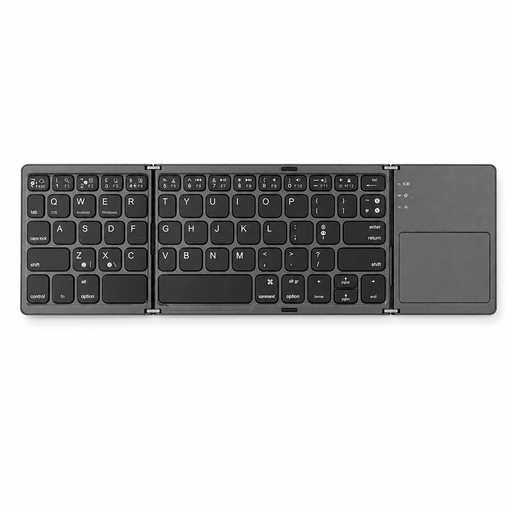
Consider this Bluetooth model if you draft on a mobile device as well as a computer; its title lists iPads and smartphones among compatible devices. Check the exact key arrangement, device compatibility and typing sound for your own setup.
 No image available
Consider this model if you prefer a compact mechanical layout and want a choice of wired, Bluetooth and 2.4 GHz connections. Its title specifies a US QWERTY layout; check the symbol positions, device compatibility and switch sound before using it for café writing.
 No image available
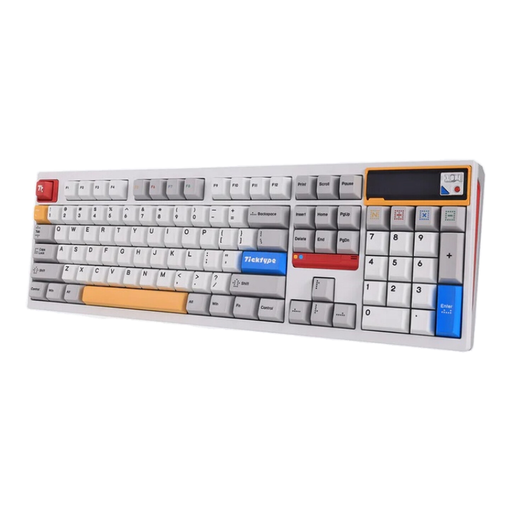
This full-size mechanical option is worth considering if its key arrangement matters more to you than carrying the smallest board. The title identifies hot-swappable switches and the Silent Tactile variant; that name is not a measure of café typing noise. Check its size and US symbol positions before choosing it for seminar drafting.
Choose a layout whose symbol positions and editing keys suit the device and typing habits you use for drafting. Check the exact British English, UK-ISO or other variant rather than assuming every keyboard in a model range has the same Enter key or punctuation positions.
No: check operating-system support and connection methods for the exact model and device. Logitech UK lists broad operating-system support for the Pebble Keys 2 K380s and Keys-To-Go 2, while Apple UK specifically describes automatic Mac pairing for its cited Magic Keyboard.
Check your local council’s electrical-recycling route or a retailer take-back option rather than assuming it belongs with ordinary household rubbish. GOV.UK identifies the Waste Electrical and Electronic Equipment Regulations 2013, as amended, as the UK legislation underpinning electrical-equipment waste handling.