Between-visit tablet planners
If you draft agendas and make quick amendments at client sites or while travelling between them, a keyboard that is easy to pack and has protected keys may matter more than a number pad.


Choose a covered, ultra-portable Bluetooth keyboard if you mainly draft agendas and notes on a phone or tablet; choose a compact multi-device keyboard if you regularly move between devices. If attendance figures or schedules call for frequent number entry, a foldable keyboard with a number pad may justify more bulk. Before buying, check the UK layout, compatibility with your devices, switching controls and, for a keyboard case, the exact tablet model it fits.
If you draft agendas and make quick amendments at client sites or while travelling between them, a keyboard that is easy to pack and has protected keys may matter more than a number pad.
If a work laptop, tablet and phone all feature in your planning day, check that one keyboard can connect to each device and that switching between them suits your workflow.
If you regularly enter attendee counts, timings or room allocations, a fuller layout may be worth carrying, even when it takes more bag space.
For consumers planning training sessions between client visits, the useful starting point is the need that would most influence the purchase: carrying the keyboard, switching devices, entering figures or navigating on a tablet.
| Concern | What to check | Who this matters to |
|---|---|---|
| Carry size and protection | Compare packed dimensions and weight; decide whether the keys need a built-in cover. | If I only have short gaps to draft an agenda, I want a keyboard I can pack without fuss or leaving its keys exposed. Around 31% of consumers put carrying and protection first. |
| Device switching | Check compatibility with each device and how the keyboard switches between paired devices. | When my plan is on a laptop but messages arrive on a phone, repeated pairing would interrupt a brief work session. For around 31% of consumers, switching devices is the primary concern. |
| Layout for figures and longer plans | Check whether you need a number pad and whether the arrow and function keys suit your work. | If I often update attendance totals and timing grids, I would accept a larger keyboard for the keys I use regularly. Entering figures and longer plans comes first for around 23% of consumers. |
| Navigation without a mouse | Decide whether touch input is enough; if choosing a keyboard case, match it to the exact tablet model. | Editing documents on a tablet can make me want pointing controls without packing a separate mouse. Around 15% of consumers prioritise that navigation need. |
A covered slim keyboard and a folding keyboard with a number pad serve different needs. ProtoArc specifies a 297.72 g weight and 20.95 mm folded depth for its XK01, so the word ‘foldable’ alone does not tell you how it will fit in your bag.
Measure the space you normally have available and choose a layout that includes the inputs you actually use.
Apple’s Magic Keyboard for iPad Pro is designed for specific iPad Pro models; a similar-looking case is not enough to establish fit.
Find your tablet’s exact model and compare it with the keyboard case’s compatibility details before ordering.
Connecting to several operating systems does not establish that the shortcuts you use in planning software will behave identically on each one. Workplace Bluetooth restrictions may also affect use.
Check your organisation’s device rules and the shortcuts you rely on, including function keys, before settling on a model.
GOV.UK advises that unwanted electrical products and batteries should not go in household rubbish.
Use an appropriate electrical-waste collection route and follow local guidance for a device with a battery that cannot be removed.
Its portable and compact keyboard lines offer different ways to balance protected carrying, device switching and typing features.
Its UK-layout folding models are relevant when a fuller keyboard or integrated pointing control matters alongside portability.
Its Magic Keyboard for iPad Pro is a keyboard-case option for owners of a compatible iPad Pro, rather than a general-purpose keyboard for several devices.
These keyboards offer different layouts for drafting plans, working across devices or entering figures between visits. Check each model’s carrying size and key layout against the work you do most often.
 No image available
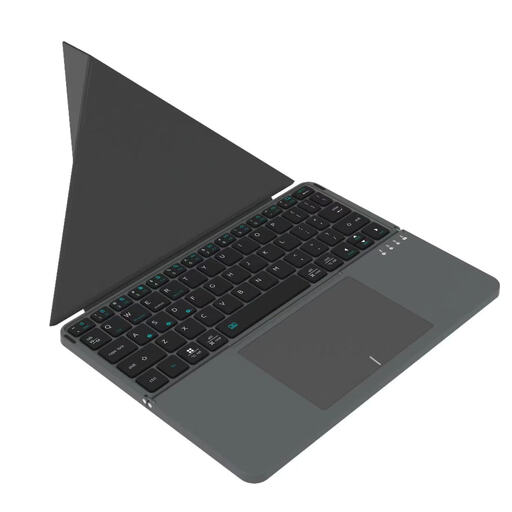
A UK-layout Bluetooth option to consider if your planning involves typing at more than one location. Check its packed size against the space available in your bag.
 No image available
A wireless option for consumers planning on a computer, iPad or smartphone. Check the key layout, exact weight and the connections required by your own devices before buying.
 No image available
The full-size UK layout is worth considering if a smaller keyboard would make longer plans awkward to type. Check whether its size works for the journeys between your client visits.
 No image available
A compact-layout option if you are comfortable typing training notes on a US keyboard layout. Its title specifies 68 keys, Bluetooth 5.1 and wired connectivity; check the symbol positions and carrying weight for your routine.
Yes, if the exact keyboard supports each device’s operating system and connection method. Logitech specifies switching among up to three compatible devices for Keys-To-Go 2 and Pebble Keys 2; check your devices and operating-system versions against the model you choose.
Not necessarily for agendas, emails and text-based plans. If you regularly enter attendance figures, budgets or timings, a number pad may be worth the extra space: ProtoArc specifies one for the foldable XK01, along with a weight of 297.72 g and a folded depth of 20.95 mm.
No. Apple’s Magic Keyboard for iPad Pro is model-specific, so match the keyboard variant to your iPad’s exact generation and screen size before ordering.
Use an appropriate electrical-waste collection route rather than household rubbish. GOV.UK advises that unwanted electrical products and batteries should be collected for recycling; follow local collection guidance if the keyboard’s battery cannot be removed.