Hotel-desk mobile planners
If you move between the hotel, renovation site and meetings, a keyboard that travels easily and works with your devices can help with notes and supplier messages. In a shared room, key noise matters too.


A compact Bluetooth keyboard is a practical choice if you need to write notes and supplier messages on several devices at a small hotel desk. If your plans centre on a compatible iPad, a keyboard case can add a trackpad; if you will enter measurements and costs repeatedly, a fuller layout with a number pad may be worth the extra space it takes.
If you move between the hotel, renovation site and meetings, a keyboard that travels easily and works with your devices can help with notes and supplier messages. In a shared room, key noise matters too.
If drawings, photos, mark-ups and documents live mainly on your iPad, a trackpad and a usable viewing position may matter more than switching the keyboard between devices. A keyboard case must fit your exact iPad.
If you will enter room dimensions, quantities and costs repeatedly, consider whether a dedicated number pad is worth a larger keyboard on your desk and in your bag.
Identify the device you will use, then decide whether limited desk space, iPad navigation or repeated number entry will shape your working day most.
| Concern | What to check | Who this matters to |
|---|---|---|
| Carry size and shared-room typing | Compare packed dimensions, weight and key layout; check the stated power method and any quiet-key claim. | If I am carrying the keyboard to appointments and working at a small desk, I need it to pack easily without disturbing someone sharing the room. Around 42% of consumers would put portability and quiet typing first. |
| Device fit and document navigation | Check the exact tablet model or supported operating systems, and decide whether you need a trackpad or multi-device switching. | When my plans and photos are on an iPad, I need a case that fits it and lets me navigate documents comfortably. Roughly 33% of consumers would make that tablet workflow their primary concern. |
| Numbers and longer typing sessions | Look for a dedicated number pad if needed, then compare the keyboard’s open footprint with your desk space. | For repeated measurements, quantities and cost entries, I would accept more bulk to have the keys I use most. About 25% of consumers would prioritise numeric-entry work. |
Cases can be tied to particular tablet generations and software versions. Apple’s Magic Keyboard for iPad Air, for example, requires iPadOS 18.3 or later and supports specified iPad Air models.
Match your exact iPad model and installed iPadOS version against the case maker’s compatibility list.
A compact keyboard may omit the dedicated number pad that you want for room measurements and cost sheets. A fuller folding layout also takes up more space when opened.
Check the actual key layout and compare the open keyboard with the hotel desk space you expect to use.
Support for several devices does not establish that shortcuts, key labels or customisation work the same way on each operating system.
Confirm your device’s operating system, preferred UK layout and required shortcuts for the particular keyboard variant.
The Keychron K3 Max has a UK-ISO configuration, but a product specification alone does not establish that this variant is available for your trip.
Check the selected layout, current availability and applicable after-sales terms with the seller before making plans around it.
Logitech offers two relevant approaches here: the covered Keys-To-Go 2 for travel and the compact Pebble Keys 2 K380s for switching between devices.
Apple’s Magic Keyboard is a keyboard-case route for supported iPad Air models, rather than a standalone keyboard for a range of devices.
The UK-layout XK01 is a folding option for planners who want a dedicated number pad for repeated measurements and cost entries.
The K3 Max offers a compact mechanical option for someone who values configurable shortcuts and several connection methods.
These keyboards cover full-size desk use, an iPad keyboard case and a compact-layout option for hotel-room planning. Compare each one with the device you own, the space available and the amount of number entry you expect.
 No image available
Consider this UK keyboard for notes and renovation figures across devices. Check whether its full-size footprint fits your hotel desk; if you share the room, check the key sound before relying on it for late typing.
 No image available
A full-size layout may suit schedules and budget work if you have enough room to set it up. Check its width against your working surface and confirm that its key sound and battery arrangement suit a shared hotel room.
 No image available
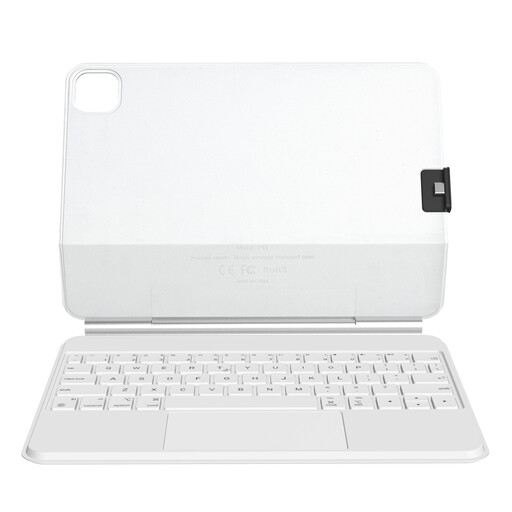
For planning around an iPad, this magnetic keyboard case pairs a trackpad with a detachable protective cover. Its title names iPad Pro 11-inch and iPad Air 10.9-inch and 11-inch sizes; check your exact iPad generation against the listing, as well as the case’s packed size.
 No image available
This UK-layout keyboard is an option if entering figures matters more to you than packing the smallest board. Check its weight and desk footprint before taking it to a hotel, and assess key sound separately if the room is shared.
 No image available
The 108-key layout may appeal if you spend much of the trip entering quantities and costs. This variant has a US layout, an 8000 mAh battery and silent tactile switches; check whether the key positions, packed dimensions and actual typing sound suit your plans.
Choose a UK layout if that is the key arrangement you normally use, and check the exact variant before ordering. Apple labels its relevant case British English, ProtoArc labels the XK01 UK Layout, and Keychron offers a distinct UK-ISO K3 Max selection.
Match a keyboard case to your exact tablet model and software version before ordering. Apple’s Magic Keyboard for iPad Air, for example, requires iPadOS 18.3 or later and supports specified iPad Air models; a standalone Bluetooth keyboard has different device-compatibility checks.
Take whichever your chosen keyboard requires. The Keys-To-Go 2 listing specifies coin-cell batteries, whereas ProtoArc’s XK01 uses USB-C recharging, so do not assume that every travel keyboard charges with the same cable.