Choose a standalone Bluetooth keyboard if you write seminar questions on more than one device, but check compatibility, switching and the supplied key layout before buying. An iPad keyboard case makes more sense when it fits your exact iPad and you want a viewing position, protection and a trackpad in one accessory; it is a device-specific choice rather than a universal keyboard.
Who needs which setup?
Tablet-first seminar participant
If you bring a tablet to seminars, decide whether you want a keyboard that can also work with other devices or a case made for your exact tablet. A standalone keyboard may call for a separate stand when you need an upright screen.
Quiet shared-room writer
When you type while someone else is speaking, key noise matters alongside size. Look for an explicit quiet-key description rather than assuming a compact keyboard will be unobtrusive.
Multi-device student or researcher
If you draft questions on a phone, tablet and laptop, check the operating systems listed for the keyboard and how it switches between connected devices. Logitech describes multi-device switching for its Keys-To-Go 2 and Pebble Keys 2 K380s models.
What matters when choosing?
Standalone Bluetooth keyboard
Choose it when: You want to write on different devices rather than commit to one tablet. Logitech lists several operating systems for Keys-To-Go 2 and describes switching among up to three devices.
Accept that: A separate stand may be needed to hold a tablet upright; a compact keyboard does not necessarily include a trackpad.
iPad keyboard case
Choose it when: You use a compatible iPad and want a keyboard, viewing position and trackpad in one carried accessory. Apple lists model-specific keyboard options with these features.
Accept that: Fit depends on the named iPad model and size, so the case cannot take the place of a universal keyboard for your other devices.
| Concern |
What to check |
Who this matters to |
| Carrying and protection |
Check packed size and weight, plus whether the keys have a cover or you will carry a separate stand. |
If I move between seminar rooms, I want a keyboard that is manageable to pack without leaving its keys exposed. Around 42% of consumers put carrying and protection first. |
| Quiet typing |
Look for an explicit quiet-key description and consider whether the key feel suits longer writing sessions. |
When I write questions during a talk, I do not want my typing to distract nearby participants. Quiet writing comes first for roughly 33% of consumers. |
| Device and layout fit |
Confirm your device’s operating system, the switching method and the supplied key layout; for a case, match the exact iPad model. |
If I alternate between devices, I need the keyboard to work with each one and have a familiar layout. About 25% of consumers prioritise that fit. |
Mistakes to avoid
-
Assuming a compact keyboard includes a stand
A standalone keyboard may leave your tablet without an upright viewing position, while an iPad case can combine screen support and a trackpad with the keyboard.
Decide whether you need typing alone or also a stand, protection and pointer control before choosing the accessory.
A standalone setup may mean carrying a separate stand, case or mouse.
-
Treating Bluetooth as a compatibility guarantee
Operating-system support and device switching differ between keyboards. An iPad keyboard case also has to fit a named iPad model.
Match the compatibility list to every device you plan to use, and check how the keyboard switches if you will move between them.
-
Judging layout and noise from size alone
A portable design does not establish that the supplied keys have a UK layout or will be quiet during a seminar.
Check the selected layout variant and look for an explicit quiet-key description if you will type while others are speaking.
-
Putting an unwanted keyboard or battery in household rubbish
GOV.UK advises that electrical products and batteries should go through appropriate recycling routes rather than household rubbish.
Check local electrical-waste and battery collection options when the keyboard or its batteries are no longer usable.
Relevant brands to consider
Logitech
Its compact Bluetooth keyboards include standalone options for tablets, phones and laptops.
- Logitech describes Keys-To-Go 2 as slim, covered and able to switch among up to three devices; it describes Pebble Keys 2 K380s as compact, quiet and able to switch among three devices.
- Check the supplied layout and whether your tablet setup also needs a stand or trackpad.
Apple
Its iPad keyboard cases suit readers who want a model-specific accessory with screen support and a trackpad.
- Apple lists Magic Keyboard and Magic Keyboard Folio options with trackpads and other features that vary by model.
- Check the accessory against your exact iPad: compatible models differ across the iPad Pro, iPad Air and standard iPad ranges.
Keychron
Its UK range is relevant when key layout is a priority and you want to compare keyboard formats.
- Keychron UK lists ISO options in compact and larger formats, including selected wireless and low-profile models.
- Check portability, connection method and the exact UK-layout variant model by model; the range is not solely made up of travel keyboards.
Joybuy product choices
These choices cover standalone wireless keyboards for writing across devices and a keyboard case for a compatible iPad. Some standalone models are full-size, so weigh carrying space against the setup you want at the seminar desk.
 No image available
Targus EcoSmart™ Full Size Wireless Keyboard (UK)
Consider this model if you have room for a full-size keyboard at the seminar desk and do not need the smallest item to carry.
The title identifies a wireless, UK-labelled variant. Confirm the supplied key layout, device compatibility and key noise for your intended setup.
View on Joybuy
 No image available
Rapoo E9050L 75% Wireless Keyboard, US QWERTY (White)
This slim keyboard is worth considering for moving between study locations if a US QWERTY layout suits your writing.
Its title lists 78 keys, Bluetooth 5.0/4.0 and 2.4 GHz connections, and support for four devices. Check compatibility with your intended phone or tablet, particularly if you use iPadOS.
View on Joybuy
 No image available
Hyper® HyperSpace Next Bluetooth Keyboard (UK, White)
If you draft questions on different devices, check whether this Bluetooth keyboard’s pairing and switching behaviour matches the way you work.
The title identifies a UK variant. Confirm the supplied layout and key noise before relying on it for typing during talks.
View on Joybuy
 No image available
VoxorAI BOX1 Bluetooth Keyboard (Black)
For questions drafted on a phone, tablet or laptop, check this keyboard against the particular device you intend to bring.
The title states Bluetooth connectivity and names computers, laptops, iPads and smartphones. Confirm the supplied layout, key noise and device-switching method if those affect your choice.
View on Joybuy
 No image available
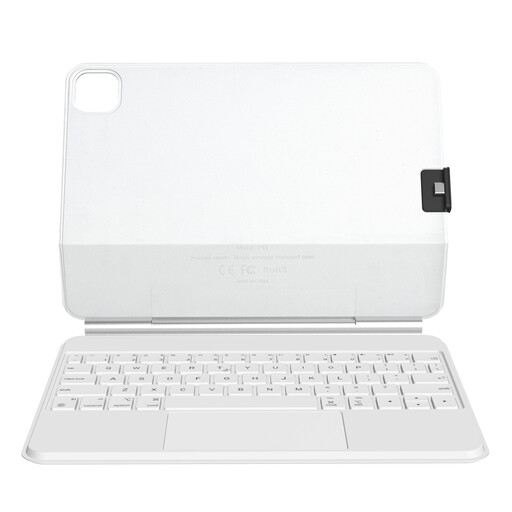
Rexsun P11-2 Keyboard Case for iPad Pro 11-inch and iPad Air 10.9-inch or 11-inch (White)
For an iPad-first seminar setup, this case brings a keyboard and pointer control into one accessory.
The title specifies a detachable protective cover and trackpad. Match your exact iPad model and generation before buying, and check the supplied key layout and typing noise.
View on Joybuy
Common questions
Should I get a Bluetooth keyboard or an iPad keyboard case for seminars?
Choose a standalone Bluetooth keyboard if you need to write on more than one device; choose an iPad case if it fits your exact model and you want its integrated screen support and trackpad. Apple lists its keyboard accessories by compatible iPad model, so check the generation and size rather than relying on the word “iPad” in a product title.
How can I avoid getting the wrong keyboard layout?
Check the layout of the selected variant, not just the keyboard family or its listing image. Keychron UK identifies ISO and UK-oriented choices in its range, but the layout of one variant does not establish the layout of every keyboard sold under the same family name.
What should I do with an unwanted keyboard or its batteries?
Use an appropriate electrical-waste or battery collection route rather than putting them in household rubbish. GOV.UK advises that electrical products and batteries should be recycled when they are no longer wanted or usable; check local collection arrangements for the keyboard and any removable batteries.


