Small-desk seminar writers
You need room for your device, reading material and handwritten notes as well as the keyboard. Its width and depth matter more than a general description of it as portable.


If desk space and carrying weight matter most, start with a slim portable keyboard, but check its width, depth, layout and compatibility with your device. A keyboard designed for quiet, multi-device use may suit a shared seminar better; a compact mechanical model is worth considering when remapping or a wired option matters more. Apple’s Magic Keyboard is an option only when your Apple device meets its stated requirements.
You need room for your device, reading material and handwritten notes as well as the keyboard. Its width and depth matter more than a general description of it as portable.
You write in a shared room and may move between a laptop, tablet and phone. Key noise and a convenient way to switch devices shape your choice.
You are willing to consider a 75% layout to keep more typing controls, with remapping, switch choice or a wired connection taking priority over the smallest footprint.
For writing seminar questions on a small desk, establish how much flat space remains beside your other materials. Then decide whether unobtrusive typing or keyboard controls matter more, and confirm the physical layout and device compatibility before ordering.
| Concern | What to check | Who this matters to |
|---|---|---|
| Desk space and carrying weight | Compare the keyboard’s width and depth with the clear desk area; check its weight if you carry it between seminars. | I need room to keep notes and reading material beside my device, and I do not want the keyboard to dominate my bag. Around 45% of consumers put footprint and carrying weight first. |
| Quiet shared-room typing | Look at the stated key design and whether the keyboard switches between the devices you use; a quiet-key description is not a measured noise rating. | When discussion is happening nearby, I want to enter questions without making my typing a distraction and move easily between devices. Quiet, multi-device use comes first for around 28% of consumers. |
| Typing controls and connection | Check the physical layout, available connection modes and any requirements for remapping software. | I rely on shortcuts or prefer a cable option, so giving up some desk space may be worthwhile. Around 27% of consumers prioritise those controls and connection choices. |
Portable keyboards can have different footprints. Logitech specifies the Keys-To-Go 2 at 250 × 105 mm and the Pebble Keys 2 K380s at 279.5 × 124.2 mm; either size still needs to fit your actual workspace.
Measure the usable flat area after placing your device and papers, then compare both keyboard dimensions with the space left.
A compatible connection does not tell you whether the physical keys match the layout you expect. Apple lists device requirements for its Magic Keyboard, while Keychron offers specific ISO-layout variants.
Confirm the exact model, operating-system version, connection method and British English or UK-ISO layout where that layout matters to you.
Logitech describes the Pebble Keys 2 as having quiet low-profile keys. Keychron’s K3 Version 3 instead offers a low-profile 75% mechanical layout with Bluetooth and wired use; that does not establish how quietly it will type in a seminar.
Prioritise the key design described for quiet use if shared-room discretion matters most. Consider the mechanical route when its controls or connection options serve a more important need.
Logitech specifies replaceable CR2032 batteries for the Keys-To-Go 2, while Apple’s Magic Keyboard uses USB-C charging. Those arrangements call for different routines.
Choose the power arrangement you are prepared to maintain, and check local electricals and battery-recycling instructions when the keyboard reaches the end of its life.
A keyboard that uses replaceable coin cells will need replacement batteries.
Its Keys-To-Go 2 and Pebble Keys 2 K380s illustrate different portable, non-mechanical choices: one prioritises a slim footprint, while the other adds multi-device switching.
The Magic Keyboard (USB-C) British English is a compact option for a setup that meets Apple’s stated device and operating-system requirements.
The K3 Version 3 UK-ISO is relevant if a low-profile 75% mechanical layout and a choice of Bluetooth or wired use matter more than the smallest travel footprint.
These choices include Bluetooth keyboards and compact-format gaming keyboards with differing stated layouts. For a small seminar desk, compare the dimensions of the exact variant and check its connection and physical keys before choosing.
 No image available
Consider this Bluetooth option if you want a separate keyboard for seminar writing. Check the UK variant’s physical key layout and measured width and depth against your desk space.
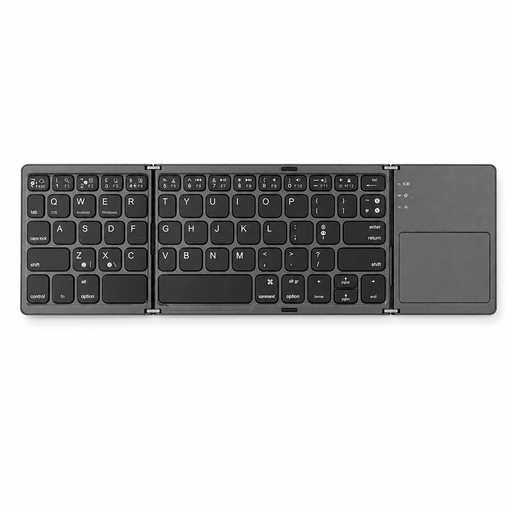 No image available
The Bluetooth connection makes this a candidate if you prefer a wireless desk setup. Check its unfolded dimensions, physical key layout and compatibility with your device before using it for seminar questions.
 No image available
Consider this UK-layout gaming keyboard if its keys suit the way you write and use shortcuts. Check its width and depth, connection requirements and device compatibility; the product name alone does not establish quiet seminar typing.
 No image available
The stated 75% layout and wired, Bluetooth and 2.4G modes give you connection choices if keyboard controls matter to your writing routine. Its title specifies US QWERTY: check that layout, the exact footprint and device compatibility before buying. A sound-related description does not establish how quiet it will be in a seminar.
Measure the clear space after placing your device, papers and notes, then compare it with the keyboard’s width and depth. Logitech specifies the Keys-To-Go 2 at 250 × 105 mm and the Pebble Keys 2 K380s at 279.5 × 124.2 mm; a description such as compact cannot tell you which will fit your arrangement.
Choose according to what would disrupt your writing more: audible typing in a shared room or losing the controls and connection options you use. Logitech describes the Pebble Keys 2 as having quiet low-profile keys and three-device switching; Keychron’s K3 Version 3 offers a mechanical 75% layout, remapping and wired use, but those features do not establish that it is quiet.
Confirm the exact device and operating-system version, the required Bluetooth or cable connection, and the physical keyboard layout. Logitech lists platform-specific requirements for the Keys-To-Go 2, Apple lists Apple-device requirements for its Magic Keyboard (USB-C), and Keychron offers a UK-ISO K3 variant for Windows and macOS.
Check your local electricals-recycling arrangements rather than putting the keyboard straight into ordinary household waste. UK government guidance describes the Waste Electrical and Electronic Equipment framework as intended to reduce electrical waste sent to landfill; follow local instructions for any removable batteries as well.