Tablet and phone travel writers
If you edit notes, captions and journal entries mainly on mobile devices, a keyboard that works with each device you carry matters more than features intended for a desk setup.


Choose a slim Bluetooth keyboard with key protection if you mainly edit on a phone or tablet and pack it away between journeys. A larger compact keyboard may suit longer revisions or a preference for configurable keys, but check that its size fits your bag and working space. For either route, confirm the selected variant’s device compatibility, key layout and power arrangement.
If you edit notes, captions and journal entries mainly on mobile devices, a keyboard that works with each device you carry matters more than features intended for a desk setup.
If you expect to revise several pages during a journey, a compact 75% layout, switch choice or remapping may be worth considering alongside the space the keyboard takes up.
If your journal stays on compatible Apple devices, a compact rechargeable keyboard is one option; check the exact device requirements and layout before choosing a variant.
For train journeys, start with the device you will write on and the space available for carrying and typing. Then decide whether short edits or longer revisions should drive the layout choice.
| Concern | What to check | Who this matters to |
|---|---|---|
| Packability and protection | Compare closed dimensions and weight; check whether key protection is built in. | If I keep packing the keyboard beside my tablet, I want it to take little room without leaving the keys exposed. Around 31% of consumers put packability and protection first. |
| Device compatibility and switching | Check each device’s operating system against the manufacturer’s compatibility list and confirm how many devices the keyboard can pair with. | When my notes are on a phone but I revise on a tablet or laptop, I need the keyboard to work with both without awkward re-pairing. For around 25% of consumers, device compatibility and switching are the main concern. |
| Typing through longer revisions | Look at the key arrangement and available switch options; decide whether wired use or remapping would help your editing. | Reworking several pages during a journey makes key placement and editing controls more important to me than the smallest possible board. Longer-session typing comes first for around 25% of consumers. |
| Layout and power | Confirm the selected variant’s UK or US layout and whether its charging or replaceable-battery arrangement suits your routine. | I do not want unfamiliar punctuation keys or a power arrangement that clashes with what I carry. Around 19% of consumers make the exact layout and power setup their primary concern. |
Apple’s UK Magic Keyboard listing identifies a US-English variant, while Keychron lists UK-ISO versions of the K3 Max. Enter-key shape and punctuation placement can affect editing if they differ from the layout you normally use.
Read the selected variant’s title and layout specification, rather than relying on the country of the shop.
Logitech states broad operating-system support for the universal Keys-To-Go 2, whereas Apple gives specific device requirements for its Magic Keyboard. Pairing capacity also varies by model.
Match the manufacturer’s compatibility requirements to each phone, tablet or computer you plan to use, and check how device switching works.
Keychron’s low-profile K3 Max offers a 75% layout, switch variants and remapping, but those options do not by themselves tell you whether its carrying size suits your journey.
If longer revisions and configurable keys matter to you, compare the selected variant’s dimensions with your bag and the space where you expect to type.
UK government guidance says electrical products and batteries marked with the crossed-out wheelie-bin symbol should not go in household rubbish.
Use an appropriate battery or electrical-waste collection route, following local instructions for a device with a built-in battery.
Logitech’s Keys-To-Go 2 is relevant if a covered, slim Bluetooth keyboard will travel with a tablet or phone.
Apple’s compact Magic Keyboard is an option for a journal workflow on compatible Apple devices.
Keychron’s K3 Max offers a compact mechanical route for writers interested in key configuration.
Microsoft’s Designer Compact Keyboard is a Bluetooth option for a compatible Windows setup.
These keyboards offer different ways to edit a travel journal on a train, from a folding Bluetooth model to compact layouts with more keys. Compare each one’s layout, device fit and carrying size against how you actually write.
 No image available
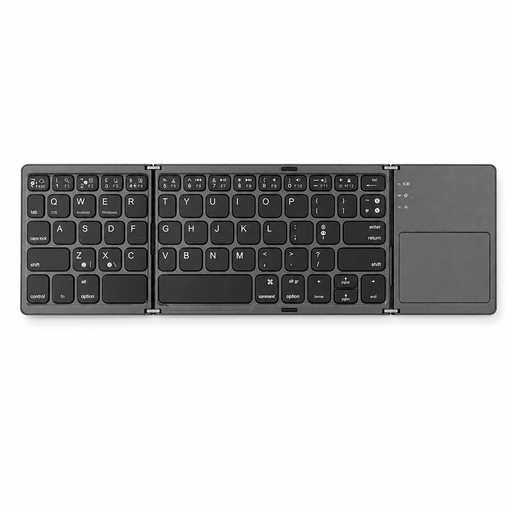
Consider this UK-labelled keyboard if your journal moves between devices, but check its carrying dimensions and the space available for typing on the train.
 No image available
The 75% layout is worth considering for longer editing sessions. Check its carrying weight and compatibility with your particular phone or tablet before relying on it for train journeys.
 No image available
Consider it for editing on a phone, tablet or computer. Confirm the key layout, device-switching arrangement and battery routine if those affect your journey.
 No image available
Its 68-key US layout and Bluetooth or wired connection may suit writers who want a compact mechanical board. Check its carrying weight, device-switching capacity and the mouse bundle’s contents before ordering.
 No image available
The 75% layout offers a compact mechanical option with wired, Bluetooth and 2.4 GHz connection modes. Check its dimensions, weight and compatibility with your writing device before choosing it for train use.
Choose a UK layout if that is the arrangement you normally use and want the keys to feel familiar. Check the exact variant: Apple’s UK Magic Keyboard listing identifies a US-English model, while Keychron lists UK-ISO versions of the K3 Max.
It can if the exact model supports all three devices and the switching arrangement you need. Logitech states that the universal Keys-To-Go 2 supports Android, ChromeOS, Windows, iPadOS, iOS and macOS and connects to up to three devices; check other models against their own compatibility requirements.
Choose the arrangement that fits what you already carry and are willing to maintain. Apple’s listed Magic Keyboard charges by USB-C, while Microsoft Support says the Designer Compact Keyboard uses four CR2032 coin cells; check the exact model’s power requirements before travelling.
Use an appropriate collection route rather than household rubbish for electrical products and batteries bearing the crossed-out wheelie-bin symbol, as advised by the UK Office for Product Safety and Standards. Follow local collection instructions, particularly if the keyboard has a built-in battery.