For notes in a shared carriage, start with a keyboard that fits your bag and has keys you are comfortable using near other passengers. Then check the exact UK-layout variant and its connection to your laptop or tablet. Bluetooth suits a compatible device, while receiver and wired options are useful only if you can connect and carry what they require.
Who is this for?
Quiet-carriage note takers
If you type beside other passengers, a compact keyboard with restrained key noise may matter more than a full-size layout. Logitech describes its Pebble Keys 2 K380s as portable, with quiet low-profile keys; that description is not a measured noise level.
Tablet-and-laptop switchers
If you take notes on a tablet during a journey and continue on a laptop, check how the keyboard connects to each device and how you switch between them. Logitech, Keychron and CHERRY describe different connection options for the models discussed below.
Frequent long-note writers
If your notes turn into longer writing sessions, weigh the layout and available space against ease of carrying. The Health and Safety Executive advises attention to workstation setup and breaks for prolonged display-screen work; an external keyboard alone does not settle how comfortable a train-seat setup will be.
What matters when choosing?
Check bag and table fit alongside key noise, then confirm the layout and connection against the device you will actually use for notes. If you write for long stretches, consider how the keyboard fits into your whole working setup.
| Concern | What to check | Who this matters to |
|---|
| Carrying and key noise |
Compare dimensions with your bag and available table space; assess any quiet-key description without treating it as a sound measurement. |
When I type beside other passengers, I want a keyboard I can carry easily without drawing attention through key noise. Around 36% of consumers would put discreet, bag-friendly typing first. |
| Device connection |
Confirm compatibility with your exact device and check whether a receiver, cable or usable port is needed. |
If I move between a tablet and laptop, I need a connection that works with both without disrupting my notes. Roughly 29% of consumers would prioritise connection flexibility. |
| Familiar key layout |
Confirm the selected UK or UK-ISO variant and the presence of keys you regularly use for symbols and shortcuts. |
When I type notes quickly, unfamiliar punctuation positions could slow me down. Around 21% of consumers would make a familiar layout their main concern. |
| Longer-session setup |
Consider key arrangement and a stable working surface; plan breaks or changes of activity during extended sessions. |
If I continue writing well beyond the journey, I need a setup I can use without assuming a smaller keyboard solves every comfort issue. About 14% of consumers would put longer-session setup first. |
Common buying mistakes
-
Assuming every version has a UK layout
A product family can include different regional layouts, changing the positions of familiar symbols. Keychron, for example, lists a UK-ISO version of the B1 Pro.
Check the layout of the selected variant, not just the keyboard family name.
-
Choosing a connection before checking the device
Bluetooth pairing, a 2.4 GHz receiver and a wired connection make different demands on your tablet or laptop. The available modes also differ by keyboard.
Check your device, operating system and ports, then decide whether you need an alternative to Bluetooth.
-
Treating a compact layout as a comfort guarantee
A smaller board can save carrying space while changing key placement or omitting a number pad. The Health and Safety Executive also notes that poorly arranged display-screen work can contribute to discomfort.
Balance the keys you use most against portability, and take breaks during extended writing sessions.
-
Forgetting the battery plan
A wireless keyboard needs power when it is time to take notes; advertised battery figures are specific to a model and its stated conditions.
Check how the chosen keyboard is powered or charged, and whether its cable permits use while charging if that matters to you.
Brands to consider for portable keyboards
Logitech
The Pebble Keys 2 K380s is a reference point for a compact Bluetooth keyboard aimed at use across several devices.
- Logitech states that this model switches among three devices, supports Windows, macOS, iPadOS, iOS and Android, and has quiet low-profile keys.
- Confirm compatibility with your exact device and the layout of the variant you select; the quiet-key description is not a measured train-carriage noise result.
Keychron
The B1 Pro is a compact option to examine if a specifically labelled UK-ISO variant and several connection modes matter to you.
- Keychron states that the B1 Pro UK-ISO version supports Bluetooth, a 2.4 GHz receiver and a wired connection.
- Check the selected regional variant and the ports or accessories needed for your intended connection. Keychron's battery-life figure is a manufacturer claim subject to its usage assumptions.
CHERRY
The KW 9200 MINI is a compact model to consider when you want more than one way to connect.
- CHERRY states that this model has two Bluetooth channels, a 2.4 GHz channel and a wired channel, and comes with a carrying case.
- It omits a numerical keypad, which matters if number entry is a regular part of your notes.
Joybuy keyboard choices
These keyboards offer different trade-offs for train note-taking: full-size UK-labelled options, smaller Bluetooth designs and compact US-layout models. Check each selected variant against your bag, device and usual key layout before choosing.
 No image available
Targus EcoSmart full-size wireless keyboard, UK layout
Consider this if familiar full-size keys matter more to you than taking up minimal train-table space. The title identifies a wireless UK version; check its footprint against your bag and assess key noise if you will type near other passengers.
View on Joybuy
 No image available
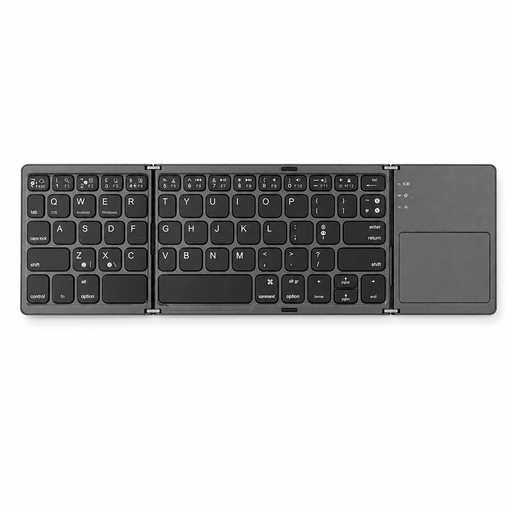
VoxorAI B033 black Bluetooth keyboard
Consider this for Bluetooth notes when carrying space is a priority. Confirm the key arrangement if you rely on UK punctuation, and check device pairing and key noise for your train use.
View on Joybuy
 No image available
Hyper HyperSpace Next Bluetooth keyboard, UK version, white
Consider this if you want a UK-labelled Bluetooth keyboard and have room for a full-size layout. Check the keyboard's dimensions against your train table and bag, as well as whether its key noise suits shared seating.
View on Joybuy
 No image available
Lofree OE907 65% mechanical keyboard, US layout, with mouse offer
Consider its smaller layout only if the US key arrangement works for your notes. The title specifies 68 keys, Jellyfish switches and Bluetooth 5.1 or wired use; the switch name does not establish how quiet typing will be beside other passengers. Confirm the mouse offer and selected bundle contents before ordering.
View on Joybuy
 No image available
AULA F75 75% keyboard, US layout
Consider this compact layout if you can work with US key positions. The title lists wired, Bluetooth and 2.4 GHz modes; check the required connections for your device, bag fit and actual key noise before relying on it for train notes.
View on Joybuy
Frequently asked questions
Do I need a UK-layout keyboard for lecture notes?
Not necessarily, but choose an explicitly labelled UK or UK-ISO variant if familiar symbol and punctuation positions matter to your typing. A model family can contain several regional layouts; Keychron lists UK among the B1 Pro ISO versions.
Is Bluetooth enough for a train note-taking keyboard?
Bluetooth can be enough when your note-taking device supports the selected keyboard. Choose receiver or wired options if you need those connections for another device, and check the required port, receiver or cable before ordering.
Will an external keyboard prevent discomfort during long journeys?
No keyboard can guarantee a comfortable train-seat setup. The Health and Safety Executive notes that poorly arranged display-screen work can contribute to discomfort; use a stable surface where possible and take breaks or change activity during longer sessions.
How can I check for a UK product-safety recall?
Search the exact model in the UK government's Product Safety Alerts, Reports and Recalls service before buying. An absence of a listed alert is not proof that a keyboard has been independently safety-tested.


