What matters when choosing?
Start with the concern that would most disrupt your transcript work, then check the layout, table space and connections against the devices you use.
| Concern |
What to check |
Who this matters to |
| Typing position |
Check keyboard height and whether the screen and mouse can be positioned without reaching or twisting. |
For a long editing session, I need room to type without hunching over a low laptop screen. Around 36% of consumers put sustained comfort and posture first. |
| UK key layout |
Confirm the selected physical variant says UK or UK-ISO; do not judge it from a generic product image. |
When I am correcting punctuation and entering timestamps, unfamiliar key positions interrupt my work. A familiar layout is the primary concern for around 29% of consumers. |
| Space and noise |
Check the keyboard’s open footprint, room for a mouse and whether its key sound suits a shared room. |
If I have to clear the table afterwards or work near other people, storage and typing noise matter each time I sit down. Around 21% of consumers place those needs first. |
| Device switching |
Check operating-system compatibility, supported connection modes and whether a receiver is included if you need one. |
When my transcript and reference notes are on different devices, I want to switch without repeatedly pairing the keyboard. Connection flexibility comes first for around 14% of consumers. |
Joybuy keyboard options
These keyboards offer different ways to handle transcript editing at a shared table, from a full-size UK board to a compact Bluetooth option. Check the exact key layout, working footprint and typing sound against your own setup before choosing.
 No image available
Targus EcoSmart Full-Size Wireless Keyboard (UK)
Consider this if a full-size UK keyboard matters more to you than the smallest possible board. Check that it leaves room for your laptop and mouse, and assess its key sound if you edit near other people.
View on Joybuy
 No image available
ASUS ROG Strix Scope II 96 Wireless Keyboard, White (UK Layout)
The UK-layout 96 model is worth considering if you want a less spread-out key arrangement for number-heavy editing. Check the exact switch variant and its sound before choosing it for a shared room.
View on Joybuy
 No image available
Hyper HyperSpace Next Bluetooth Wireless Keyboard, White (UK)
This UK-labelled Bluetooth keyboard may suit editing across devices. Confirm that it supports each device you intend to use, and check its typing sound and open footprint for your kitchen table.
View on Joybuy
 No image available
HP 960 Ergonomic Split-Layout Wireless Keyboard with Padded Wrist Rest
The split layout and padded wrist rest may interest you if typing position is your main consideration during long sessions. Confirm the physical UK key layout and the space the keyboard needs; its shape does not replace a suitable screen and seating position.
View on Joybuy
 No image available
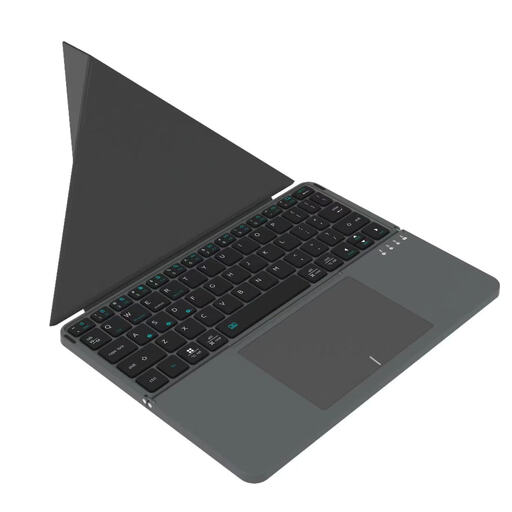
VoxorAI BOX1 Bluetooth Keyboard, Black
Consider this for a table you regularly clear after editing, or for typing with a computer, tablet or phone. Check the physical UK key placement, the keys your editing shortcuts require and whether its sound and typing position suit longer sessions.
View on Joybuy
Frequently asked questions
Is an external keyboard enough for long laptop editing sessions?
No: an external keyboard helps you separate typing height from screen height, but the rest of the setup still matters. For prolonged laptop use, the Health and Safety Executive advises a separate keyboard and mouse so the screen can be raised, with the keyboard just below elbow height and central to the display.
Should I look specifically for a UK-ISO keyboard?
Choose a UK or UK-ISO physical layout if familiar key positions matter to your editing accuracy. Confirm the selected variant: Keychron lists UK-ISO options separately, while ProtoArc labels its XK01 as a UK-layout model.
Does a foldable keyboard make sense for a kitchen table?
It can if you must put the keyboard away after each session, provided its open size and keys suit the work. ProtoArc lists the UK-layout XK01 at 386.39 mm wide when expanded, with a numeric keypad; compare that width with the space left for your laptop and mouse.
What if typing brings on persistent hand or wrist symptoms?
Do not rely on a keyboard purchase as treatment. The NHS advises seeing a GP if symptoms associated with repetitive strain injury do not go away or get worse. For work-related home use, the Health and Safety Executive also describes workstation-assessment duties that can apply to people using display-screen equipment daily for continuous periods of an hour or more.


