Quiet shared-space transcribers
If you edit beside other library users, key sound may matter more than extra controls. Look for a claim about the specific keyboard’s typing noise, rather than assuming that a small keyboard will be quiet.


For editing interview transcripts in a library, start with a compact keyboard whose manufacturer explicitly describes its keys as quiet, then check its layout and compatibility with your editing device. A covered, slim keyboard makes more sense when bag space is the main constraint; a programmable mechanical model suits shortcut-heavy work only if its particular switches are acceptable in a shared room. Apple’s Touch ID keyboard is an option for a compatible Apple-silicon Mac, not a substitute for cross-platform flexibility.
If you edit beside other library users, key sound may matter more than extra controls. Look for a claim about the specific keyboard’s typing noise, rather than assuming that a small keyboard will be quiet.
If playback, notes and editing move between devices, check support for each operating system and the number of devices the keyboard can switch between.
If you repeatedly use playback controls, speaker labels or formatting commands, programmable keys may be worth configuring. Check that the keyboard and your editing software support the shortcuts you intend to use.
For library transcript editing, settle your requirements for typing noise and carrying space before deciding whether device switching or programmable shortcuts justify a different layout.
| Concern | What to check | Who this matters to |
|---|---|---|
| Typing noise | Look for a quiet-key claim for the exact model; check the chosen switch if considering a mechanical keyboard. | I need to keep typing from distracting people nearby, even during a long transcript. Around 36% of consumers put low-disruption typing first. |
| Portability | Compare published dimensions and weight, whether a cover is included, and whether the layout retains keys you use often. | My keyboard has to fit alongside the device and interview materials I carry to the library. For around 29% of consumers, carrying space is the primary concern. |
| Device compatibility | Confirm operating-system support and the number of devices you need to switch between; check whether a cable is needed for your workflow. | I edit on one device but use another for playback or reference, so switching matters more to me than extra controls. Around 21% of consumers prioritise connecting their devices. |
| Editing shortcuts | List your repeated commands, then check whether remapping works with your device and software. | Repeated playback and formatting actions interrupt my typing, and I want keys I can assign to those commands. Shortcut control comes first for around 14% of consumers. |
Size and key profile do not establish how a keyboard will sound in a shared room. Logitech describes the Pebble Keys 2 K380s as having quiet keys, while Keychron’s description of acoustic foam on the separate K3 Version 3 does not establish a comparable sound level.
Check a quiet-key claim for the exact model you are considering. For a mechanical keyboard, confirm its switch variant and assess whether its typing sound suits your library.
A different key arrangement can disrupt familiar punctuation and shortcuts. Apple specifies that its Magic Keyboard with Touch ID requires a Mac with Apple silicon running macOS 15.1 or later.
Confirm the exact UK or British English variant where you need one, your operating system and any multi-device or wired-connection requirement before ordering.
Programmable keys help only when you can assign actions your transcript workflow actually repeats. Keychron says the K3 Max must be connected by cable to use its web configurator for remapping.
Write down the commands you use frequently, then check both the setup method and your software’s shortcut support.
Its Pebble Keys 2 K380s and Keys-To-Go 2 illustrate different compact Bluetooth approaches to editing on the move.
The K3 Max is relevant if a compact UK-ISO mechanical layout and programmable controls matter to your transcript workflow.
The British English Magic Keyboard with Touch ID is a compact option for a compatible Apple-silicon Mac.
These keyboards offer different layouts for a library editing setup, from full-size and split designs to 75% models. Check the particular keyboard’s typing sound, layout and carrying dimensions against your own requirements before choosing.
 No image available
Consider this UK-version keyboard if you want a full-size layout for editing. Its full-size format also makes carrying space an important check for library trips.
 No image available
The 75% layout is worth considering if you want fewer keys than a full-size board. The title specifies wired, Bluetooth and 2.4G modes and a QWERTY US layout; check whether that key placement and this model’s typing sound suit your library work.
 No image available
Consider its split layout and padded wrist rest if you expect to type at a library desk for extended periods. Check the space it occupies and how easily you can carry it before choosing it as a portable keyboard.
 No image available
This UK-labelled wireless model is an option if you are considering a reduced layout for transcript editing. Check its dimensions for your bag and assess its typing sound before relying on it in a quiet library.
 No image available
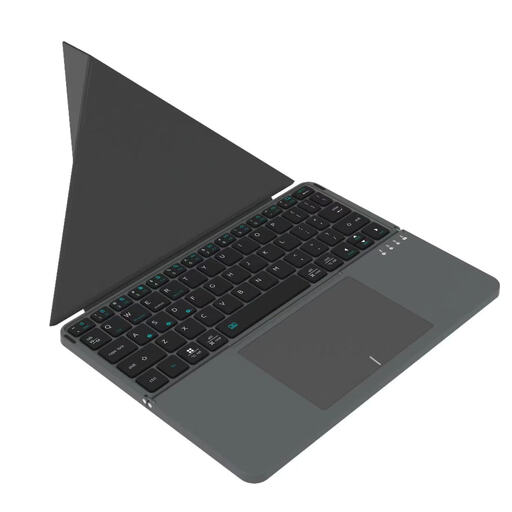
Consider this Bluetooth keyboard if your library setup uses a computer, laptop, iPad or smartphone. Confirm its key layout, device-switching behaviour and typing sound for the devices and transcripts you use.
A mechanical keyboard can suit shortcut-heavy editing if its particular switches and typing sound are acceptable in your library. Keychron lists remapping for the K3 Max, but its specifications do not establish a measured sound level; if disturbing others is your main concern, begin with a model explicitly described as having quiet keys.
Choose a UK layout if that is what you normally use for punctuation, symbols and shortcuts. Keychron identifies a UK-ISO K3 Max option, and Apple labels its cited Magic Keyboard British English; confirm the exact variant rather than relying on the product-family name.
For eligible UK online orders, GOV.UK says traders must tell customers they can cancel up to 14 days after delivery. Check the seller’s cancellation instructions, any applicable exceptions and return costs before ordering; remedies for faulty or misdescribed goods are separate from a change-of-mind cancellation.
Check an appropriate electrical-equipment collection or recycling route rather than putting the keyboard in ordinary waste. GOV.UK notes that battery-powered products can fall within electrical and electronic equipment guidance; your local authority or the seller can advise on available collection options.