
24/7 Customer Support

Free returns

Same-day & Next-day Delivery

Quality Guaranteed

Unlock Your Welcome Offers: FREE Delivery | Up to 80% OFF | Free 30-day JoyPlus trial
Download the APP
A portable mini fridge can keep drinks cold in a car, store food in a campervan or provide a private drinks cooler in a bedroom. However, choosing by capacity or low price alone can lead to disappointment. The most common problems are linked to cooling technology, power compatibility and misleading capacity claims.
This guide from the Joybuy Product Recommendation Officer explains which specifications matter, which features may not suit your needs and which options match different UK lifestyles.
A thermoelectric mini fridge generally cools to a stated number of degrees below the surrounding temperature. For example, a unit rated to cool 20°C below ambient may struggle to reach refrigerator temperatures in a warm vehicle or conservatory. These models usually cannot freeze food.
A portable compressor cooler works more like a conventional fridge and can offer a wider temperature range, including freezing. This makes it more suitable for meat, fish, frozen food and longer camping trips, although compressors can be heavier and may cost more.
A 12V car fridge needs a suitable DC socket and a reliable power supply. Some vehicle sockets switch off when the ignition is off, so the fridge may stop cooling while parked. Check your vehicle handbook and avoid leaving a powered cooler connected if it could drain the starter battery.
Useful features include three-stage battery protection, which allows the input level to be adjusted. For campervans, boats and motorhomes, also check whether the model supports 24V DC and whether your leisure battery has sufficient capacity.
Advertised capacity does not always show how much usable space is available. Shelves, cooling components and divided compartments can affect what fits inside. Before buying, compare the internal dimensions with the bottles, lunch boxes or food containers you intend to carry.
A 6-litre car cooler may suit drinks and snacks, while an 18-litre portable freezer offers more flexibility. Larger dual-zone models provide separate storage areas but require more room, ventilation and secure transport.
For occasional drinks and snacks, a compact car cooler and warmer may be sufficient. These models can often cool and heat, but warming performance is not the same as cooking or food-safe hot holding. Follow the product instructions and avoid storing perishable food for extended periods without confirming the internal temperature.
For camping, fishing or road trips where reliable low temperatures matter, look for a compressor model with a stated range such as -20°C to +20°C. A temperature display, ECO mode and adjustable settings make daily use easier.
An AC/DC portable fridge is more versatile than a DC-only unit. AC support allows use from a UK household socket, while 12V or 24V DC power suits cars, vans, lorries, boats and motorhomes.
Check the included cables carefully. Some compact fridges include both AC and DC adapters, while others require an additional mains adapter. Compressor models may also need a short cooling period after being moved before operation.
Do not place a compressor cooler tightly against a wall or inside an enclosed cupboard. The supplied product information for the EUHOMY models recommends approximately 100mm of clearance around the compressor ventilation area. Poor airflow can affect performance.
For vehicles, secure larger units with straps or another suitable restraint. Anti-shock construction can help during travel, but it does not replace secure positioning. Noise ratings around 40–42dB may be suitable for many bedrooms or sleeping areas, although perceived noise depends on the room and operating cycle.
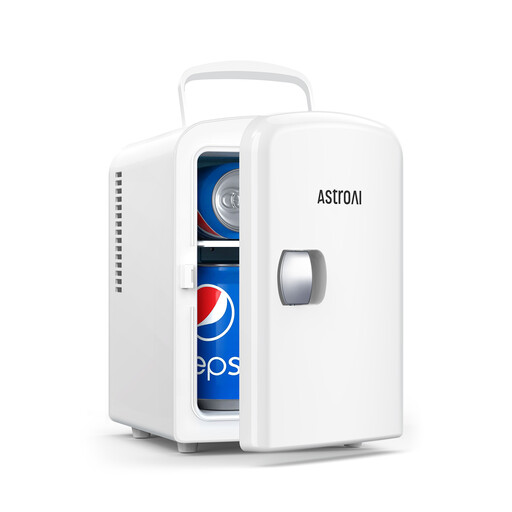
Why This Fits Their Persona: A compact choice for a student room, home office or occasional car journeys where drinks, snacks or skincare need separate storage.
Its listing clearly identifies thermoelectric cooling and states that it cannot freeze, avoiding confusion with a compressor freezer.
4-litre capacity, AC and DC cables, and cooling up to 20°C below ambient with warming up to 66°C.
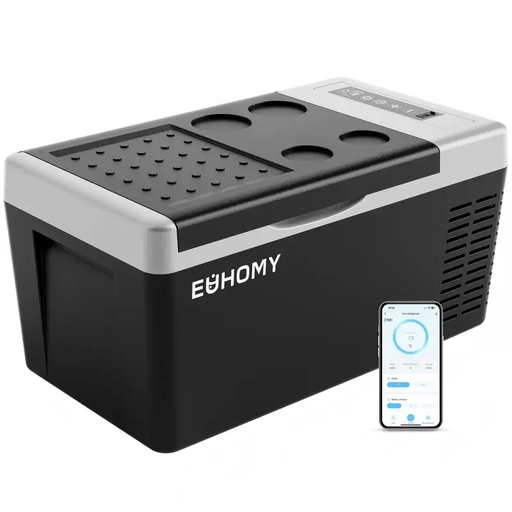
Why This Fits Their Persona: Suitable for couples, weekend campers and motorists wanting fridge and freezer functions in one portable unit.
The stated -20°C to +20°C range distinguishes it from cooling-chip models that cannot freeze.
18-litre capacity, 12/24V DC and 100–240V AC compatibility, app control and three-stage battery protection.
Why This Fits Their Persona: Designed for larger households, motorhome owners, boat users and extended trips requiring substantial chilled or frozen storage.
Its dual-zone layout and compressor temperature setting provide more control than a basic electric cool box.
49.4-litre capacity, 12/24V and 240V operation, LCD controls, Bluetooth app connection and battery protection.

Why This Fits Their Persona: A small footprint suits bedrooms, offices and personal drink or skincare storage where freezer performance is unnecessary.
The listing specifies cooling-chip technology, a minimum stated temperature and that it cannot freeze.
AC/DC operation, up to 66°C warming, compact dimensions and a stated noise level of approximately 40dB.
We have compiled a complete, real-time list of products that fully satisfy these strict selection criteria and UK safety regulations.
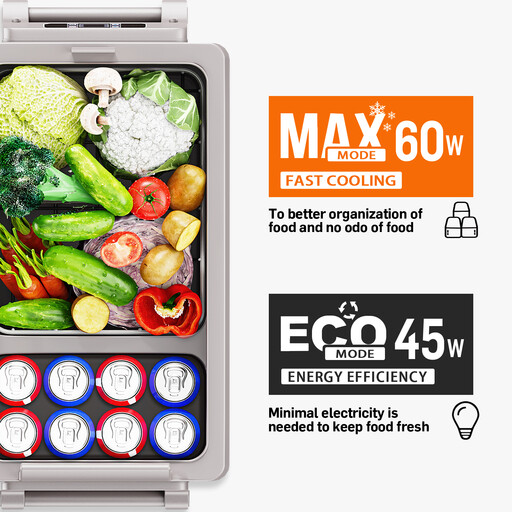
Running cost depends on wattage, usage time, ambient temperature and electricity or battery pricing. The EUHOMY 18-litre model lists consumption of approximately 45W, but actual energy use varies because the compressor cycles rather than operating continuously. Thermoelectric models also need continuous power while cooling, so compare the stated input and expected daily usage.
Only if the vehicle, leisure battery or power station is designed for continuous use. Confirm whether the accessory socket remains live when the ignition is off, select an appropriate battery-protection setting and monitor the battery level. For a standard car battery, disconnecting the fridge when parked is a sensible precaution.
Yes, provided the model has suitable ventilation and its noise level is acceptable for you. A compact thermoelectric mini fridge may be convenient for drinks or skincare, while a compressor model offers lower-temperature storage. Keep the unit on a stable, level surface with space around its ventilation area, and use a UK-compatible household supply when operating from mains power.