
24/7 Customer Support

Free returns

Same-day & Next-day Delivery

Quality Guaranteed

Unlock Your Welcome Offers: FREE Delivery | Up to 80% OFF | Free 30-day JoyPlus trial
Download the APP
By Joybuy Product Recommendation Officer
A portable mini fridge can be useful in a bedroom, home office, student accommodation, car, campervan or tent. However, compact cooling products are not interchangeable. A 4-litre thermoelectric cooler will not perform like a compressor freezer, while a large dual-zone unit may be unnecessary for keeping a few drinks beside your desk.
Before buying, look beyond capacity and promotional phrases such as “fast cooling” or “energy saving”. The cooling method, power connection, ventilation and intended environment have a greater effect on everyday usability.
Many small personal fridges use thermoelectric cooling. Their performance is usually described as cooling a certain number of degrees below the surrounding temperature. If a room is 25°C and the appliance cools by 18°C, the theoretical internal temperature is around 7°C, but actual results depend on ventilation, contents and how often the door is opened.
This is different from a compressor appliance, which normally allows a selected temperature range and may operate below 0°C. Check whether you need a thermoelectric cooler and warmer for drinks and skincare, or a compressor system for frozen food.
A 12V car fridge draws power from the vehicle, but the socket may only work while the ignition is on. Leaving a unit connected for long periods can reduce battery charge. Battery-protection settings are useful, but they do not remove the need to follow the vehicle and appliance instructions.
For a portable car fridge, check whether it supports 12V and 24V DC, whether an AC adaptor is included and whether the unit should be secured during travel.
Advertised litres do not always indicate how many bottles, cans or lunch boxes will fit. Shelves, compressor compartments and internal contours reduce usable room. Also measure your intended location, including door clearance and space around ventilation openings.
A large mini fridge for bedroom use may be awkward beside a bed, while a small 4-litre model may be inadequate for a family road trip.
For skincare, drinks and snacks, a skincare fridge or small personal cooler may be sufficient. For meat, frozen food or extended outdoor trips, consider compressor cooling instead.
For UK home use, confirm that the product includes a suitable 220–240V AC connection or adaptor. For travel, look for 12V DC compatibility; 24V support is useful in lorries, buses and some larger recreational vehicles.
Energy labels also provide a basis for comparison. For example, the EUHOMY 49.4-litre model is listed as Energy Class C, while the 18-litre model is listed as Energy Class D. Actual running costs depend on temperature settings, ambient conditions, usage and electricity tariffs.
Noise ratings around 25–42 dB are quoted for several compact models, but perceived noise depends on the room and surface. A compressor may produce an occasional operating sound, while fan-based thermoelectric models can run continuously.
Leave the manufacturer-specified clearance around vents. The EUHOMY 49.4L model specifies 100 mm around the compressor ventilation area, while the 18L model specifies 10 cm. Keep vents unobstructed, place the appliance on a stable surface and secure it in a vehicle using an appropriate restraint where advised.
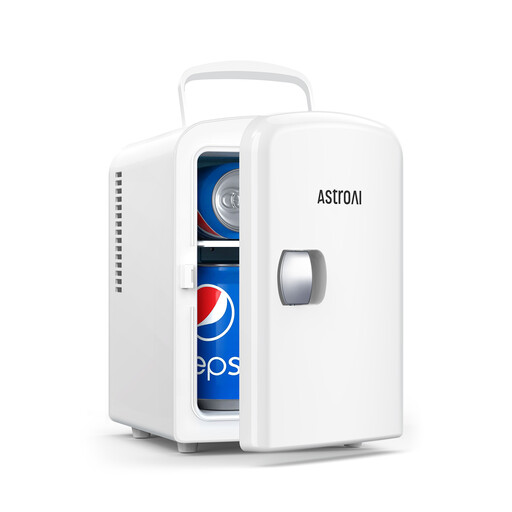
Why This Fits Their Persona: A compact option for a bedroom, desk, office or occasional car journey where a few cans, snacks or skincare items are enough.
Its specification states that it uses thermoelectric cooling and cannot freeze, making the performance limitation clear before purchase.
4-litre capacity, 220–240V AC and 12V DC cables, cooling up to 20°C below ambient and warming up to 66°C.
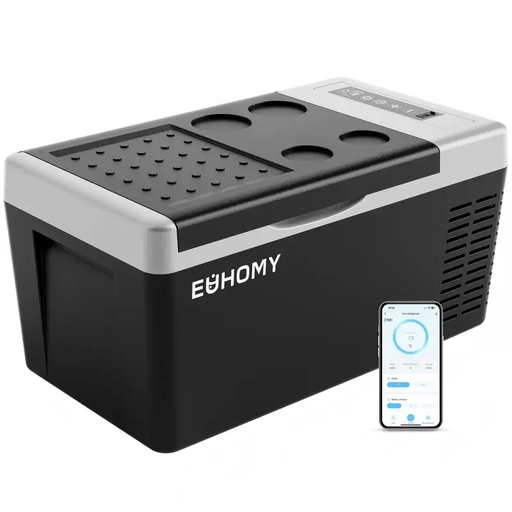
Why This Fits Their Persona: Suitable for UK road trips, caravanning, boating and camping when controlled cooling or freezing is more important than the smallest footprint.
The compressor design and stated -20°C to +20°C range distinguish it from a cooler that only reduces temperature relative to the room.
18-litre capacity, 12/24V DC and 100–240V AC compatibility, app control and three-stage battery protection.
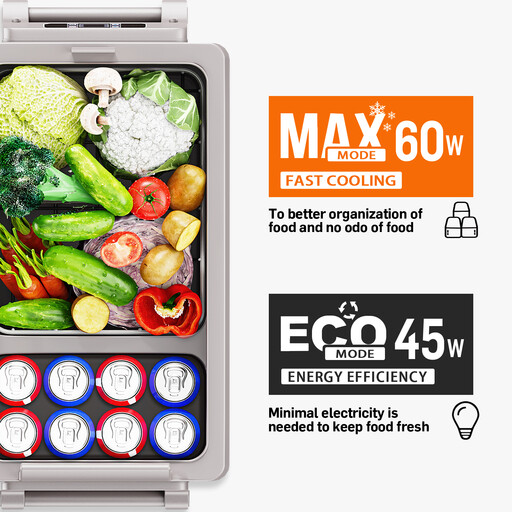
Why This Fits Their Persona: Designed for longer trips, larger groups, motorhomes, lorries, boats and outdoor use where separate storage areas and higher capacity are useful.
The dual storage areas help separate different foods, while the stated 100 mm ventilation clearance addresses the risk of obstructed heat dissipation.
49.4-litre capacity, two zones, -20°C to +20°C temperature setting, 12/24V DC and 240V AC power, plus Bluetooth control.

Why This Fits Their Persona: A practical match for drivers, anglers, campers and boat owners who need an ice-free fridge freezer in a compact vehicle-friendly format.
Its compressor specification, stated -20°C minimum and three-level battery protection make its intended travel use clearer than a basic cooling box.
9-litre capacity, 12V operation, temperature memory, shock-resistant design and operation on slopes up to 45° as specified.
We have compiled a complete, real-time list of products that fully satisfy these strict selection criteria and UK safety regulations.
Running cost depends on wattage, electricity price, ambient temperature and usage time. A thermoelectric model may run continuously to maintain cooling, while a compressor model cycles on and off. Check the product’s stated power consumption and energy label where available, then compare this with your tariff.
Only if the vehicle socket, battery and appliance instructions allow it. Use the built-in battery-protection setting where provided, keep ventilation clear and disconnect the unit during extended parking unless you have a suitable auxiliary power source.
Yes, a compact skincare fridge can store suitable cosmetics and personal-care items, provided the product instructions permit it. A thermoelectric model is generally intended for cooling rather than freezing. Keep products sealed, avoid overfilling and follow the storage guidance supplied with each cosmetic item.