
24/7 Customer Support

Free returns

Same-day & Next-day Delivery

Quality Guaranteed

Unlock Your Welcome Offers: FREE Delivery | Up to 80% OFF | Free 30-day JoyPlus trial
Download the APP
A portable mini fridge can make motorway journeys, camping weekends and small bedrooms more convenient. However, the phrase covers very different appliances. A compact thermoelectric cooler may be suitable for drinks and skincare, while a compressor model can operate at freezer temperatures. Choosing by appearance or can capacity alone can lead to disappointing cooling, unexpected power issues and limited everyday usefulness.
Many small cooler and warmer units advertise cooling by 16–22°C below the surrounding temperature. This is a temperature difference, not a fixed internal temperature. If your car reaches 30°C in summer, the contents may remain considerably warmer than 8°C.
Thermoelectric models are generally designed for drinks, snacks and personal-care products. They normally cannot freeze items. A compressor cooler box, by contrast, uses a compressor system and can offer a set temperature such as -20°C to +20°C, depending on the model.
A 12V car fridge draws power while connected. Battery-protection settings can help reduce the risk of excessive discharge, but they do not replace sensible use. Check whether your vehicle socket remains live when the ignition is off, and disconnect the unit during long stops unless you have a suitable leisure battery or power station.
Also check the cable length, fuse requirements and the vehicle’s accessory-socket rating. A mini fridge for car use should sit securely, with ventilation openings kept clear.
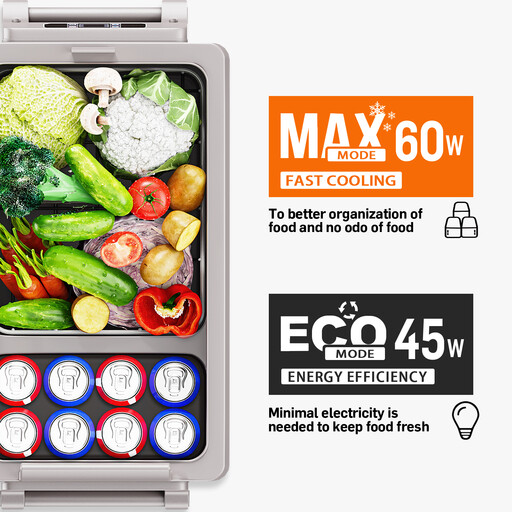
A product may hold six or eight cans, but removable shelves, bottle shapes and internal walls affect usable space. Compressor units also need clearance around the ventilation area. For example, the EUHOMY 18L model specifies approximately 10cm of clearance around its compressor area.
Never push a powered cooler tightly against a car seat, wall or cupboard. Restricted airflow can reduce performance and increase running demands. For food use, follow the appliance instructions and avoid treating a portable cooler as a substitute for a properly installed household refrigerator.
A 4–6L skincare fridge or personal cooler may fit several cans, serums or snacks while maintaining a small footprint. An 18L travel fridge gives more room for food and drinks without approaching the footprint of a large under-counter appliance. Units around 49L are more appropriate for caravans, boats, extended camping or group trips, but need stronger vehicle storage and secure fixing.
Measure the intended location, including lid-opening space. For vehicles, confirm that the unit can be restrained during braking and turning. Handles, shoulder straps, cup holders and non-slip feet can make a noticeable difference when moving between a tent, car and campsite.
An AC/DC portable fridge is more flexible than a DC-only model. Look for compatibility with UK mains electricity, normally 220–240V AC, as well as 12V vehicle power. Some larger units also support 24V systems used in certain trucks, buses and recreational vehicles.
Energy labels may help compare applicable compressor models, but actual consumption varies with ambient temperature, set temperature, ventilation and how often the lid is opened. Noise figures are also worth checking if the unit will be used in a bedroom or sleeping area. A stated 40–42dB operating level is quieter than many larger appliances, but perceived noise depends on the room and surface.
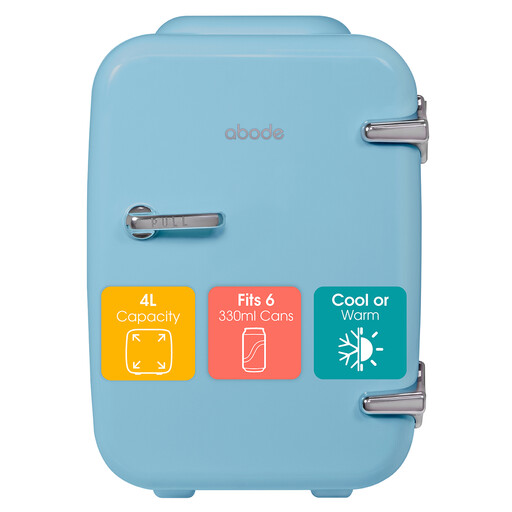
Why This Fits Their Persona: A practical choice for students, office users and occasional travellers who need a small cooler without compressor-style capacity.
Its stated cooling performance is given as 16–20°C below ambient, making the thermoelectric limitation clear rather than implying freezer operation.
4L capacity, 2kg weight, carry handle, 230V AC and 12V DC operation, plus warming from 50°C to 65°C.
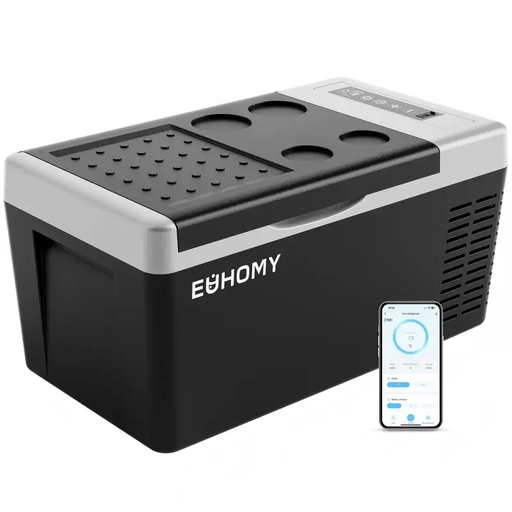
Why This Fits Their Persona: Suitable for caravanners, campers, boat owners and drivers wanting set-temperature cooling in a relatively compact format.
It uses compressor cooling with a stated -20°C to +20°C range, rather than relying only on an ambient-temperature reduction.
18L capacity, 12/24V DC and 100–240V AC compatibility, three-stage battery protection, app control and stated noise of 42dB.
Why This Fits Their Persona: Designed around higher-volume storage for extended camping, motorhome trips, fishing, boating and shared travel.
Its larger body should be secured with ratchet straps or bungee cords, while the stated ventilation clearance helps buyers plan installation properly.
49.4L dual storage areas, -20°C to +20°C temperature setting, 12/24V DC and 240V AC power, LCD controls and Bluetooth app connection.

Why This Fits Their Persona: A small footprint suits desks, bedrooms, university accommodation and car journeys where portability matters more than freezing.
The listing states that its cooling chip is not a compressor and cannot freeze, so expectations are clearer for drinks and skincare storage.
6L capacity, up to eight cans in the stated configuration, 220–240V AC and 12V DC power, plus cooling and warming modes.
We have compiled a complete, real-time list of products that fully satisfy these strict selection criteria and UK safety regulations.
Only if the vehicle’s power system is suitable and the socket remains powered. A standard starter battery may discharge if the fridge runs for many hours. Battery protection can reduce the risk but cannot guarantee that the vehicle will start afterwards. A leisure battery or portable power station is more appropriate for extended use.
Running cost depends on wattage, operating time, ambient temperature and electricity or battery prices. Thermoelectric units may use modest power but often need continuous operation. Compressor models cycle on and off once the target temperature is reached, although their total consumption varies by conditions. Check the product’s stated wattage and energy information rather than judging by capacity alone.
Lifespan depends on ventilation, transport, cleaning, power stability and frequency of use. Avoid blocking vents, protect the unit from excessive moisture and follow the manufacturer’s instructions. Compressor models contain moving components, while thermoelectric units use a solid-state cooling module but still rely on fans and electrical connections. A clear warranty and accessible support are useful considerations before purchase.