
24/7 Customer Support

Free returns

Same-day & Next-day Delivery

Quality Guaranteed

Unlock Your Welcome Offers: FREE Delivery | Up to 80% OFF | Free 30-day JoyPlus trial
Download the APP
A portable mini fridge cooler and warmer can be useful in a bedroom, home office, car, tent or caravan. However, product listings often make compact appliances sound more capable than they are. A small thermoelectric unit may keep drinks cooler than the surrounding room, but it is not necessarily a freezer. A car fridge may work from a 12V socket, but that does not mean it should run continuously with the engine switched off.
Before buying, check the cooling method, power requirements, internal capacity and ventilation space. These details have more impact on daily usefulness than appearance or a long list of accessories.
Many small AC/DC mini fridges, skincare fridges and thermoelectric cooler and warmer units state that they cool to a certain number of degrees below ambient temperature. This is a relative figure, not a guaranteed internal temperature.
For example, a unit offering cooling of 16°C–20°C below ambient may perform differently in a warm bedroom, a parked car or a shaded campsite. Thermoelectric models generally cannot freeze food or make ice. They are more suitable for drinks, snacks, cosmetics and short-term storage.
If you need frozen food, meat or longer-term chilled storage, look for a compressor cooler box or portable refrigerator freezer with a stated temperature range below 0°C.
Some 12V car coolers include a vehicle cable but require a separate AC adapter for household use. This can add cost and make the appliance less convenient for a bedroom, student accommodation or home office.
Check whether the box includes both 230V AC and 12V DC cables, or whether one is sold separately. Also confirm that the car socket remains powered when the ignition is off if you need cooling while parked. Otherwise, continuous use may drain the vehicle battery.
A stated capacity such as six or eight cans does not show how easily larger bottles, lunch boxes or skincare containers will fit. Shelves, door baskets and internal corners reduce usable space.
Measure the items you plan to store and compare them with the internal dimensions. A 4L or 5L mini drinks fridge may suit a desk, but a family picnic or caravan trip may require an 18L or 49.4L compressor model.
Thermoelectric cooling is compact, relatively straightforward and commonly found in portable mini fridges for bedrooms, offices and cars. It cools in relation to ambient temperature and often includes a warming mode. These units are usually suitable for drinks, snacks, beauty products and short journeys.
A compressor cooler box actively controls the internal temperature and can generally cool below freezing. Compressor models are more appropriate for camping, boating, caravanning and storing perishable food. They can be heavier and may produce a low operating hum, so check the stated noise level if the appliance will sit beside a bed.
For UK household use, look for compatibility with 220–240V AC outlets. For vehicles, check for 12V DC compatibility; larger units may also support 24V systems used in some lorries or buses.
Use the supplied cable and keep the ventilation area clear. A vehicle-mounted unit should be secured with a seat belt, straps or another suitable restraint so it cannot slide during braking or cornering. Never obstruct cooling vents or place the appliance in direct sunlight for prolonged periods.
A compact mini fridge for bedroom use should leave adequate space around its vents and door. Compare external dimensions with your desk, bedside table, boot or passenger seat. A carry handle, shoulder strap and non-slip feet can make a noticeable difference when moving between a car, tent and accommodation.
Noise figures are useful but should be treated as guide values because sound can vary by setting and environment. Models listed at approximately 40–42 dB may be more suitable for overnight use than louder appliances, although a compressor starting cycle can sound different from a small fan.
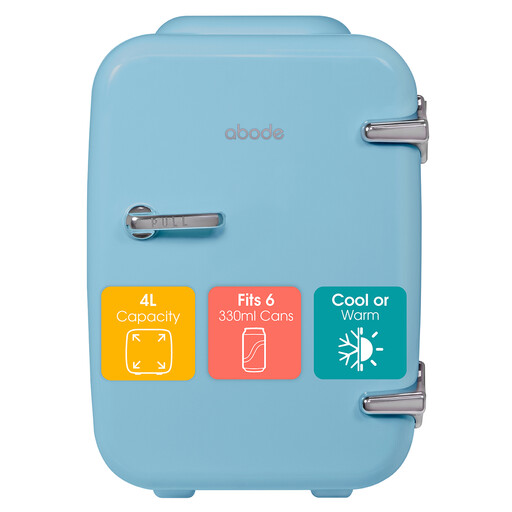
Why This Fits Their Persona: A compact option for a desk, bedroom, university room or occasional road trip, with a 2 kg carry weight and both AC and 12V power included.
Its stated cooling performance is given as 16°C–20°C below ambient, making the thermoelectric limitation clear rather than implying freezer performance.
4L capacity; cooling and warming modes; 230V AC and 12V DC cables supplied.
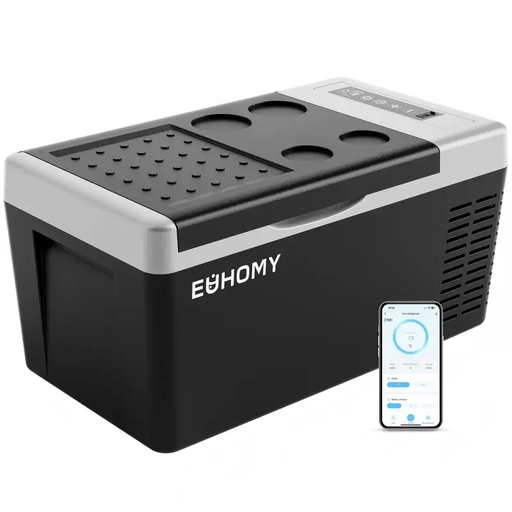
Why This Fits Their Persona: Suitable for shoppers who need controlled cooling for camping, boating, caravanning, travel or household backup rather than a small personal cooler.
Its compressor system and stated range of -20°C to +20°C distinguish it from thermoelectric boxes that cannot freeze.
18L capacity; 12V/24V DC and 100–240V AC operation; three-stage battery protection; app control.
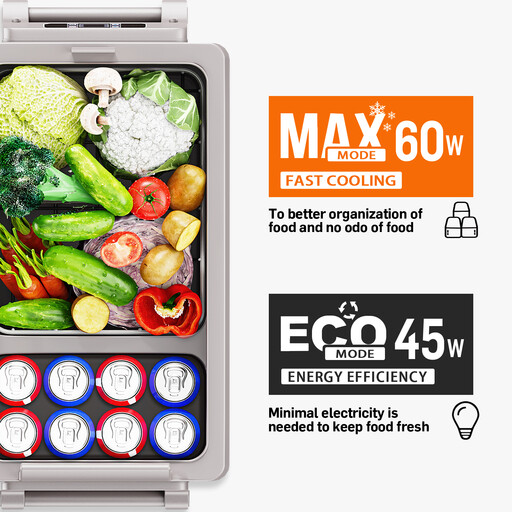
Why This Fits Their Persona: Designed for larger groups, motorhome trips, fishing, boating and extended outdoor use where a personal travel cooler box would be too restrictive.
The dual storage area and compressor design provide more practical separation and temperature control than a small warm-and-cool box.
49.4L capacity; two storage zones; 12/24V DC and 240V AC compatibility; temperature setting from -20°C to +20°C.
We have compiled a complete, real-time list of products that fully satisfy these strict selection criteria and UK safety regulations.
Yes, a small thermoelectric model can suit drinks, snacks, skincare products or toiletries. Check its dimensions and stated noise level, and leave the required ventilation space. It should not be treated as a replacement for a full food refrigerator unless the manufacturer specifies suitable food-storage use.
It depends on the vehicle socket and power system. Some sockets switch off with the ignition, while others remain live. Check the vehicle handbook and monitor battery use. A model with battery-protection settings can help, but it does not remove the need for responsible power management.
Running cost depends on the selected temperature, ambient heat, insulation, ventilation and electricity tariff. Compressor units may offer more controlled cooling than thermoelectric models, but their energy use varies by operating cycle. Compare the stated wattage, energy information and intended usage rather than relying on capacity alone.