
24/7 Customer Support

Free returns

Same-day & Next-day Delivery

Quality Guaranteed

Unlock Your Welcome Offers: FREE Delivery | Up to 80% OFF | Free 30-day JoyPlus trial
Download the APP
A portable mini fridge can be useful beside a bed, under an office desk, in a student room or inside a car. However, compact cooling products are often marketed with large capacity claims and vague temperature promises. Choosing by appearance alone can leave you with a unit that is too small, too warm, noisy or unsuitable for your power supply.
Joybuy’s Product Recommendation Officer has filtered the practical details that matter most, including capacity, cooling technology, power options and everyday placement.
A product described as a 4 litre mini fridge may not hold four litres of drinks in a convenient arrangement. Internal walls, shelves, cooling components and the door shape reduce usable room. Check the internal dimensions and the stated can or bottle capacity before ordering.
For example, a unit that holds six 330 ml cans may work well as a drinks mini fridge, but it may not accommodate tall bottles, food containers or larger skincare packaging without removing a shelf.
Many compact models are thermoelectric mini fridges, using a cooling chip rather than a compressor and refrigerant. Their temperature is generally described as a reduction below the surrounding temperature, not a fixed refrigerator temperature.
This means performance varies with room or vehicle temperature. A unit rated to cool up to 20°C below ambient temperature may feel substantially cooler in a bedroom than inside a hot car. These models cannot freeze items, and they require continuous power to maintain cooling.
An AC/DC mini fridge is more flexible, but check precisely what is supplied. AC power is intended for a compatible household socket, while DC power usually connects to a 12V vehicle socket. Confirm the voltage, cable type and plug arrangement before use.
For UK households, also check the supplied mains plug or whether a suitable UK adaptor is required. Do not use a damaged cable, overloaded adaptor or unsuitable extension lead. Products with an electrical safety listing, such as ETL Listed models, should still be used according to the supplied instructions and voltage requirements.
A small 4 litre mini fridge is suited to a few cans, snacks, toiletries or selected beauty products. A 6 litre mini fridge offers more flexibility for drinks and larger containers, but it will also need a little more space on a desk, beside the bed or in a vehicle.
Measure both the available surface and the door-opening clearance. Pay attention to internal dimensions rather than relying solely on the external litre figure. For a mini fridge for bedroom or office use, leave space around the ventilation area and avoid placing it directly against a wall or inside an enclosed cabinet.
Look for a clear temperature specification. “Cools quickly” is less useful than a stated figure such as “up to 20°C below ambient”. Remember that this is not the same as maintaining a chosen temperature regardless of weather.
A mini cooler and warmer can be useful for keeping drinks or snacks warm, but warming temperatures may reach around 65–66°C. This does not mean every item is suitable for heating. Follow the product instructions and check packaging guidance for food, cosmetics and other contents.
Thermoelectric units often draw power continuously while cooling, so running cost depends on the model’s wattage, how long it operates and your electricity tariff. Product descriptions that do not provide energy consumption should not be used to estimate an exact monthly cost.
For a mini fridge for office, bedroom or dormitory, consider fan noise and vibration. In a car, make sure the vehicle socket and fuse can support the appliance. Some models advise using the DC cable only while the engine is running, helping to reduce the chance of draining the vehicle battery.
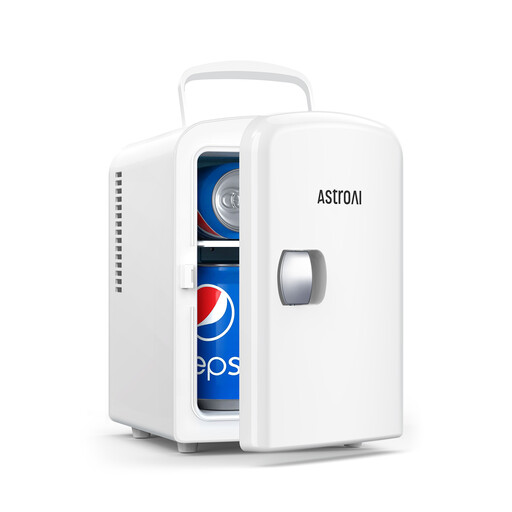
Why This Fits Their Persona: Its compact footprint suits a student room, worktop or bedside table, while the 4-litre interior is sized for up to six 330 ml cans.
The listing states its internal and external dimensions, cooling limit and inability to freeze, avoiding an unclear temperature promise.
AC and 12V DC cables are included; the unit can cool up to 20°C below ambient and warm contents up to 66°C.
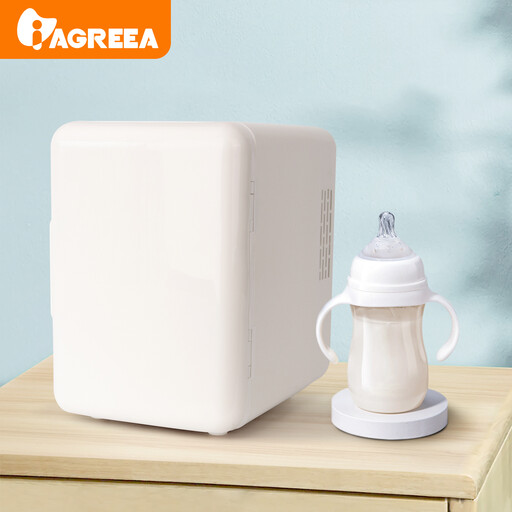
Why This Fits Their Persona: The 4-litre personal fridge is designed for desks, vanities, bedside tables and other settings with a small footprint where visibility and organisation matter.
The specification states a cooling range of 8–10°C below ambient, manual cool/heat/off control and a noise level below 25 dB.
It includes an internal LED light, reversible door hinge, AC adaptor and a stated one-year manufacturer warranty.

Why This Fits Their Persona: The larger 6-litre layout suits drivers, travellers and users who need room for more drinks, snacks or skincare containers.
The product information separates external and internal dimensions and explains that the thermoelectric system cannot freeze.
It can hold up to eight 330 ml cans, or four 550 ml bottles with the shelf removed, and includes AC and 12V DC power options.
We have compiled a complete, real-time list of products that fully satisfy these strict selection criteria and UK safety regulations.
Yes, provided it has enough ventilation and an acceptable noise level for your room. Check the stated dB figure where available. A thermoelectric model may run continuously, so consider both fan noise and electricity use before placing it beside the bed.
Many AC/DC models can run from a 12V vehicle socket using the supplied DC cable. Use the correct cable, check the fuse and follow the manufacturer’s guidance on engine operation. Avoid leaving the appliance running for extended periods if it could discharge the vehicle battery.
There is no single figure for every model. Running cost depends on wattage, operating time, ambient temperature and your electricity tariff. Check the product specification for power consumption, then use: watts ÷ 1,000 × hours used × your tariff per kWh. Thermoelectric products may consume power continuously while cooling, even when the interior has reached a comfortable temperature.