
24/7 Customer Support

Free returns

Same-day & Next-day Delivery

Quality Guaranteed

Unlock Your Welcome Offers: FREE Delivery | Up to 80% OFF | Free 30-day JoyPlus trial
Download the APP
By Joybuy Product Recommendation Officer
A portable neck fan can make commuting, travelling, working or attending an outdoor event more comfortable without needing to hold a device. However, not every wearable fan delivers a practical balance of airflow, battery life, comfort and noise.
The most expensive-looking model is not automatically the right choice. Before buying, UK shoppers should look beyond phrases such as “powerful cooling” and check the specifications that affect everyday use.
Rechargeable neck fan listings often show the longest possible runtime, usually measured at the lowest wind setting. Higher airflow can consume considerably more power. For example, a model advertised with up to 16.5 hours may provide a shorter operating period at its highest setting.
Always check whether runtime varies by speed, whether the battery can be used while charging and how long a full recharge takes.
A strong airflow can be useful outdoors, but a loud motor may become distracting in an office, on public transport or during a conversation. “Quiet” should not be treated as a universal performance guarantee unless the listing provides a measurable decibel figure.
Look for a quiet neck fan with several speed settings, allowing you to use a lower setting indoors and increase airflow outside.
A bladeless neck fan removes exposed rotating blades, which can reduce concerns about hair becoming caught in a visible fan grille. It still contains a motor, battery and electrical components. Do not immerse it in water, use it if the casing or cable is damaged, or modify the internal structure.
For UK use, check that the product includes clear instructions, suitable charging information and responsible-person details where applicable. Keep lithium-battery devices away from excessive heat and stop using one if it becomes unusually hot, swells or develops an odour.
Battery capacity is commonly shown in mAh, but this figure alone does not tell you how long a fan will run. Motor efficiency, airflow level and operating conditions also matter.
A useful checklist for a rechargeable neck fan includes:
The JISULIFE Portable Neck Fan Life 4 lists a 5000mAh lithium-ion battery, a 3–4-hour charging time and an operating range of 2.5–16.5 hours, depending on the selected gear and use scenario. Its USB-C charging connection can be convenient for travellers carrying compatible cables and power banks.
A neck fan with multiple speeds gives you more control than a single-output model. Lower airflow may be more appropriate in a shared office, while a higher setting can be useful during outdoor activities.
Also check how air is distributed. Openings on both sides can direct airflow towards the face and neck, while a poorly positioned outlet may cool one area unevenly. Manual controls and a readable display can be useful when adjusting the fan without removing it.
A wearable fan rests on your neck for extended periods, so weight and shape matter. A flexible or ergonomic neck brace may be more comfortable than a rigid frame, but fit remains personal.
Consider where you will use it:
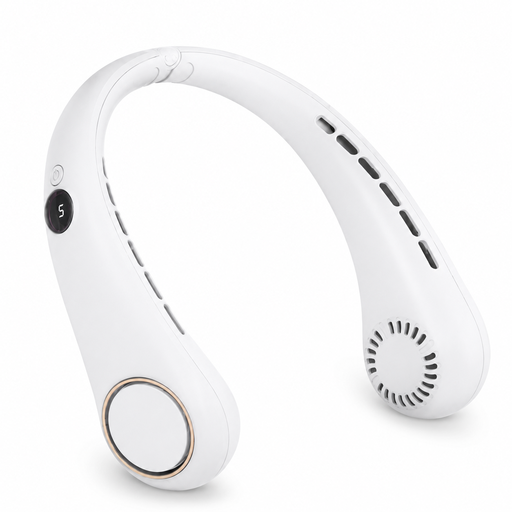
Why This Fits Their Persona: A straightforward option for commuters, office workers and shoppers trying a wearable fan for the first time. It provides three selectable wind speeds and a visible LED display without a complicated control system.
The three-speed control helps avoid relying on one fixed airflow level, while the LED display makes the selected setting easier to check.
Hands-free wearable format; three manual wind speeds; compact design for work, travel and outdoor use.
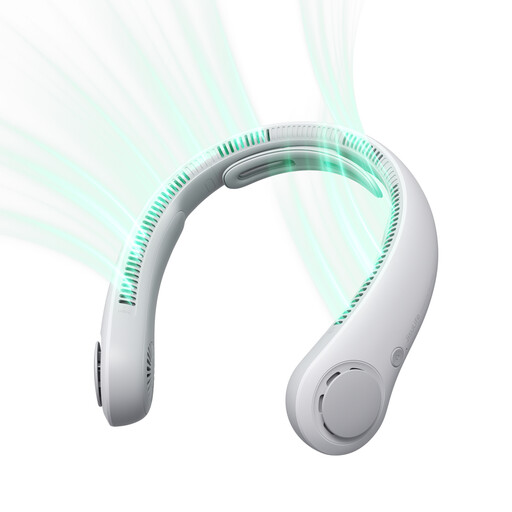
Why This Fits Their Persona: Suitable for shoppers who want a more adjustable personal cooling fan for travel, festivals, outdoor work or indoor use. Its neck-support design and five speed settings offer more control over daily use.
The listing specifies speed-dependent runtime rather than presenting one figure as universal. Its bladeless construction also avoids exposed rotating blades, although normal battery and heat precautions still apply.
5000mAh battery; five speeds; USB-C charging; approximately 282g; stated 2.5–16.5-hour operating range.
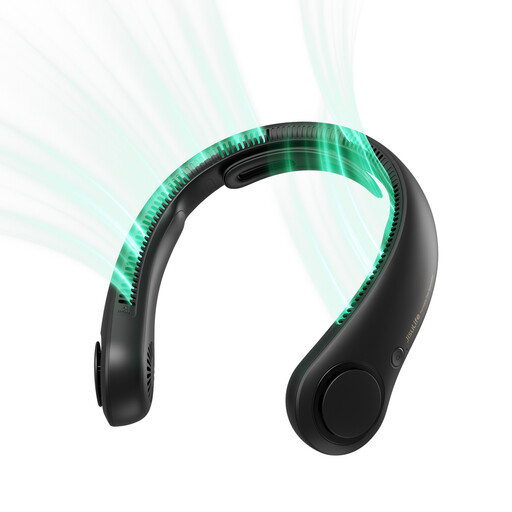
Why This Fits Their Persona: A practical match for longer outdoor shifts, walking routes, gym sessions and events where access to a mains socket may be limited. The black finish may also suit users seeking a less noticeable wearable device.
Five settings allow the airflow to be reduced indoors or increased outside. The stated runtime range makes it easier to plan around speed and charging needs.
Hands-free neck brace format; two air inlets and multiple outlets; USB-C charging; can be used while charging according to the listing.
We have compiled a complete, real-time list of products that fully satisfy these strict selection criteria and UK safety regulations.
Charge the fan using the supplied or compatible cable, then place it around your neck with the airflow outlets facing towards your face and neck. Begin on the lowest speed and increase it gradually. Keep the air inlets clear of clothing and hair, and follow the manufacturer’s instructions for cleaning and charging.
Battery lifespan depends on charging habits, storage temperature, usage frequency and the battery cell itself. Day-to-day operating time depends on the selected speed. Avoid leaving a lithium-ion fan in direct sunlight, near heaters or inside a hot car, and stop using it if the battery shows signs of swelling or damage.
A rechargeable neck fan generally uses a small amount of electricity compared with larger household cooling appliances, but the exact cost depends on battery capacity, charging frequency and your electricity tariff. The JISULIFE Life 4 lists an 18.5Wh battery; multiplying the energy used for each recharge by your tariff provides a more realistic estimate than relying on a general running-cost claim.