
24/7 全天候客户支持

免费退货

当日/次日达

品质保障

开启新人专享福利: 全场免邮 | 低至 2 折 | 免费试用 30 天 JoyPlus 会员
下载 Joybuy
A portable pill organiser can make medication, vitamins and supplements easier to arrange at home, work or while travelling around the UK. However, attractive packaging and broad claims do not always reveal whether a pill box will suit your routine.
The main buying mistakes usually come from three areas:
The right choice depends on how often you take medication, how much you carry and how easily you can open each compartment.
Start by counting the number of doses needed each day. A daily pill box with one or four compartments may be enough for a straightforward routine, while a weekly pill organiser is more suitable when you want to prepare several days in advance.
Common formats include:
Check that the labels correspond with how the organiser will actually be used. A weekly organiser with only one section per day may not provide enough separation for multiple daily doses.
Capacity is more important than the overall size shown in a product photo. Fish oil, large vitamins and irregularly shaped tablets can take up considerably more room than standard tablets.
Look for:
A large-capacity pill dispenser can be helpful for supplements, but it may be less discreet or less convenient for a small handbag. Conversely, a mini case may be portable but unsuitable for several bulky capsules.
If material information matters to you, look for a clearly stated BPA-free pill container made from plastic such as polypropylene. Some products specify food-grade or medical-grade plastic, but this describes the stated material rather than confirming that the organiser is suitable for every medication.
An airtight pill organiser with a silicone sealing ring may provide a closer closure than a basic snap lid. Even so, keep medicines away from heat, direct sunlight and damp areas. Do not store liquid medication in a compartment designed for tablets or capsules unless the product instructions specifically allow it.
The closure should also suit the user. Push-button or ergonomic lids may be easier for people with arthritis or limited hand mobility, while very small snap tabs can be difficult to operate repeatedly.
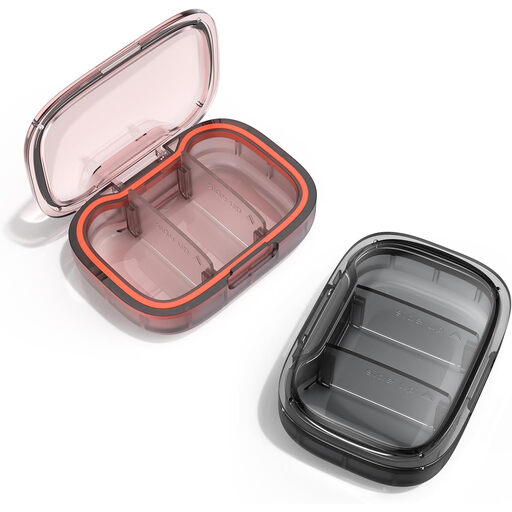
Why This Fits Their Persona: A pack of two gives a simple way to keep one case at home and another in a work bag, handbag or overnight luggage.
The three-compartment layout is more informative than an unlabelled container, while the compact format avoids buying a bulky weekly case for occasional use.
Two cases are included; the product is described as moisture-proof and suitable for vitamins, fish oil and supplements.
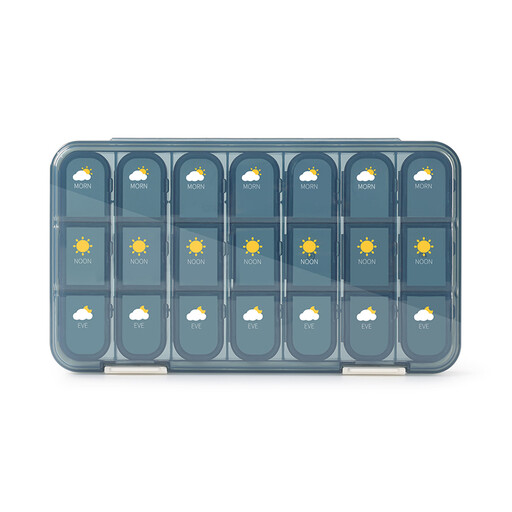
Why This Fits Their Persona: This format suits users who prepare a full week in advance and want separate daily boxes that can be carried individually.
The 21-compartment design separates three daily periods across seven days, reducing confusion caused by a single undivided daily space.
It has seven removable daily compartments, a snap-lock lid and a silicone sealing ring described for airtight storage.
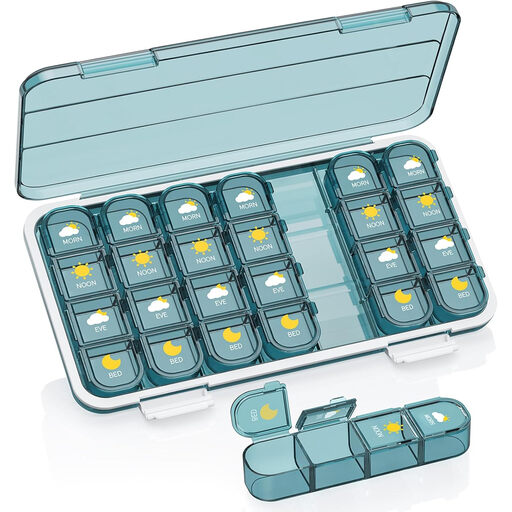
Why This Fits Their Persona: Users with several daily doses or a wide range of supplements may benefit from four separate sections for each day.
Four daily divisions avoid forcing multiple dosing times into one compartment, a common source of mix-ups.
The organiser covers seven days and is designed for vitamins, fish oils and supplements as well as daily medication.
We have compiled a complete, real-time list of products that fully satisfy these strict selection criteria and UK safety regulations.
It can be convenient for short trips, commuting and overnight stays. For prescription medicines, check the advice from your pharmacist and carry the original packaging or prescription information where appropriate. Choose a secure travel pill case with clear compartments and avoid leaving it in a hot car or direct sunlight.
There is no universal lifespan. Durability depends on the plastic, hinges, closure and frequency of use. Inspect it regularly rather than relying on a stated long-term claim. Cracks, loose lids, damaged seals and faded labels are practical signs that replacement may be sensible.
Choose a weekly pill organiser if you want to prepare several days at once. A daily pill box is more suitable when you carry only one day’s supply or prefer to refill frequently. If you take doses at several times each day, select a 3-times-a-day pill box, 4-times-a-day pill organiser or AM/PM format that matches your instructions.