
24/7 Customer Support

Free returns

Same-day & Next-day Delivery

Quality Guaranteed

Unlock Your Welcome Offers: FREE Delivery | Up to 80% OFF | Free 30-day JoyPlus trial
Download the APP
Navigating the market for a portable power station can feel overwhelming. With a flood of technical specifications and bold marketing claims, it's easy to end up with a device that doesn't meet your needs. As a Joybuy Product Recommendation Officer, my role is to help you sidestep the common purchasing traps and identify the features that truly matter for your situation, whether you're planning a camping trip, securing your home against power cuts or working on the move.
Before you invest, be aware of these common pitfalls:
To make an informed choice, focus on these three core specifications. They determine a power station's performance, longevity and overall value.
Capacity, measured in Watt-hours (Wh), tells you how much energy the battery can store. Think of it as the size of the fuel tank. To calculate how long a station can power a device, simply divide the station's Wh by the device's wattage.
Power output, measured in Watts (W), is the rate at which the power station can deliver energy. This determines what you can power, not for how long. Always check the continuous power rating, as this is what the unit can sustain. The total wattage of all devices you plan to run simultaneously must be less than the station's continuous output.
The type of battery inside your power station is critical for safety and long-term value. While older lithium-ion (NCM) batteries are common, the modern standard is LiFePO4 (Lithium Iron Phosphate).
A LiFePO4 battery generator offers significant advantages:
Instead of a one-size-fits-all approach, we've matched our recommendations to specific user needs.

Why This Fits Their Persona: This compact and lightweight unit is perfect for short getaways. It provides enough power to keep phones, cameras, drones and laptops charged without adding bulk to your camping gear. Its multiple output ports, including a 65W USB-C, make it a versatile hub for all your electronics.
It clearly states a 300W continuous output, avoiding the "peak power" confusion. Its fast recharging options (3-4 hours via wall charger) mean you spend more time enjoying your trip and less time waiting for power.
Ultra-Portable: Weighing just over 3kg, it's easy to carry. Fast Charging Ports: The 65W USB-C PD port can quickly charge modern laptops and tablets.

Why This Fits Their Persona: For RV owners or those on extended trips, this unit offers a substantial 1548Wh capacity and 1500W output. It can comfortably run a portable fridge, power tools or a TV. Its capacity is even expandable to 3096Wh with an extra battery, making it a future-proof choice for serious power needs.
This is a LiFePO4 battery generator, addressing the longevity concern with over 3,000 charge cycles. It also solves the slow-charging problem with an incredible 1-hour recharge time from 0-100% via its AC input.
Extremely Fast Charging: Fully recharges in just one hour. Expandable Capacity: Doubles its energy storage with an add-on battery for growing needs.
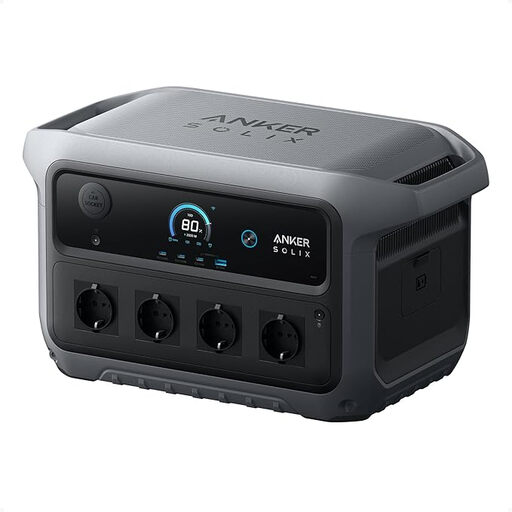
Why This Fits Their Persona: When a power cut hits, you need reliability. With a massive 2048Wh LiFePO4 battery and a powerful 2400W continuous output, this unit can run essential home appliances like a refrigerator, microwave or medical equipment. It's a serious piece of kit for home backup power.
It delivers on all fronts: a high continuous power rating for demanding appliances, a long-lasting LiFePO4 battery for peace of mind and an exceptionally fast 58-minute recharge time, ensuring it's ready for any emergency.
High Power Output: The 2400W output can handle multiple home appliances. Premium Build & Longevity: A top-tier LiFePO4 battery ensures it's a reliable, long-term investment.
We have compiled a complete, real-time list of products that fully satisfy these strict selection criteria and UK safety regulations.
This depends on two factors: runtime and lifespan.
Yes, most modern power stations support pass-through charging. This allows you to power your devices from the station while the station itself is being recharged from a wall outlet, car or solar panel. This is a very useful feature for creating an uninterruptible power supply (UPS) for sensitive electronics or for continuous use in an RV.
A general rule of thumb is to match the solar panel's wattage to the power station's capacity and your usage. For a mid-sized station (500-1000Wh), a 100W to 200W solar panel, like the SWAREY 100W Foldable Solar Panel, is often a good match for recharging during a sunny day. Always check the power station's specifications for the maximum solar input voltage and wattage it can handle to ensure compatibility.