
24/7 Customer Support

Free returns

Same-day & Next-day Delivery

Quality Guaranteed

Unlock Your Welcome Offers: FREE Delivery | Up to 80% OFF | Free 30-day JoyPlus trial
Download the APP
A portable power station UK buyers can rely on needs to match the equipment, location and expected running time—not simply the largest number on the box. Campers, caravan owners, anglers, remote workers and households preparing for power cuts can waste money when marketing claims hide the practical limitations.
Three common buying traps are worth checking before you compare models:
Battery capacity is measured in Wh. As a simple planning guide:
Approximate running time = battery capacity × 0.8 ÷ device wattage
The 0.8 factor allows for inverter and conversion losses. For example, a 500Wh camping power station running a 50W device may provide roughly eight hours under suitable conditions, although actual performance depends on the device and operating temperature.
Do not use the total capacity alone. Check the manufacturer’s rated output, port limits and whether an expansion battery is compatible.
A 500W portable power station can suit laptops, camera equipment, lights and smaller appliances. A 1000W portable power station offers more flexibility for kettles, cooking equipment or tools, but you still need to check the appliance’s start-up demand. A 2000W portable power station is more appropriate for demanding equipment, provided its continuous output and sockets meet the requirement.
For UK use, check for:
A high peak figure does not automatically mean the unit can operate a heater, induction hob or power tool continuously.
A LiFePO4 portable power station uses lithium iron phosphate cells. These are commonly selected for their stated cycle-life figures and thermal characteristics, but cycle claims are manufacturer specifications rather than a guarantee of identical results in every household.
Charging speed is also important. A fast-charging power station may save time before departure or during a short mains connection. Check whether the advertised time applies to a particular charging mode, app setting or input wattage.
For a portable power station with solar panel, confirm:
Keep the power station dry, ventilated and away from direct heat. Follow the supplied instructions, allow the unit to cool before charging if required and do not use damaged cables. Portable batteries are not a substitute for a professionally installed household electrical system.

Why This Fits Their Persona: A compact option for first-time buyers, day trips, fishing, caravan use and charging small electronics without carrying a heavier battery.
Its stated 222Wh capacity and 300W rated AC output make the intended use clearer than relying on a peak figure alone.
65W USB-C, eight listed output ports and three charging methods, including mains, car and optional solar.
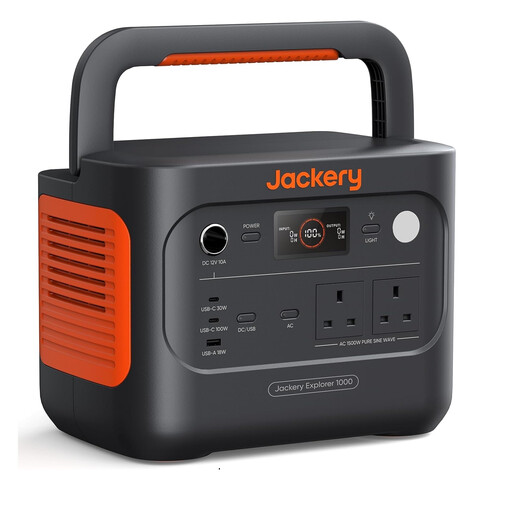
Why This Fits Their Persona: Suitable for campers, remote workers and caravan owners wanting a larger battery with app monitoring and multiple charging options.
The listing separates its 1,070Wh capacity, 1,500W rated AC output and 3,000W surge peak, helping buyers compare like for like.
LiFePO4 battery, 100W USB-C output, stated one-hour mains charging and app-based monitoring.
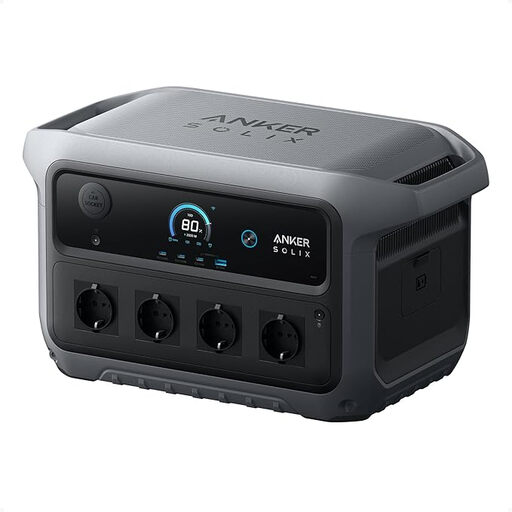
Why This Fits Their Persona: A higher-capacity choice for demanding camping setups, motorhomes and selected home blackout battery backup applications.
Its listed 2,048Wh LiFePO4 capacity and 2,400W output distinguish sustained capacity from the 4,000W peak figure.
2,048Wh storage, 2,400W rated output and a stated 58-minute full-charge time.

Why This Fits Their Persona: A 7.2kg option for fishing, short camping trips, remote work and compact motorhome or caravan equipment.
The listing gives separate 600W rated and 1,200W peak outputs, plus stated charging times for mains, solar and car input.
499Wh LiFePO4 battery, 100W USB-C, nine listed ports and optional capacity expansion to 2,047Wh.
We have compiled a complete, real-time list of products that fully satisfy these strict selection criteria and UK safety regulations.
It depends on the appliance’s continuous and start-up wattage. Check both figures and compare them with the power station’s rated AC output. A kettle can consume around 2,000–3,000W, so many compact models will not be suitable. A fridge may use less once running but can draw more when its compressor starts.
Battery lifespan depends on chemistry, charge cycles, storage temperature, depth of discharge and maintenance. LiFePO4 models often list higher cycle figures, but treat these as stated product specifications. Store the unit in a cool, dry place, avoid leaving it fully depleted for extended periods and follow the manufacturer’s storage guidance.