
24/7 Customer Support

Free returns

Same-day & Next-day Delivery

Quality Guaranteed

Unlock Your Welcome Offers: FREE Delivery | Up to 80% OFF | Free 30-day JoyPlus trial
Download the APP
A portable projector can turn a bedroom wall, garden fence or office meeting room into a large display. However, product listings often make compact models sound more capable than they are. A projector advertised as “4K supported” may not have a native 4K panel, while a high screen-size figure may only be practical in a dark room.
Before buying, UK shoppers should look beyond headline features and check brightness, native resolution, streaming compatibility, power requirements and setup flexibility. The following guide explains the key specifications and matches several options to different household needs.
A 1080P projector with 4K decoding can accept or process compatible 4K content, but that does not mean it displays a native 4K image. Native resolution describes the actual pixel structure of the projection panel.
For occasional films, gaming and presentations, native 720P may be acceptable at moderate screen sizes. If you want sharper subtitles, detailed games or a larger home cinema image, native 1080P is a more suitable specification to prioritise.
Brightness may be listed as ANSI lumens, ISO lumens or simply lumens. These measurements are not automatically interchangeable. A compact mini projector with 200–300 ANSI lumens is generally more dependent on a dark room, closed curtains or evening outdoor use. Higher brightness can provide more flexibility, but image quality still depends on distance, wall colour and ambient light.
Do not assume that a claimed 200-inch image will look clear in a typical UK living room. A smaller image at an appropriate throw distance can appear more watchable than an oversized, dim projection.
An Android projector or smart projector may offer built-in apps, screen casting or access to an app store. Yet app availability, updates and copyright restrictions can vary. Some models may not support direct wireless mirroring of subscription services from a smartphone because of HDCP restrictions.
Check whether you need a TV stick, HDMI cable or laptop. Built-in Wi-Fi is useful, but it should not replace checking the available inputs and software compatibility.
Look for the words native 1080P, native 720P or 4K native, rather than relying only on “4K supported”. A native 1080P model is generally more appropriate for large subtitles, console menus and office presentations. Contrast figures can help indicate the difference between dark and light areas, but they are most useful when compared within the same product range.
For a bedroom or darkened lounge, a lower-brightness mini projector may be sufficient. Outdoor use usually requires complete darkness, a stable surface and a light-coloured projection area. Models with higher listed brightness offer more scope for indoor viewing, but no home projector should be expected to perform like a television in direct daylight.
For a family film night, position the projector away from rain, dew and dust. Portable does not mean weatherproof, and most mains-powered models still need access to a safe power source.
Auto keystone correction can square an image when the projector is angled, while manual focus may still be required to sharpen the picture. Vertical correction is not the same as four-point or horizontal correction, so check the exact feature description if side projection is important.
Measure the room before purchase. A short throw distance can suit a bedroom, whereas a large screen may require more space. A tripod projector screen can provide a flatter, more consistent surface than a painted wall, particularly outdoors.
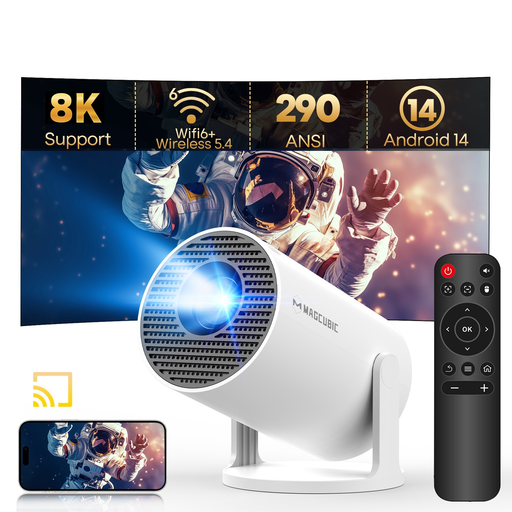
Why This Fits Their Persona: Its compact 0.77-pound design, Android 14 system and rotating stand suit first-time buyers who want bedroom or occasional outdoor viewing without carrying a larger unit.
The listing specifies native 720P rather than implying native 8K, and gives a 290 ANSI lumens rating to set more realistic expectations for dark-room use.
Native 1280 × 720 resolution, auto keystone correction, 180-degree rotation, Wi-Fi 6 and Bluetooth 5.4.
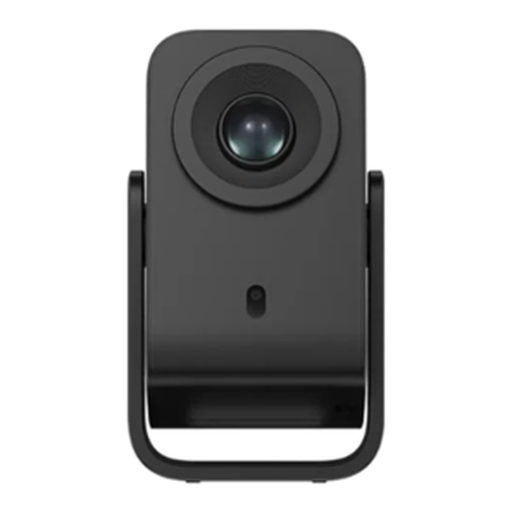
Why This Fits Their Persona: This portable home cinema projector is suited to households seeking native Full HD, integrated smart features and simpler setup for regular indoor viewing.
Its specification separates native 1080P from 4K input support and lists 230 ISO lumens, helping buyers compare the actual display format and brightness measurement.
Google TV, Google Cast, auto focus, auto keystone, auto screen-fit, obstacle avoidance and an integrated 8W speaker.
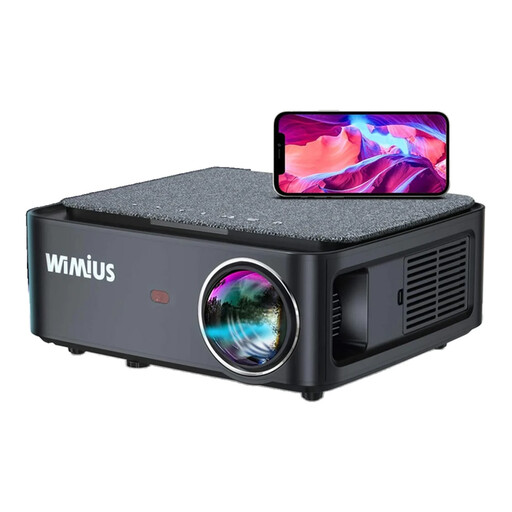
Why This Fits Their Persona: A practical choice for users connecting laptops, consoles, USB storage or media players for home cinema, gaming, presentations and evening garden events.
The listing identifies native 1920 × 1080 resolution separately from 4K video support and specifies HDMI, AV, USB and 3.5mm audio connections.
The product listing states 1200 ANSI lumens, 4D vertical and horizontal keystone correction, 50–100% zoom and a supplied carry bag.
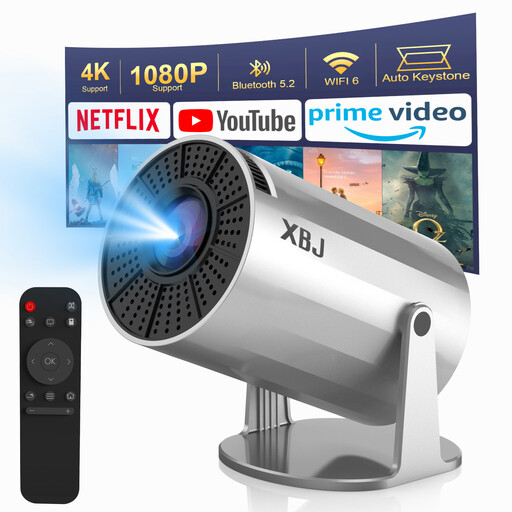
Why This Fits Their Persona: Its small 0.68kg form and rotating base suit bedrooms, caravans and occasional outdoor film nights where portability and flexible positioning matter.
The listing states native 720P, 200 ANSI lumens and manual focus, so buyers can plan for dark-room use rather than expecting native 1080P or automatic sharpening.
Android 11, Wi-Fi 6, Bluetooth 5.2, auto vertical keystone, 180-degree rotation and HDMI, USB and 3.5mm ports.
We have compiled a complete, real-time list of products that fully satisfy these strict selection criteria and UK safety regulations.
A dedicated projector screen can improve consistency, especially where walls are textured, coloured or uneven. Select a 16:9 screen for most films, streaming content and modern games. A 72-inch screen is easier to position in a bedroom, while a 100- or 120-inch screen can suit a larger lounge or garden gathering.
A tripod screen is convenient for temporary indoor and outdoor use. A foldable double-sided screen can be packed into a suitcase, but it needs secure ropes, hooks or a frame to stay taut. Check the screen’s stated viewing angle and installation method rather than choosing only by diagonal size.
Most compact models perform more effectively in a darkened room. Close curtains indoors, avoid direct sunlight outdoors and use a light, flat screen surface. Brightness ratings should be compared using the stated measurement type, such as ANSI or ISO lumens.
No. HDMI, USB or AV connections can support a laptop, games console, media player or USB drive. A Wi-Fi projector is useful for wireless casting and built-in apps, but streaming-service compatibility may still require an external TV stick.
LED models commonly list lamp-life figures in the tens of thousands of hours. Actual service life depends on ventilation, operating conditions and maintenance. Keep air vents clear, allow the unit to cool before storage and do not look directly into the active lens. Portable projectors are electronic devices, not toys, and should be kept away from moisture and unsupervised children.