
24/7 Customer Support

Free returns

Same-day & Next-day Delivery

Quality Guaranteed

Unlock Your Welcome Offers: FREE Delivery | Up to 80% OFF | Free 30-day JoyPlus trial
Download the APP
A portable projector can turn a bedroom wall into a private viewing space, support a garden film night or make presentations easier in a rented flat. However, product listings often use terms such as “4K supported”, “high brightness” and “smart” without explaining what they mean in everyday use.
Before buying, focus on the specifications that affect viewing quality, set-up time and compatibility. The right choice depends less on the largest advertised screen size and more on native resolution, measured brightness, connectivity and how you plan to use the device.
A projector described as 4K supported may accept and decode a 4K video signal while displaying it at a lower native resolution. This is different from a native 1080P projector, which uses a physical 1920 × 1080 display resolution.
For films, presentations and console games, native 1080P generally provides more detailed text and image edges than native 720P. A mini projector with native 720P can still be suitable for casual viewing, but buyers should not assume that “4K decoding” means 4K projection.
Brightness may be listed in ANSI lumens, ISO lumens or simply “lumens”. These measurements are not automatically comparable. A 200 ANSI-lumen projector is designed for darker rooms, while brighter models are more practical for rooms with some ambient light.
Even a high-brightness outdoor projector will look washed out in direct daylight. For garden viewing, wait until dusk, use a light-coloured flat surface and keep the projector protected from rain and dew.
An Android projector may offer app access, but streaming availability can depend on the operating system, licensing and app compatibility. Wireless phone mirroring may also be restricted by HDCP copyright protection, meaning some streaming services will not mirror directly from a smartphone.
Check whether the product includes licensed streaming applications or whether you will need a TV stick, HDMI cable or external media device.
For regular home cinema use, a 1080P projector offers a useful balance between detail and price. Native 720P models can work well for bedroom viewing, children’s content and occasional outdoor use, particularly when viewed from a moderate distance.
Do not select a projector based only on its maximum advertised screen size. A 200- or 300-inch image may be possible in ideal conditions, but a smaller image can appear brighter and sharper. Check the recommended throw distance and whether the projector has a useful zoom range.
Room lighting has a major effect on perceived contrast. Low-brightness models are most appropriate for a dark bedroom or evening viewing. Models with higher stated ANSI brightness provide more flexibility in a living room or at dusk, although they still require sensible lighting control.
For a projector for bedroom use, lower brightness may be adequate and can reduce the need to darken the entire room. For an outdoor projector, prioritise brightness, easy positioning and reliable mains power rather than relying on the maximum screen claim.
Auto keystone correction helps square an image when the projector is angled, while an autofocus projector can sharpen the picture after it is moved. These features reduce set-up time, but they cannot fully correct poor placement. Keep the projector on a stable surface and avoid excessive projection angles.
For wireless use, Wi-Fi 6 can help with network responsiveness when paired with a compatible router. A Bluetooth projector can connect to headphones, speakers or a soundbar, but Bluetooth is not the same as phone screen mirroring. For a projector for PS5, use HDMI for a direct connection and check the console’s output settings. Built-in speakers are convenient, but an external speaker is usually more suitable for a large room or garden.

Why This Fits Their Persona: A practical starting point for occasional films, gaming or garden use where compact size and straightforward connections matter more than Full HD resolution.
Its listing clearly states native 720P and 140 ISO lumens, helping set realistic expectations for dark or low-light viewing.
Electric focus, ±40° vertical keystone correction, HDMI, USB and Bluetooth 5.2.
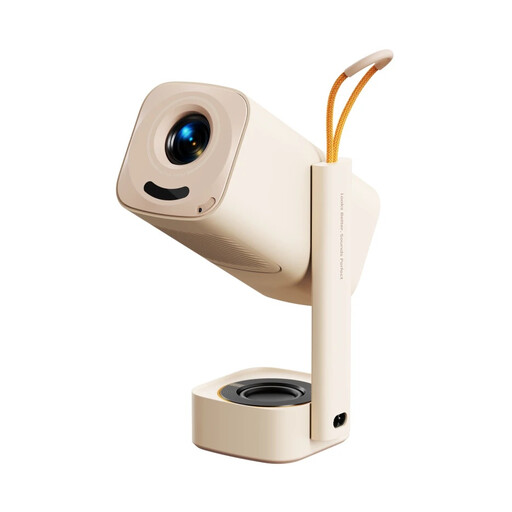
Why This Fits Their Persona: Suitable for buyers wanting native Full HD, convenient set-up and built-in access to selected streaming services for regular home viewing.
The listing separates native 1080P from HDR10 support and identifies certified Netflix, Prime Video and YouTube access.
Autofocus, auto keystone, intelligent screen alignment, Wi-Fi 6 and Bluetooth 5.4.
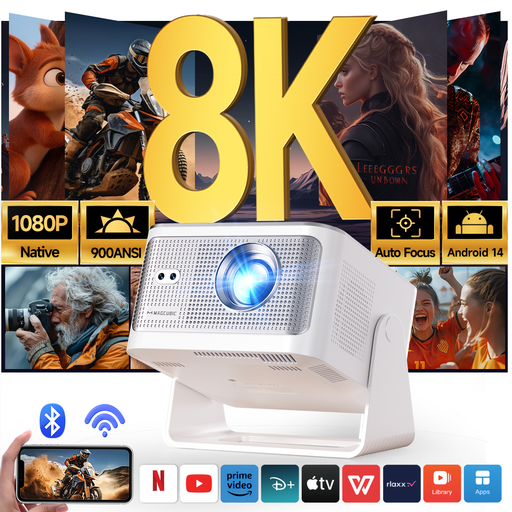
Why This Fits Their Persona: Designed for frequent film nights, gaming and flexible placement where higher stated brightness and automatic adjustments are useful.
It specifies native 1080P, 900 ANSI lumens and automatic focus and keystone correction rather than relying only on a large supported-resolution figure.
Android 14, dual-band Wi-Fi 6, Bluetooth 5.4 and a 1:1 throw ratio.
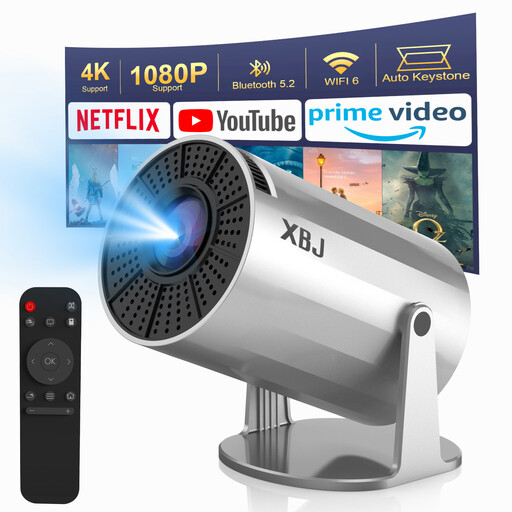
Why This Fits Their Persona: A lightweight option for renters, students and travellers who want to project on a wall or ceiling without carrying a bulky home cinema projector.
The product information states native 720P, 200 ANSI lumens and manual focus, so buyers can plan for darker-room use instead of expecting native Full HD.
180° rotating base, auto vertical keystone, Android 11 and Wi-Fi 6 screen mirroring.
We have compiled a complete, real-time list of products that fully satisfy these strict selection criteria and UK safety regulations.
Yes, provided the room can be darkened and the projector is positioned securely. A compact projector with a rotating stand can display on a wall or ceiling, while auto keystone correction simplifies angled placement. Check whether the model has autofocus or requires manual lens adjustment.
The quoted operating life varies by model and usage conditions. LED projectors may list tens of thousands of hours, but brightness can gradually change over time. Keep the vents clear, avoid overheating and follow the supplied shutdown procedure to support reliable operation.
Power consumption depends on brightness, operating system, speakers and cooling requirements. A compact LED model generally uses less power than a large traditional lamp projector, but the product’s rated wattage is the figure to compare. Remember that an external soundbar, TV stick or streaming device will add its own consumption.