
24/7 Customer Support

Free returns

Same-day & Next-day Delivery

Quality Guaranteed

Unlock Your Welcome Offers: FREE Delivery | Up to 80% OFF | Free 30-day JoyPlus trial
Download the APP
Whether you're planning a weekend camping trip, equipping your caravan for an off-grid adventure or preparing for unexpected power cuts at home, a reliable source of electricity is essential. A portable solar generator offers a clean, quiet and convenient solution. But with so many options on the market, navigating specifications like wattage, battery chemistry and solar compatibility can be confusing.
This guide is designed to simplify your search. We'll break down the key features to consider and present a selection of models that cater to different needs, from powering a simple campsite to running essential home appliances.
Before looking at specific products, it's helpful to understand what makes a good portable power solution. Focusing on these three areas will help you find a unit that matches your requirements.
These two figures are the most important specifications on any portable power station.
Many modern portable power stations use Lithium Iron Phosphate (LiFePO4) batteries. Compared to older lithium-ion types, a LiFePO4 solar generator offers significant advantages. They are generally safer, more stable at higher temperatures and have a much longer lifespan. A LiFePO4 battery can typically handle thousands of charge cycles before its capacity starts to noticeably degrade, making it a durable choice for long-term use as a caravan power pack or emergency power supply UK.
A portable power station becomes a true solar generator when paired with a solar panel. When choosing a panel, consider its wattage and portability. A 100w foldable solar panel is often a good balance, providing a decent charging speed without being too bulky. Check for compatibility; many panels come with multiple adaptors to connect to different brands of power stations, giving you a versatile off-grid power kit.
Here are our recommendations for portable power solutions, selected to cover a range of uses from light-duty camping to robust home backup.
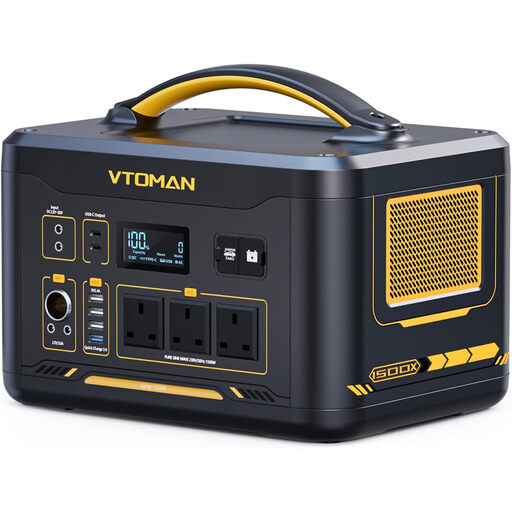
Why It Stands Out: The VTOMAN Jump1500X is a powerful and versatile unit built around a durable LiFePO4 battery. Its standout feature is the 1500W constant-power output, which can handle demanding appliances. The capacity is a substantial 828Wh, and for those needing even more runtime, it's expandable to 2376Wh with an additional battery (sold separately).
Pros:
Who is it for? This is an excellent choice for caravan and motorhome owners, anyone needing a serious emergency power supply UK or campers with high-power devices.

Why It Stands Out: This compact power station prioritises portability without sacrificing essential features. Weighing just over 3kg, it's easy to carry on a hike or from the car to the tent. Despite its small size, it includes a pure sine wave AC outlet, which is safer for sensitive electronics, and a powerful 65W USB-C port for fast charging.
Pros:
Who is it for? Ideal for weekend campers, anglers, festival-goers or anyone needing a lightweight power source for charging phones, cameras, drones and laptops on the go.
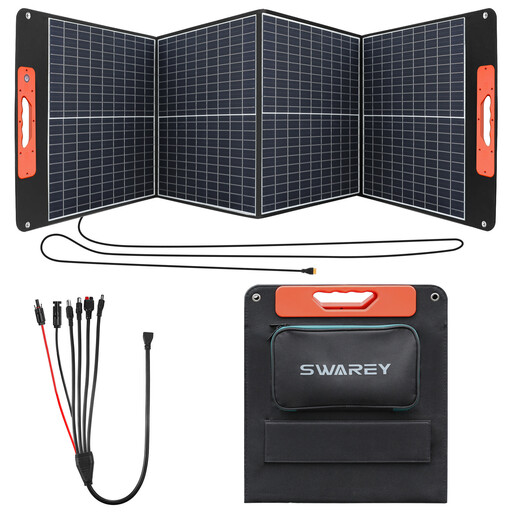
Why It Stands Out: To truly harness the sun, you need an efficient panel. The SWAREY 100W panel uses high-efficiency monocrystalline cells to achieve a conversion rate of up to 23%. Its clever Ray Tracer technology helps you find the optimal angle to the sun in seconds. It's designed for maximum compatibility, with an included 5-in-1 cable that connects to most power stations on the market.
Pros:
Who is it for? This is a must-have accessory for anyone who owns a portable power station and wants to stay charged during multi-day off-grid trips, from camping to van life.
A reliable power source is just one piece of the puzzle for a great outdoor adventure. If you're planning your next trip, you might be looking for tents, sleeping bags, cooking equipment and more.
Explore our full range of camping accessories to find everything you need to make your next outing comfortable and memorable.
1. What can you run on a portable solar generator? This depends entirely on the generator's output wattage (W) and capacity (Wh). A smaller 300W unit can comfortably run laptops, phones, cameras, drones and LED lights. A larger 1500W model can handle all of that plus more demanding items like a mini-fridge, a projector, a fan or even low-wattage power tools. Always check the power requirements of your appliance before plugging it in.
2. How long does a portable power station last? The lifespan is measured in charge cycles. A station with a LiFePO4 battery, like the VTOMAN Jump1500X, is typically rated for 3,000 or more full charge/discharge cycles before the battery capacity drops to 80%. For an average user, this translates to many years of reliable service. The runtime on a single charge depends on the battery's Wh capacity and the power draw of the devices connected to it.
3. Are solar generators worth it in the UK? Yes. While the UK isn't the sunniest country, modern solar panels are surprisingly efficient even in overcast conditions. They don't need direct, bright sunlight to generate power, although they will perform best on a clear day. For a camping generator or emergency backup, having the ability to recharge for free using daylight provides valuable energy independence and peace of mind.