Deadline-led handover sender
You have a finished recording package to copy promptly and need to check whether the computer, cable and drive can deliver the transfer speed you expect.


Choose a portable SSD if you will copy recordings repeatedly, travel with the drive or work to a tight handover deadline. A portable HDD is a reasonable route when archive capacity matters more than transfer speed and the drive can be handled carefully. Whichever you choose, check the recipient’s connection and file-system needs, keep a separate copy and confirm that the client can open the recordings.
You have a finished recording package to copy promptly and need to check whether the computer, cable and drive can deliver the transfer speed you expect.
You are delivering many sessions or retained project folders and need enough drive capacity, as well as access on the client’s computer.
You are transferring client, interview or participant recordings and need to agree how access will be controlled while retaining a separate recoverable copy.
For a client handover, establish the folder size and the recipient’s computer before choosing between SSD speed and HDD capacity. Password protection is a separate decision that may apply to either route.
Consider it when: copying is deadline-sensitive, repeated or part of a travelling handover.
Allow for: quoted transfer speeds depend on the host, cable and supported operating mode.
Consider it when: the recording archive is large and transfer time is less critical.
Allow for: careful handling in transit and a check of the exact model’s connection and capacity.
| Concern | What to check | Who this matters to |
|---|---|---|
| Successful handover | Test-open representative recordings after copying and keep an independent copy until the client confirms access. | If the client cannot open the files, I still need a copy from which to resolve the problem. Around 42% of consumers put a verifiable handover and retained copy first. |
| Cross-device access | Confirm whether the client uses Mac, Windows or both, and agree the file system before copying. | My client may use a different computer, so being able to access the delivered files matters more to me than the drive’s headline speed. For around 33% of consumers, cross-device access is the primary concern. |
| Speed and portability | Check the computer’s port and cable against the drive’s stated interface; assess any stated protection within its limits. | With a tight deadline or frequent travel, I want the copying setup to suit the time available and the way I carry the drive. Faster, more mobile transfers come first for around 25% of consumers. |
Apple Support states that erasing and reformatting a storage device deletes its files. A file-system change could therefore erase the recordings you meant to deliver.
Keep the originals on another computer or drive before formatting the handover drive, then copy the delivery folder again.
Samsung says the T7 Shield’s quoted maximum speeds require a compatible USB 3.2 Gen 2 host and cable, with UASP enabled.
Check the sender’s port and cable before relying on that speed to meet a copying deadline.
A client’s copy does not replace your retained copy while receipt and file access are still being confirmed. The National Cyber Security Centre advises keeping backup devices secure and disconnected when not in use.
Retain an independent copy until the client confirms the recordings open, and disconnect backup media when it is not needed.
Samsung bases the T7 Shield’s dust, water and drop claims on controlled internal tests and says that such damage is excluded from its warranty. Password protection can also prevent the client opening files if access details are not shared correctly.
Check the chosen drive’s stated limits, agree a separate channel for any password and test access before handover.
The T7 Shield portable SSD line is relevant when copying time and carrying the drive between locations matter.
The X10 portable SSD line offers another route to consider for larger active recording folders.
The One Touch portable HDD range is relevant to capacity-led handovers and models offering controlled file access.
These portable SSDs suit handovers where copying and carrying the recordings matter; the portable HDD offers another option for a large archive when transfer speed is less critical. Check the finished folder size, the client’s computer and any confidentiality requirements against the exact drive you choose.
 No image available
Consider this portable SSD for a handover involving travel or a tight copying schedule. It is a 1 TB USB 3.2 Gen 2 model; Samsung’s quoted T7 Shield speeds require a compatible host and cable with UASP enabled. Check that the client can use the connection and any password-protection setup before handing it over.
 No image available
Consider this SSD when the handover folder calls for more capacity while copying speed remains important. The named variant has 4 TB capacity and USB Type-C 3.2 Gen 2 connectivity. Check the actual folder size and recipient connection; this T7 is not IP-rated for water resistance.
 No image available
Consider this portable SSD if a 2 TB drive accommodates the delivery folder and its working margin. The named variant uses USB Type-C 3.2 Gen 2 connectivity. If you use its optional password protection, set up access for the recipient before handover; protect the drive from moisture.
 No image available
Consider this 2 TB portable SSD for carrying a recording package between locations. Before choosing it for the client, confirm the required connector and operating-system compatibility, along with password protection if the handover calls for it.
 No image available
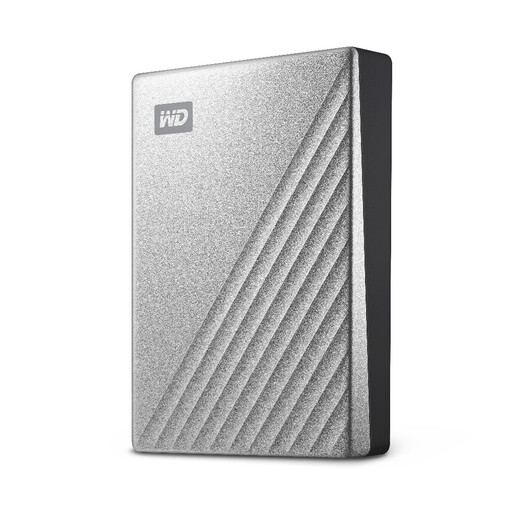
Consider this portable HDD when a large recording archive matters more than a speed-led transfer. It has 4 TB capacity; for Mac read/write use, the listing specifies a downloadable NTFS driver. Confirm the client’s setup before copying, and handle the drive carefully in transit.
Choose a portable SSD if the copying deadline or travel is the main concern; consider a portable HDD if the archive is large and transfer time matters less. Check the actual folder size, recipient connection and handling needs rather than choosing by drive type alone.
For a drive over 32 GB that will be used with both Mac and Windows computers, Apple Support UK identifies ExFAT as the format to choose. Confirm the client’s requirements first, and retain another copy before formatting because erasing a drive deletes its files.
If the agreed handover requires password protection or hardware encryption, confirm that the exact drive and the client’s computer support the setup, then share access details through a separate agreed channel. Keep an independent copy; the National Cyber Security Centre advises keeping external backup devices secure and disconnected when not in use.
For a UK consumer purchase, the Consumer Rights Act 2015 requires supplied goods to be of satisfactory quality. Those statutory rights are separate from any voluntary manufacturer warranty or data-recovery service; check which issue you are reporting rather than treating a recovery package as a replacement for your rights.