
24/7 Customer Support

Free returns

Same-day & Next-day Delivery

Quality Guaranteed

Unlock Your Welcome Offers: FREE Delivery | Up to 80% OFF | Free 30-day JoyPlus trial
Download the APP
There are few dashboard lights more unwelcome than the low tyre pressure warning. It often appears at the most inconvenient times, leading to a detour to the nearest petrol station, where you might find the air pump is out of order, occupied or requires a frantic search for loose change. Maintaining correct tyre pressure is not just about avoiding inconvenience; it is crucial for your safety, fuel efficiency and the lifespan of your tyres.
A portable tyre inflator is a straightforward solution to this common problem. Keeping a compact, reliable device in your boot means you can check and top up your tyres at home, at work or on the roadside, ensuring you are always prepared. This guide is designed to help you understand the key features to look for and to highlight a few models that offer a great balance of performance, convenience and value.
Navigating the market for a car tyre pump can be confusing. Here are a few practical points to consider to help you find the right device for your needs.
The first major decision is how your inflator will be powered. A rechargeable tyre inflator offers ultimate convenience. These cordless air compressor models run on a built-in battery, allowing you to use them anywhere without being tethered to your car. They are perfect for quick top-ups. On the other hand, a 12V tyre inflator plugs directly into your car's cigarette lighter socket. This provides a continuous, reliable power source, which can be reassuring on long trips or if you need to inflate multiple tyres from flat. Some models offer the best of both worlds with a dual power supply.
Two key metrics determine an inflator's performance: maximum pressure (measured in PSI) and airflow rate (measured in litres per minute, L/Min). While most car tyres require between 30-40 PSI, a higher maximum PSI (e.g., 150 PSI) indicates a more robust motor. A higher airflow rate means faster inflation. For ease of use and safety, look for a digital air compressor that features a clear screen and an automatic shut-off function. This allows you to preset your desired pressure, and the device will stop automatically, preventing over-inflation. A built-in tyre pump with pressure gauge is essential for accurate readings.
Many modern inflators are multi-functional tools. If you also ride a bicycle or motorcycle, check that the device is suitable as a motorcycle tyre inflator and includes the necessary valve adapters (like a Presta adapter for some bikes). Other highly practical features include a built-in LED light, which is invaluable for dealing with a flat tyre at night, and a USB output port that allows the device to double as a power bank for charging your phone in an emergency.
Here are a few standout options that deliver on performance and practicality for UK drivers.

View GOOLOO GT160 Tyre Inflator
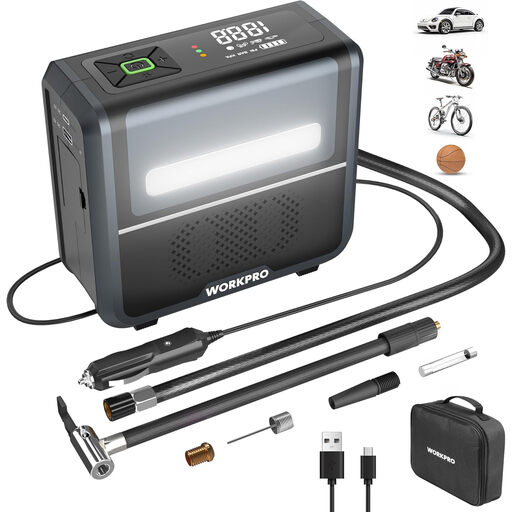
View WORKPRO 3-in-1 Tyre Inflator
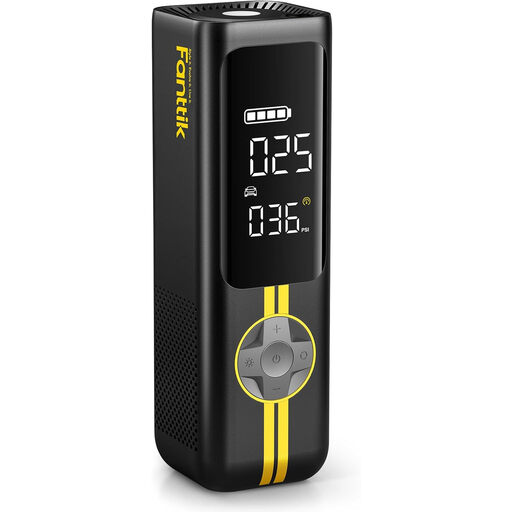
View Fanttik X8 APEX Tyre Inflator
While the models above are excellent all-rounders for cars and general household use, dedicated cyclists may prefer a more compact and lightweight solution. If you are primarily looking for a device to keep your bicycle tyres at optimal pressure, a purpose-built cordless bike pump might be a better fit.
Explore our curated selection of pumps for cyclists to find the perfect model for your ride.
Q1: How often should I check my car's tyre pressure? It is recommended to check your tyre pressure at least once a month and always before embarking on a long journey. A portable inflator makes it easy to perform this vital safety check in minutes from your own driveway.
Q2: Can I use a portable car tyre pump for other things? Absolutely. Most models are versatile and come with a set of adapters. This allows you to use them for inflating bicycle tyres, motorcycle tyres, footballs, basketballs and even some smaller inflatables like paddling pools or airbeds.
Q3: Is a cordless air compressor powerful enough for an SUV? Yes, many modern cordless models are more than capable of handling the larger tyres found on SUVs. Look for a device with a high maximum pressure rating (e.g., 150 PSI or more) and check that its specifications are suitable for your vehicle's recommended tyre pressures, which can be found in your car's manual or on a sticker inside the driver's door jamb.