
24/7 Customer Support

Free returns

Same-day & Next-day Delivery

Quality Guaranteed

Unlock Your Welcome Offers: FREE Delivery | Up to 80% OFF | Free 30-day JoyPlus trial
Download the APP
A slow puncture or an unexpected flat tyre can turn a smooth journey into a roadside headache. While a portable car tyre inflator seems like the perfect solution, the market is flooded with options that often over-promise and under-deliver. Many UK drivers have found themselves with a device that fails when they need it most.
As the Joybuy Product Recommendation Officer, my role is to help you see past the marketing jargon. Before you buy, be aware of these common pitfalls that lead to disappointment:
To avoid these traps, focus on the core specifications that determine a device's real-world performance and reliability.
Your first decision is how the device will be powered. There is no single right answer; it depends entirely on your needs.
While almost every electric tyre pump advertises a maximum pressure of 150 PSI, this figure is less important for cars (which typically require 30-40 PSI) and more relevant for high-pressure road bike tyres. A more practical measure of performance is the airflow rate, measured in litres per minute (L/min).
A higher L/min rate means the pump can move more air, inflating your tyre faster and putting less strain on the motor. For standard car tyres, an airflow rate of 20-35 L/min is a good benchmark for efficient performance.
Beyond power and speed, a few key features separate a basic pump from a truly useful tool:
Based on these practical criteria, we have matched several products to different user needs.
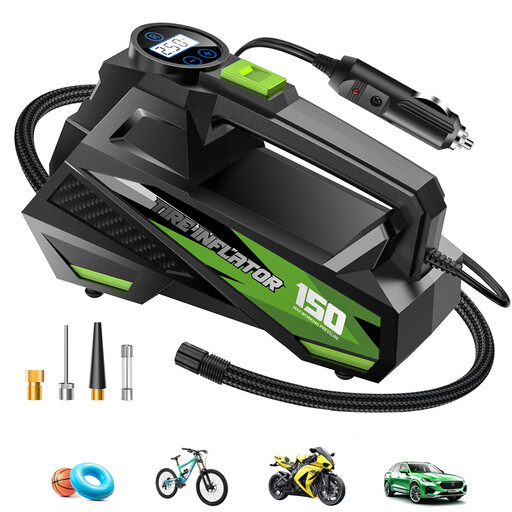
Why This Fits Their Persona: This user needs a reliable, straightforward tool for routine pressure checks and emergencies. They value dependability over extra features and want something that just works when plugged in.
As a 12V tyre inflator, it draws power directly from the car, completely avoiding the pitfall of a dead battery on a cordless model. Its simple mechanical design focuses on the core job of inflation.
Consistent power for peace of mind. The extended power cord is designed to reach all tyres on a standard vehicle without issue. It is a compact and cost-effective solution.
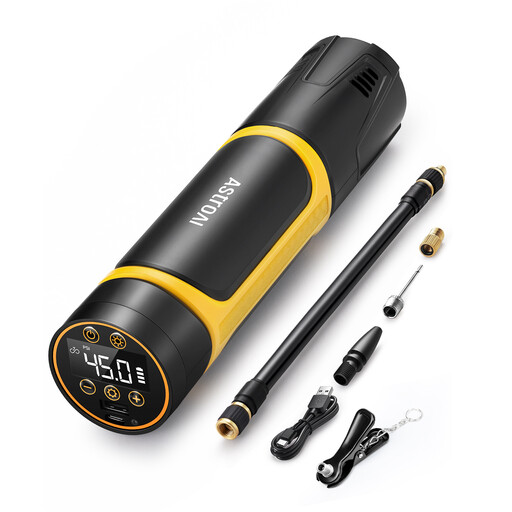
Why This Fits Their Persona: This person owns a car, a motorcycle and/or bicycles. They need a single, versatile cordless tyre inflator that can handle different valve types (Schrader for cars, Presta for road bikes) and pressure needs.
It directly addresses the issue of inaccurate pressure with specific modes for car, motorcycle tyre inflator and bike pump use, each with sensible presets. The auto shut-off feature ensures correct pressure every time.
Includes both Presta and Schrader valve adapters. The 5 intelligent modes and a clear digital gauge simplify switching between different vehicles and items.
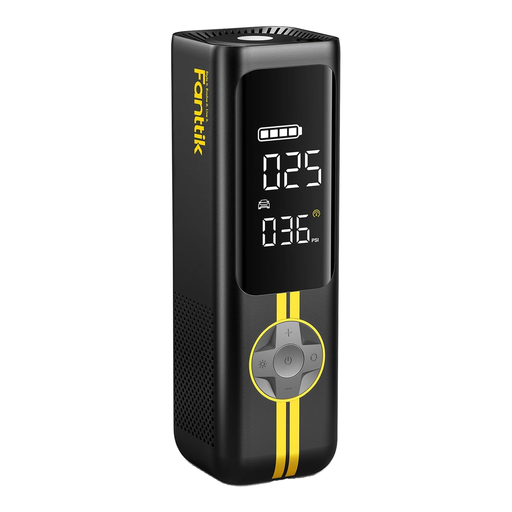
Why This Fits Their Persona: This user loves gadgets that are powerful, efficient and multi-functional. They want a premium cordless device for road trips and daily use that also serves as a power bank for their phone.
It tackles the weak battery pitfall with a substantial battery capacity, providing up to 40 minutes of runtime. It also counters the speed myth with a focus on fast, continuous operation thanks to its cooling system.
Multi-functional design includes a power bank and LED torch. The dual-screen display and one-click operation make it exceptionally user-friendly.
We have compiled a complete, real-time list of products that fully satisfy these strict selection criteria and UK safety regulations.
1. How long does a cordless tyre inflator battery really last? This depends heavily on the battery's capacity (mAh) and the work it is doing. A quality inflator with a battery of 4000mAh or more should be able to top up four car tyres with plenty of charge to spare. Some higher-capacity models (6000mAh+) may inflate a single car tyre from flat, or multiple bicycle tyres. Always check the manufacturer's specifications, which often state performance in terms like "inflates X car tyres from 30 to 36 PSI".
2. Can I leave a 12V tyre inflator plugged in? You should only have a 12V inflator plugged in and running when your vehicle's engine is on. This prevents the inflator from draining your car battery. It is not designed to be left plugged in permanently. Once you have finished inflating your tyres, you should always unplug the device and store it safely.
3. How accurate are the digital pressure gauges on these devices? Most modern digital gauges are quite accurate, often to within +/- 1 PSI, which is sufficient for passenger vehicles. They are a significant improvement over older analogue dials. For peace of mind, you can occasionally cross-reference the reading with a separate, reliable pencil or digital pressure gauge, especially when the inflator is new.