
24/7 Customer Support

Free returns

Same-day & Next-day Delivery

Quality Guaranteed

Unlock Your Welcome Offers: FREE Delivery | Up to 80% OFF | Free 30-day JoyPlus trial
Download the APP
A portable tyre inflator can be useful for routine pressure checks, gradual air loss and roadside top-ups. It can also save a trip to a petrol station when your car, motorcycle or bicycle tyre needs attention. However, product listings often make comparison harder than it needs to be.
The headline figure is not always the most useful buying guide. A 150 PSI tyre inflator may have a high theoretical pressure limit but still inflate a car tyre slowly. A cordless model may be convenient but unsuitable if its battery is flat. Some compact pumps also require cooling breaks that are not clearly highlighted in short listings.
Before choosing, watch for these common pitfalls:
For everyday car use, look beyond the PSI number and check the stated airflow, usually shown in litres per minute (L/min). Higher airflow can support quicker inflation, although actual results vary according to tyre size, starting pressure and valve connection.
A cordless tyre inflator with a 150 or 160 PSI rating can be suitable for cars, motorcycles, bicycles and balls, provided the recommended pressure falls within its operating range. It does not mean the pump is designed for lorries, large vans or trailers.
The duty cycle is equally important. It describes how long a portable air compressor can operate before it needs to cool. A pump intended for occasional top-ups may not be suitable for inflating several large tyres from very low pressure. Follow the manufacturer’s operating instructions and allow cooling pauses where required.
A rechargeable air pump is convenient for carrying in a glovebox, boot or rucksack. Check:
A dual-power car tyre pump can provide extra reassurance for longer journeys: cordless operation is convenient, while a 12V connection can be useful if the internal battery has not been charged. Keep in mind that a 12V wired inflator should normally be connected to the vehicle socket according to the instructions, with the engine running where specified to reduce the risk of draining the battery.
A built-in digital tyre pressure gauge makes it easier to set a target value than relying on a basic analogue dial. Look for selectable units such as PSI, bar and kPa, as well as a display that is readable in low light.
An automatic shut-off tyre pump stops when the preset pressure is reached. This helps reduce over-inflation caused by leaving the pump running, but it does not remove the need to check the vehicle’s recommended pressure. In the UK, the correct figure is commonly found on the driver’s door jamb, fuel-filler flap or in the vehicle handbook.
Check the included fittings too. Car and motorcycle tyres generally use Schrader valves, while many road and hybrid bicycles use Presta valves. An adapter may be needed.
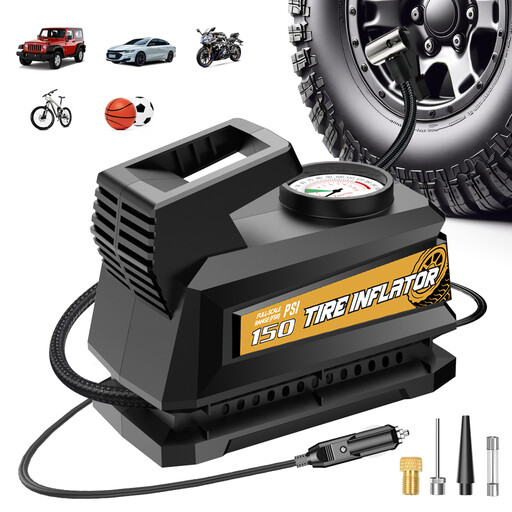
Why This Fits Their Persona: A straightforward option for drivers who want a compact car tyre pump for occasional top-ups without managing a rechargeable battery.
Its 12V plug-and-play design avoids relying on battery charge levels. Use it with the vehicle socket and follow the supplied instructions.
12V wired power; portable 22-cylinder design; suitable for vehicle tyres and other inflatables.
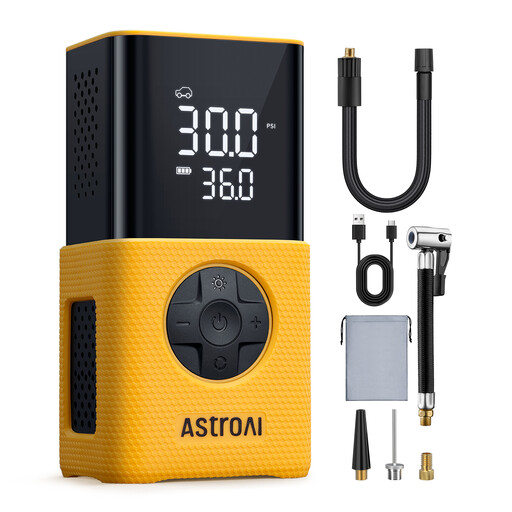
Why This Fits Their Persona: Suitable for users who value a small-footprint cordless design, preset modes and additional roadside functions for regular car ownership.
The 4000mAh battery, preset function and auto-off feature address common convenience issues. It is not intended for off-road vehicles, motorhomes, lorries or trailers.
150 PSI maximum pressure; 17L/min airflow; USB-C input/output; three-mode LED light; four pressure units.
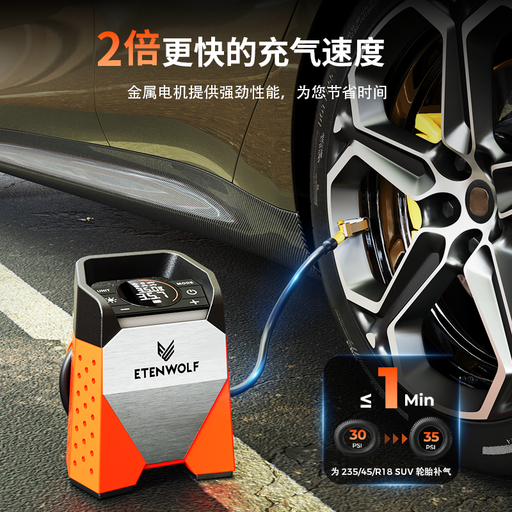
Why This Fits Their Persona: A practical match for drivers who want a higher-rated 160 PSI air compressor for passenger cars, SUVs, bikes and balls.
Its listing states a 100% duty cycle and automatic stop at the selected pressure, while the 12V connection provides a vehicle power option.
160 PSI maximum operating pressure; 12V power; supplied Presta adapter, ball needle and tapered nozzle.
We have compiled a complete, real-time list of products that fully satisfy these strict selection criteria and UK safety regulations.
A portable pump is designed for inflation and pressure maintenance. If a tyre repeatedly loses air, has visible damage or becomes unsafe, stop driving and arrange appropriate assistance.
For many UK drivers, it is a useful backup for gradual pressure loss and minor top-ups. It is not a substitute for a spare wheel, sealant kit or roadside assistance where a tyre is punctured or structurally damaged.
Service life depends on storage, charging habits, heat and frequency of use. Keep the unit dry, avoid leaving it in extreme temperatures and follow the specified charging instructions. Battery runtime will gradually reduce as the rechargeable cell ages.
A 12V electric tyre inflator generally uses modest power for short top-ups, while a cordless model draws energy from its internal battery and must be recharged. The practical cost is usually linked more to electricity used for charging and battery replacement over time than to individual inflation sessions.