
24/7 Customer Support

Free returns

Same-day & Next-day Delivery

Quality Guaranteed

Unlock Your Welcome Offers: FREE Delivery | Up to 80% OFF | Free 30-day JoyPlus trial
Download the APP
A portable tyre inflator can be a useful addition to a car boot, motorcycle storage box or cycling bag. It may help you top up a tyre at home, prepare for a long journey or deal with gradual pressure loss before reaching a garage. However, choosing the right model requires more than looking at a large PSI number on the packaging.
Marketing claims can make compact pumps seem suitable for every vehicle and inflation task. In practice, power source, duty cycle, valve compatibility and battery capacity have a greater effect on usability. The following guide explains the main buying pitfalls and highlights options for different UK users.
A 150 PSI air pump or 160 PSI model may sound powerful, but maximum pressure does not tell you how quickly it inflates a car tyre. Airflow, motor output and the tyre size being inflated also matter.
A pump intended for bicycles and sports balls may be suitable for small, occasional jobs but less convenient for repeatedly topping up four car tyres. Check whether the listing provides airflow information, such as litres per minute, and whether it states vehicle compatibility.
A cordless tyre inflator is convenient because there is no cable to route from a 12V socket. Nevertheless, its battery will eventually need charging. Cold weather, larger tyres and repeated inflation can reduce the practical runtime.
For emergency use, check the stated charging method, battery capacity and charging time. If you regularly drive long distances or own an electric vehicle, consider carrying a charging cable or choosing a 12V tyre inflator that can draw power from the vehicle.
Small compressors generate heat during inflation. A model that is compact enough for a glove compartment may require cooling breaks, particularly when inflating several tyres. Ignoring the instructions can make the pump uncomfortable to handle and may shorten its service life.
Look for clear guidance on continuous use, cooling periods and storage. A digital display and automatic shut-off are useful, but they do not remove the need to monitor the pump and hose.
A rechargeable air compressor is practical for cyclists, motorcyclists and drivers who want quick access away from a socket. Battery capacity is usually shown in mAh, although this figure alone does not guarantee a particular number of inflations.
A wired car tyre inflator connects to a vehicle’s 12V DC socket. The engine should normally be running when using this type of pump, following the manufacturer’s instructions, to reduce the risk of draining the vehicle battery. Check cable length if your vehicle has a large wheelbase. A 3-metre lead can be more convenient when reaching all four wheels.
Your vehicle’s recommended pressure is listed on the tyre placard, usually around the driver’s door area, or in the handbook. Set the pump to that recommendation rather than automatically choosing its highest available setting.
A digital tyre pressure gauge or digital display can make target setting easier than a basic mechanical gauge. Useful features include selectable PSI, Bar or kPa readings and automatic shut-off after the preset pressure is reached. Even so, display accuracy can vary between products, so use a separate gauge periodically if precise pressure checks are important.
Most car and motorcycle tyres use standard Schrader valves. Bicycle tyres may use Schrader or Presta valves, so a Presta adapter may be necessary. Nozzle sets can also support footballs, inflatables and other small items.
Do not assume a general-purpose portable air compressor is suitable for vans, large SUVs, caravans or heavy goods vehicles. Several compact models specify that they are intended for cars, motorcycles, bicycles and balls rather than larger commercial tyres.
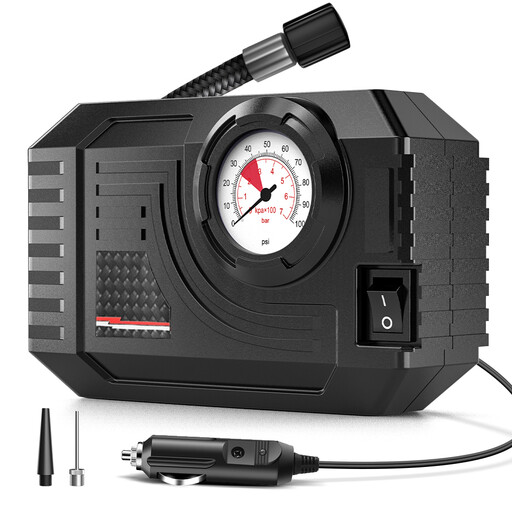
Why This Fits Their Persona: A straightforward wired option for drivers who want a compact pump for occasional car, motorcycle or bicycle top-ups without relying on a rechargeable battery.
Its wired 12V design avoids unexpected battery depletion, while the simple operation makes the power requirements clear before use.
Portable format; suitable for car, motorcycle and bicycle tyres; no permanent installation required.
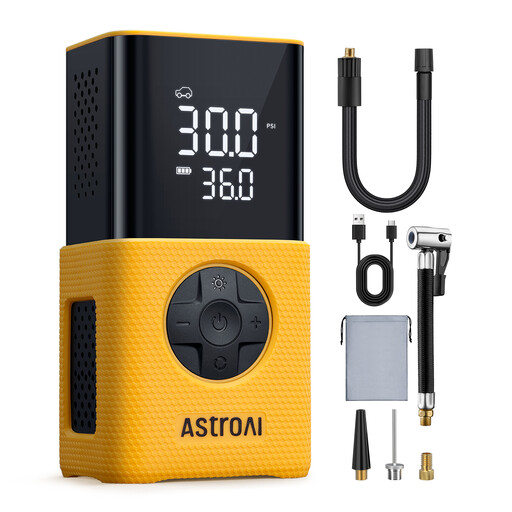
Why This Fits Their Persona: Its cordless, pocket-sized format suits UK motorists, cyclists and electric vehicle users who value a digital interface and low storage demands.
The built-in battery and preset auto-off function reduce cable dependence and the risk of continuing to inflate beyond the selected target.
150 PSI maximum pressure; 4000mAh rechargeable battery; digital dual-value display; LED, SOS and strobe modes.
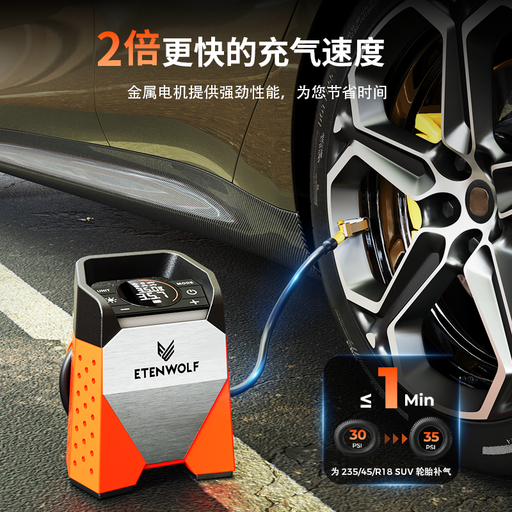
Why This Fits Their Persona: A heavier 1.47 kg unit with stated 160 PSI maximum operating pressure suits drivers who want a more substantial emergency roadside inflator for cars, SUVs, bikes and balls.
The specification lists a 1.25 CFM airflow capacity and quick-inflation feature, giving more useful information than relying on PSI alone.
160 PSI maximum operating pressure; 1.25 CFM airflow; supplied Presta adapter, inflation needle and tapered nozzle.
We have compiled a complete, real-time list of products that fully satisfy these strict selection criteria and UK safety regulations.
For electric vehicles, the same tyre-pressure guidance applies, but boot space and access to a 12V socket vary by model. A cordless pump can be easier to position, while a wired model may be preferable for longer inflation sessions.
It can be useful for correcting gradual pressure loss or dealing with an underinflated tyre before visiting a garage. It is not a substitute for a spare wheel, sealant kit or roadside assistance, and it should not be used to conceal tyre damage.
A 12V model draws power from the vehicle while connected. The exact energy use depends on motor output and inflation time, but following the instructions to run the engine during use helps avoid unnecessary strain on the vehicle battery. Rechargeable models use mains or USB charging before deployment.
Some models include multiple nozzles or adapters and list compatibility with all three. Check the valve type, pressure range and intended tyre size before purchasing. A compact bicycle pump may handle cycle tyres efficiently but take longer with a car tyre, while a car-focused compressor may be less convenient to carry on a bicycle.