
24/7 Customer Support

Free returns

Same-day & Next-day Delivery

Quality Guaranteed

Unlock Your Welcome Offers: FREE Delivery | Up to 80% OFF | Free 30-day JoyPlus trial
Download the APP
A portable tyre inflator can be useful for maintaining pressure at home, topping up a car before a long journey or dealing with a low tyre on a country lane. However, product listings often make similar devices look interchangeable. They are not.
A compact electric tyre pump may be suitable for a bicycle or football but frustratingly slow on a family car. A cordless model may be convenient until its battery is flat. Meanwhile, a claimed 150 PSI air compressor rating does not automatically mean the pump is suitable for high-volume inflation or continuous operation.
This guide explains the practical details that matter for UK motorists, cyclists, motorcycle riders and families.
Maximum PSI is the highest pressure a pump may reach under stated conditions. It does not tell you how quickly it will inflate a tyre, how much heat it generates or whether it is intended for a large vehicle.
Most car tyres operate at considerably lower pressures than 150 PSI. The correct figure for your vehicle is shown on the tyre placard, usually inside the driver’s door frame, fuel flap or vehicle handbook. Treat the maximum pressure as a capacity indicator, not as your target setting.
A cordless tyre inflator is easy to move around the vehicle and useful for bicycles or motorcycles. Its limitation is battery dependence. If it has not been charged, it may not be available when needed.
A 12V tyre inflator draws power from a vehicle socket, so it can be practical for roadside top-ups. The engine should be running during use where the product instructions require this, helping reduce the risk of draining the vehicle battery. Check that the cable reaches the wheel furthest from the socket.
An automatic shut-off tyre pump can stop when a preset pressure is reached, reducing the chance of over-inflation caused by distraction. It is still important to confirm the reading, use the correct pressure unit and check the valve connection. A poorly fitted nozzle can allow air to escape or produce an unreliable result.
For car use, look for a pump with a readable digital display or mechanical gauge and support for the pressure unit you use, such as PSI or BAR. A digital tyre inflator may make target-setting simpler, while a mechanical model can be straightforward and does not depend on a display battery.
Do not choose solely by a headline pressure number. Confirm whether the product supports your intended vehicle, including cars, SUVs, motorcycles and bicycles. Bicycle tyres may use Presta or Schrader valves, so an adapter could be required.
Inflation time depends on tyre size, starting pressure, airflow and the pump’s motor. Product descriptions may provide indicative times, but these should not be treated as guaranteed results for every tyre.
For occasional emergency use, a compact portable air compressor may be sufficient. If you regularly maintain several car tyres, choose a model with suitable airflow and clear operating instructions. Observe cooling breaks where specified; repeatedly running a small motor without rest can cause overheating.
Battery capacity is particularly relevant to cordless models. A 4,000–4,500mAh unit may provide useful portability, but actual runtime varies with pressure, temperature and load. Check charging time and whether the pump can also operate from a 12V supply.
Useful accessories include:
For regular cycle maintenance, pairing a bicycle tyre pump with a bicycle repair kit can be more practical than relying on an inflator alone. A puncture still requires a repair method, tyre levers and the correct replacement materials.
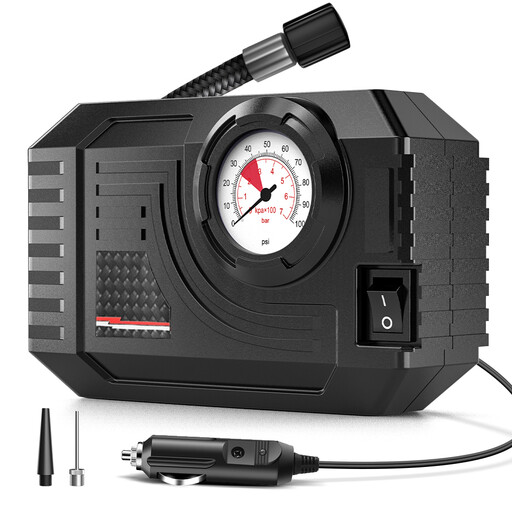
Why This Fits Their Persona: This wired mechanical air compressor suits occasional car, motorcycle and bicycle top-ups where a simple design matters more than cordless convenience.
Its straightforward operation avoids unnecessary electronic features. It uses a vehicle’s 12V socket for car or motorcycle applications, so there is no separate battery to maintain.
Portable format; suitable for car, motorcycle and bicycle tyres. A Presta adapter may be needed for some bicycles.
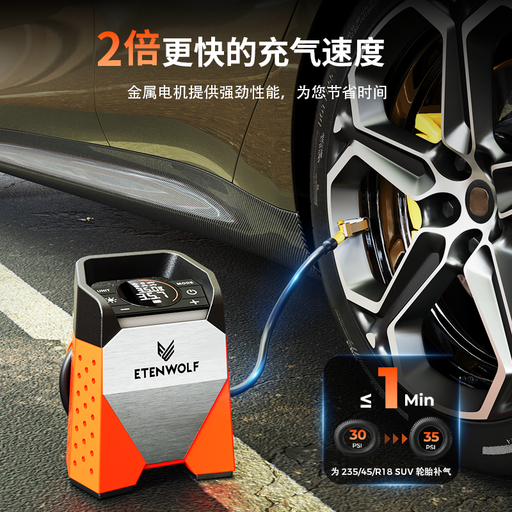
Why This Fits Their Persona: A battery-powered option for drivers who want digital control and accessories for several everyday inflating tasks.
The product lists a digital interface, automatic stopping and a lithium-ion battery. These features address pressure-setting and cable-management concerns, although charging before travel remains necessary.
160 PSI maximum operating pressure; supplied with a Presta adapter, ball needle, tapered nozzle and USB A-to-C cable.
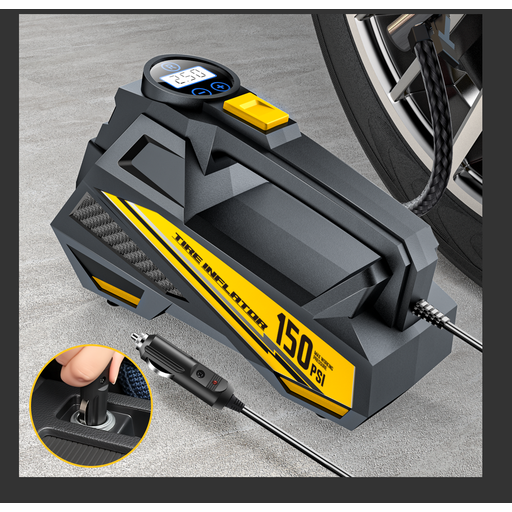
Why This Fits Their Persona: A corded choice for households maintaining cars, motorcycles, bicycles and balls from a vehicle power outlet.
The 12V connection avoids dependence on a stored battery. Its stated 150 PSI rating should still be read as a maximum, not as a recommendation for every inflatable.
12V motor; listed for cars, motorcycles, bikes and balls; includes an easy-to-read gauge.
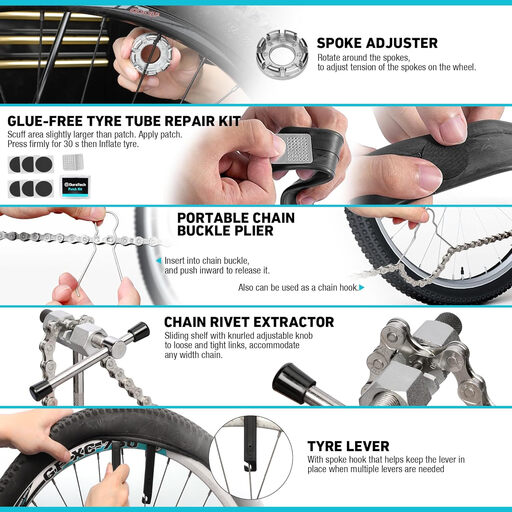
Why This Fits Their Persona: This is for people who need more than a bicycle tyre pump, including home cycle maintenance, chain work and routine DIY repairs.
It avoids buying a pump for problems that require mechanical tools. The set includes tyre levers, repair tools, wrenches, chain tools and a storage case.
31-piece bicycle repair kit; portable toolbox; includes Cr-V wrench components and bicycle-specific tools.
Before inflating:
Do not use a car tyre inflator as a substitute for repairing a puncture or replacing a damaged tyre. Check the tread, sidewall and valve for visible problems. A tyre that repeatedly loses pressure should be inspected by a qualified garage or tyre professional.
It can be useful for pressure checks and modest top-ups, particularly before long journeys or when a tyre-pressure warning appears. It does not replace a spare wheel, sealant system or roadside assistance where a tyre is damaged.
Many can, but check the valve compatibility, pressure range and supplied adapters. A Presta adapter is commonly needed for some bicycle tyres. For repeated workshop use, a dedicated bicycle tyre pump may offer a more suitable operating pattern.
A cordless pump uses energy from its rechargeable battery, while a 12V tyre inflator draws power from the vehicle. Running time depends on starting pressure, tyre size and usage. Avoid leaving a 12V pump connected after use and follow the manufacturer’s operating instructions.
We have compiled a complete, real-time list of products that fully satisfy these strict selection criteria and UK safety regulations.