
24/7 Customer Support

Free returns

Same-day & Next-day Delivery

Quality Guaranteed

Unlock Your Welcome Offers: FREE Delivery | Up to 80% OFF | Free 30-day JoyPlus trial
Download the APP
A portable tyre inflator can be useful for routine pressure top-ups, cycling trips and roadside emergencies. However, not every compact air compressor is equally suitable for UK motorists. A model that looks powerful on a product page may be inconvenient to charge, too slow for several car tyres or incompatible with your vehicle’s power supply.
Before buying a portable car tyre pump, look beyond the headline PSI figure. The right choice depends on how you travel, where you will use it and whether you prefer cordless convenience or dependable 12V power.
A 150 PSI tyre inflator or 160 PSI model may appear more capable than a lower-rated pump. Maximum pressure indicates the upper pressure limit, not necessarily how quickly it inflates a car tyre. Airflow, motor design, hose connection and duty cycle also affect performance.
For most UK cars, the recommended tyre pressure is far below 150 PSI. Check the vehicle placard inside the driver’s door, on the fuel flap or in the handbook rather than inflating to the number printed on the compressor.
A cordless tyre inflator is convenient when parked away from a socket, but its operating time depends on battery capacity, temperature, tyre size and the pressure increase required. A rechargeable tyre pump may handle occasional top-ups well but need recharging after several larger tyres.
A wired 12V car air compressor avoids this particular battery limitation, although the engine should normally be running during use to reduce the risk of draining the vehicle battery. Always follow the supplied instructions and check the vehicle socket’s fuse rating.
A pump may be advertised for cars, motorcycles and bicycles but still need an adapter for certain bicycle valves. Many car tyres use Schrader valves, while road bicycles commonly use Presta valves. Check whether the required nozzle or adapter is included.
Also look for hose length, power-cable reach and storage for accessories. A compact pump is less useful if it cannot reach the rear tyre or its connectors are easily misplaced.
For everyday cars, motorcycles and bicycles, a rating around 150–160 PSI provides sufficient headroom for normal inflation tasks. More important than the headline figure is whether the manufacturer provides an airflow rating, such as litres per minute, and clear vehicle-size guidance.
Small cordless models are generally suited to pressure adjustments and emergency top-ups. Wired or larger compressors may be more practical when inflating several car, SUV or light commercial tyres.
Choose between:
Do not run an electric air compressor continuously beyond the stated duty cycle. Allowing the motor to cool can help prevent overheating and premature wear.
A digital tyre pressure gauge makes target setting easier to read than a basic analogue dial, particularly in low light. Useful features include PSI, BAR and kPa readings, preset modes and an automatic shut-off tyre pump function.
Auto-stop reduces the need to monitor inflation constantly, but it does not replace checking the recommended pressure. Attach the hose securely, avoid moving the unit during operation and confirm the final reading once inflation is complete.
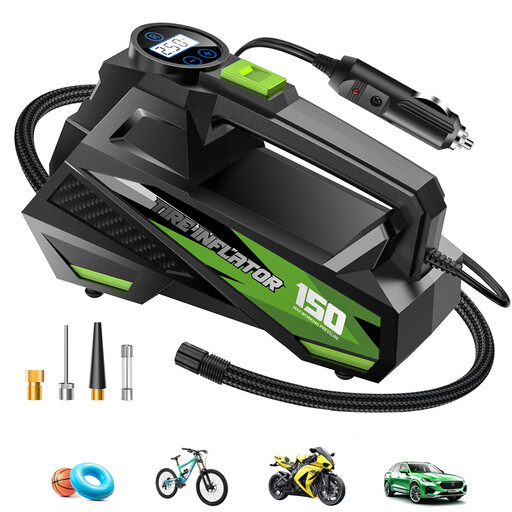
Why This Fits Their Persona: A straightforward wired option for UK drivers who want a compact pump for occasional car, motorcycle or bicycle pressure adjustments without relying on a rechargeable battery.
The extended power cord helps it reach different wheels without repeatedly relocating the unit. Engine-running guidance is provided for 12V vehicle use.
Portable format; extended power cord; suitable for cars, motorcycles and bicycles.
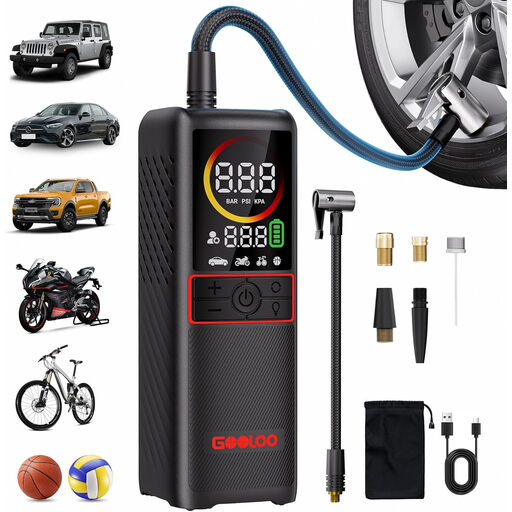
Why This Fits Their Persona: Suitable for motorists who value cordless operation, a larger display and several preset inflation modes for cars, motorcycles, bicycles and balls.
Its stated 7500mAh battery and automatic shut-off address the limitations of basic pumps, although it still needs charging before use.
160 PSI maximum pressure; 7500mAh rechargeable battery; digital display with PSI, kPa and BAR.
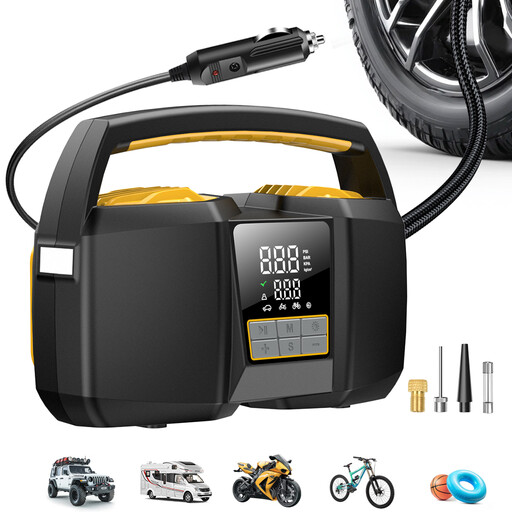
Why This Fits Their Persona: A wired choice for drivers who may need to inflate larger vehicle tyres or several tyres in one session, including some RV, SUV or light truck applications.
The wired design avoids dependence on a small internal battery. Buyers should still confirm the vehicle socket’s current capacity and the product’s duty-cycle instructions.
150 PSI rating; dual-compressor design; LED light; wired 12V operation.
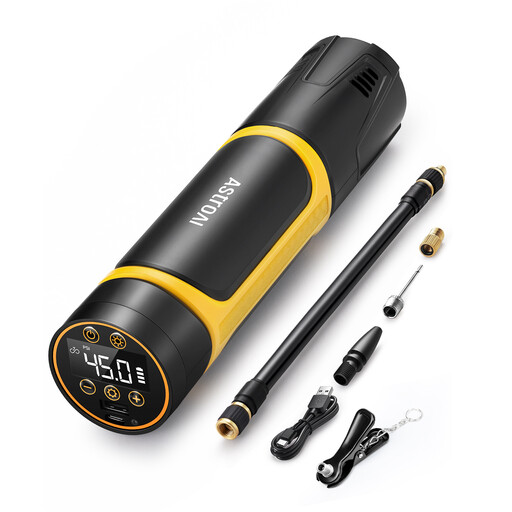
Why This Fits Their Persona: Well suited to cyclists who need Presta compatibility, while retaining modes for motorbike, car and ball inflation.
The listed Presta, Schrader and needle adapters reduce the risk of buying a multi-purpose pump that lacks the correct connector.
150 PSI maximum pressure; five inflation modes; LCD display; USB-C input and USB output.
We have compiled a complete, real-time list of products that fully satisfy these strict selection criteria and UK safety regulations.
Before using an emergency roadside air pump:
For products sold in Great Britain, review the listing and packaging for applicable conformity information, supplied instructions and the seller’s warranty or returns details. Northern Ireland requirements may differ depending on the product and supply route.
It can be useful for gradual pressure loss, seasonal checks and minor roadside top-ups. It cannot safely resolve every puncture, so it should complement—not replace—a spare wheel, sealant where appropriate and roadside assistance arrangements.
Battery life varies by capacity, tyre size, starting pressure and operating temperature. Follow the product’s stated runtime and recharge the unit after use. Storing it fully flat for long periods may leave it unavailable when needed.
Both have relatively modest direct energy costs, but the more important difference is convenience. A cordless model uses mains or USB charging, while a 12V pump draws power from the vehicle. Compare charging time, expected usage and whether you regularly have access to the car when inflation is required.