
24/7 Customer Support

Free returns

Same-day & Next-day Delivery

Quality Guaranteed

Unlock Your Welcome Offers: FREE Delivery | Up to 80% OFF | Free 30-day JoyPlus trial
Download the APP
A portable tyre inflator can be useful for routine pressure adjustments, cycling trips and roadside emergencies. However, product listings often focus on a large PSI number or impressive inflation-time claim while leaving out details that affect everyday usability.
Before buying a car tyre inflator, watch for these common pitfalls:
For cars, SUVs and MPVs, check more than the headline PSI figure. Airflow, usually listed in L/min, gives a more useful indication of how quickly the pump can move air. A model with a stated airflow of 32–45 L/min may be more suitable for repeated car-tyre adjustments than a compact unit with no airflow information.
A high-pressure pump is not automatically suitable for every vehicle. Check the product’s stated compatibility with passenger cars, SUVs, motorcycles or bicycles. Large commercial vehicles and heavy trucks may require equipment designed for higher air volumes.
Always use the pressure shown on your vehicle’s tyre placard, usually found inside the driver’s door frame, fuel flap or handbook. This figure may be given in bar, PSI or kPa. Do not use the maximum pressure printed on the tyre sidewall as your everyday target.
A digital tyre inflator with a built-in gauge can make pressure adjustments easier to manage. Useful features include:
Automatic shut-off reduces the need to monitor the display continuously, but it does not remove the need to attach the hose securely and check the final pressure. If a product relies on a mechanical gauge or provides no digital reading, consider keeping a separate tyre pressure gauge in the vehicle.
A rechargeable air compressor is convenient when you are away from a socket, particularly for bicycles, motorcycles and occasional roadside use. Battery-powered models should be fully charged before long journeys and stored away from excessive heat or moisture.
A 12V car air pump can provide continuous power while the engine is running, making it practical for several tyres or larger vehicles. Check the cable length, connector type and vehicle socket rating. Some wired inflators include a 3m cable, which can help reach all four wheels without repeatedly moving the unit.
For repeated inflation, look for clear duty-cycle guidance or cooling instructions. A compact pump that becomes hot may need pauses, even if its maximum pressure appears suitable.
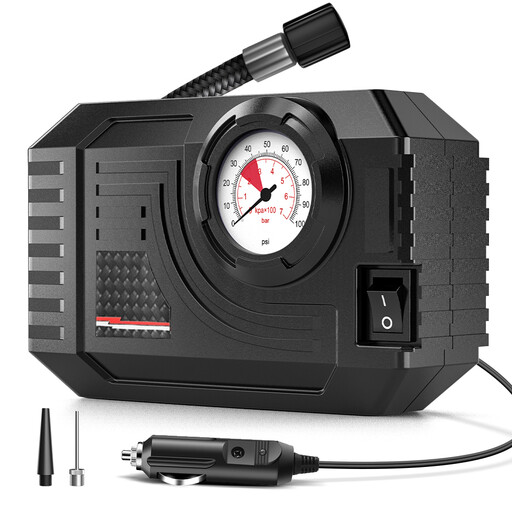
Why This Fits Their Persona: A straightforward wired option for drivers who want a compact pump for occasional car, motorcycle or bicycle pressure adjustments without relying on a built-in battery.
Its wired design avoids the risk of discovering a flat internal battery during an emergency. The instructions specify using a 12V socket with the engine running.
Portable format; listed for car, motorcycle and bicycle tyres; simple operation.
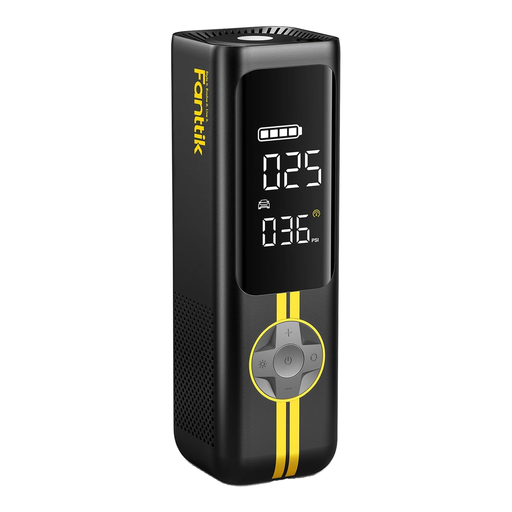
Why This Fits Their Persona: Suitable for UK motorists who value cordless convenience, clear controls and one device that can serve a car, motorcycle, bicycle or sports equipment.
The product lists four preset modes, three pressure units and automatic stopping at the selected value, rather than relying only on a headline PSI figure.
150 PSI maximum pressure; stated 40-minute runtime; USB-C input, USB-A output and LED light.
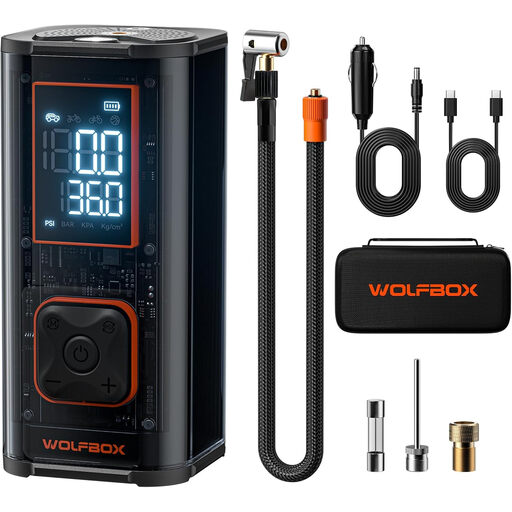
Why This Fits Their Persona: A practical match for SUV, pick-up and outdoor-travel users who prioritise a longer hose and higher-volume inflation capability.
The listing specifies a double-cylinder design, 45 L/min air flow and a 20-inch hose, giving buyers more useful information than maximum pressure alone.
150 PSI rating; double-cylinder configuration; 3.5-inch LED display and 20-inch hose.
We have compiled a complete, real-time list of products that fully satisfy these strict selection criteria and UK safety regulations.
Check tyre pressure when tyres are cold, ideally before a journey or after the vehicle has been parked for several hours. Attach the hose firmly, select the vehicle manufacturer’s recommended pressure and keep the valve cap safe while inflating.
A cordless inflator has no direct fuel cost, but it requires electricity to recharge and may need replacing when its battery eventually loses capacity. A 12V model draws power from the vehicle, so run the engine as instructed and avoid leaving the pump connected with the engine off. For occasional top-ups, either design can be economical; frequent use may favour a wired unit with continuous power.
It may restore pressure sufficiently for a short journey, depending on the cause of the air loss and the compressor’s capacity. A damaged tyre, separated valve or puncture should not be treated as a simple inflation issue. Inspect the tyre and seek assistance if it will not hold pressure.
Battery runtime varies according to tyre size, starting pressure, temperature and duty cycle. Look for a stated continuous runtime or estimated number of tyres and fully charge the unit before storing it in the car for emergencies.
Usually, no. Most everyday car tyres operate well below 150 PSI. A 150 PSI rating provides operating headroom, but airflow, gauge control, hose reach and automatic shut-off are often more relevant to routine car use. Always inflate to the pressure specified for your vehicle.