
24/7 Customer Support

Free returns

Same-day & Next-day Delivery

Quality Guaranteed

Unlock Your Welcome Offers: FREE Delivery | Up to 80% OFF | Free 30-day JoyPlus trial
Download the APP
A portable tyre inflator can be useful for routine pressure checks, long journeys and unexpected loss of air. However, choosing one based only on a large PSI figure or a polished product image can lead to wasted money.
A compact pump may be designed for balls and inflatable toys rather than vehicle tyres. A cordless model may be convenient but unsuitable if its battery is flat. Meanwhile, a 12V tyre pump can be practical for a car yet awkward to use if its cable is too short.
This guide explains the specifications that matter, common buying traps and which types of inflator suit different UK lifestyles.
A listing may advertise a 150 PSI air compressor, but maximum pressure is not the same as inflation speed, usable duty cycle or suitability for a particular vehicle. Most car owners should prioritise:
Always follow the pressure shown in your vehicle handbook, door-frame label or manufacturer guidance. Do not inflate to the maximum printed on the pump unless it is also the correct pressure for the tyre.
Small rechargeable air pumps are often excellent for swimming rings, yoga balls and air mattresses. They may not produce enough pressure for car, motorbike or bicycle tyres.
For example, the Baseus PocketGo Portable Air Pump is specified for items requiring up to 3.5 kPa and is explicitly not suitable for car, motorbike or bicycle tyres. It is an air pump for balls and low-pressure inflatables, not a car tyre inflator. Checking the pressure specification before purchasing prevents this common mismatch.
A cordless tyre inflator avoids a cable running from the 12V socket, which is useful at the roadside or beside a bicycle. However, it depends on battery capacity and charging habits. A flat battery can make it unavailable when needed.
A corded 12V tyre pump can be a sensible choice for drivers who keep the inflator in the boot and use it near the vehicle. For electric vehicle drivers, check whether the car provides a suitable 12V outlet and whether the vehicle should be switched on during use.
A digital tyre inflator should show a pressure range that covers your intended application. Car tyres commonly need substantially more pressure than low-pressure inflatables, while bicycles can require different valve fittings and higher pressure.
Look for clear compatibility with:
A claimed 150 PSI maximum may be useful for occasional bicycle or ball applications, but it does not by itself indicate how quickly a pump will inflate a car tyre.
Choose the power arrangement that matches your normal use:
For wired models, a 3-metre cable or extended power cord can make it easier to reach all four tyres. For battery-powered products, check charging time, battery capacity and whether the manufacturer states a practical number of inflation cycles.
A digital tyre inflator can make pressure setting easier to read than a basic analogue gauge. Automatic shut-off is also helpful because it stops inflation when the preset value is reached, although the reading should still be checked against a reliable pressure gauge when appropriate.
Confirm that the package includes suitable accessories. Bicycle tyres may use Presta or Schrader valves, while balls and inflatables require needle or tapered nozzles. A multi-purpose kit is only useful if the supplied fittings match your equipment.
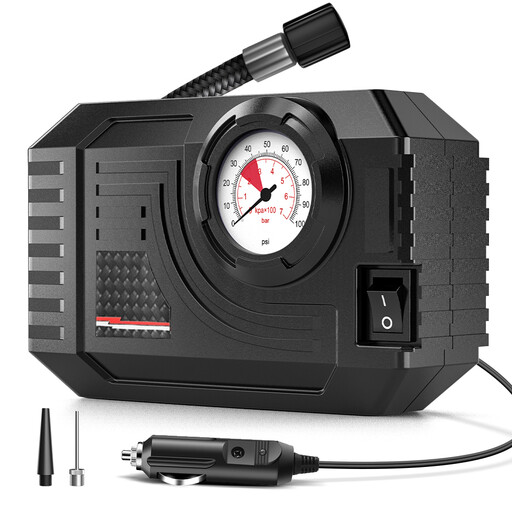
Why This Fits Their Persona: Its wired design suits drivers who want a straightforward pump for a car, motorbike or bicycle without relying on a rechargeable battery.
The product description identifies vehicle and bicycle use, helping distinguish it from low-pressure inflatable pumps. Bicycle valve compatibility should still be checked before use.
Portable wired format; suitable for car, motorbike and bicycle inflation.

Why This Fits Their Persona: Drivers and cyclists wanting a compact emergency tyre inflator may value its cordless format, digital display, lighting and multiple operating modes.
The stated specifications include preset pressure, auto-off, a 3–150 PSI range and a rechargeable battery. The listing also notes that it is not intended for off-road vehicles, motorhomes, lorries or trailers.
4000mAh battery; digital pressure modes; LED light with torch, SOS and strobe functions.
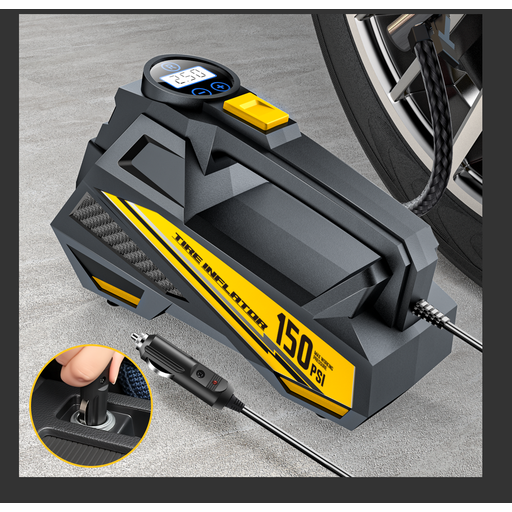
Why This Fits Their Persona: Suitable for motorists who prefer continuous 12V power and want one portable air compressor for car, motorbike, bicycle and ball inflation.
Its stated 12V connection makes the power source clear, while the built-in gauge is intended to help monitor pressure rather than relying on the headline PSI alone.
12V motor; stated 150 PSI maximum; compatibility with several inflation tasks.
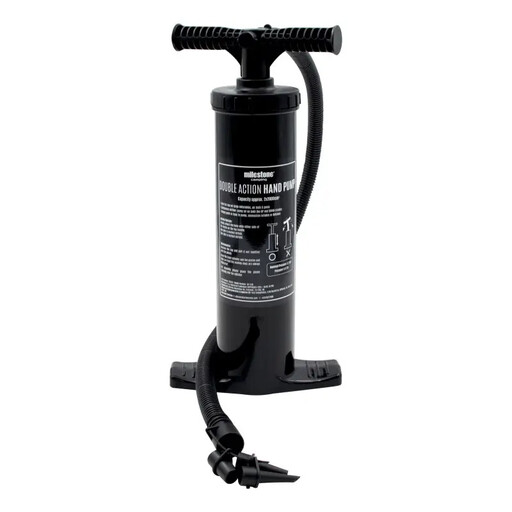
Why This Fits Their Persona: Campers and households inflating mattresses, pool toys or other low-pressure items can use it without mains electricity, a vehicle socket or battery charging.
It makes no battery or electrical claims. The double-action design and three nozzles clearly position it for compatible inflatables rather than high-pressure vehicle tyres.
Double-action airflow; two-litre capacity; three interchangeable nozzles.
We have compiled a complete, real-time list of products that fully satisfy these strict selection criteria and UK safety regulations.
It depends on the pump, tyre size and reason for the pressure loss. Many portable models are intended to top up pressure or deal with gradual deflation rather than replace roadside recovery for a damaged tyre. If a tyre will not hold air, arrange an inspection rather than repeatedly inflating it.
Both usually have modest electricity costs, but the difference depends on usage and charging method. A cordless model draws power during charging, while a 12V tyre pump uses the vehicle’s electrical system. Convenience, battery readiness and cable reach are often more important than the small running-cost difference.
Lifespan varies with construction, storage and usage. Repeated long inflation sessions, blocked ventilation, moisture and operating beyond the recommended duty cycle can cause premature wear. Keeping the pump dry, following cooling instructions and checking the cable and hose regularly can support safer, longer-term use.