
24/7 Customer Support

Free returns

Same-day & Next-day Delivery

Quality Guaranteed

Unlock Your Welcome Offers: FREE Delivery | Up to 80% OFF | Free 30-day JoyPlus trial
Download the APP
A portable tyre inflator can be a useful addition to a car boot, motorcycle storage box or cycling bag. It may help with gradual pressure loss before a journey or provide assistance during a roadside emergency. However, not every compact electric air pump is suitable for every tyre.
Marketing often focuses on a large PSI figure while overlooking practical limitations such as battery capacity, valve compatibility and heat management. Use the guidance below to compare a car tyre inflator, cordless tyre inflator or wired electric tyre pump with greater confidence.
A claimed 150 PSI tyre pump rating describes the maximum pressure the device can theoretically reach, not how quickly it will inflate a car tyre. Airflow, motor output and the tyre’s starting pressure have a greater effect on everyday performance.
A small pump designed mainly for bicycle tyres may reach a high pressure but still be unsuitable for repeated car-tyre inflation. Always check the stated inflation time, airflow and compatible vehicle types.
A rechargeable tyre inflator is convenient because it does not rely on a 12V socket. Its running time is nevertheless limited by battery capacity, temperature and the pressure being added. Some compact units may handle several bicycle tyres but offer fewer car-tyre inflations per charge.
For longer journeys, check whether the device has USB-C charging, a power-bank function or a wired backup. A 12V compressor can be practical for motorists who prefer to use the vehicle battery, provided the engine is running as instructed.
A digital tyre pressure gauge is only useful if the pump connects securely to the valve. Cars and many motorcycles use Schrader valves, while road bicycles and some electric bikes use Presta valves. An adapter may be needed.
Also check whether the manual specifies cooling breaks. Running a compact compressor continuously for too long can cause overheating, even when its headline pressure figure appears suitable.
For ordinary UK cars, motorcycles and bicycles, a working range covering the manufacturer’s recommended pressure is more important than the maximum number. A 150 PSI ceiling is generally ample for common inflatables, but it does not make a pump suitable for large commercial vehicles, trailers or off-road equipment.
Airflow, shown in L/min, helps indicate how much air the pump can move. Compare airflow figures alongside the stated inflation time, rather than relying on PSI alone.
Choose a cordless tyre inflator if you need flexibility away from a vehicle, such as when cycling, camping or using an electric bike. Battery capacity is usually shown in mAh, but real-world runtime also depends on motor efficiency and pressure.
A wired 12V portable air compressor can be a sensible option for car owners who want to avoid charging another battery. Keep the cable length in mind, particularly if the socket is in the front cabin and the valve is at the rear wheel.
A clear LCD or digital display should show the selected unit and target pressure. Useful units include PSI, bar and kPa, allowing you to match the vehicle handbook or tyre placard.
An auto shut-off air pump stops when the preset value is reached, reducing the risk of overinflation caused by distraction. It does not remove the need to set the correct pressure. Check pressures when tyres are cold and follow the vehicle manufacturer’s instructions rather than the maximum pressure printed on the tyre sidewall.
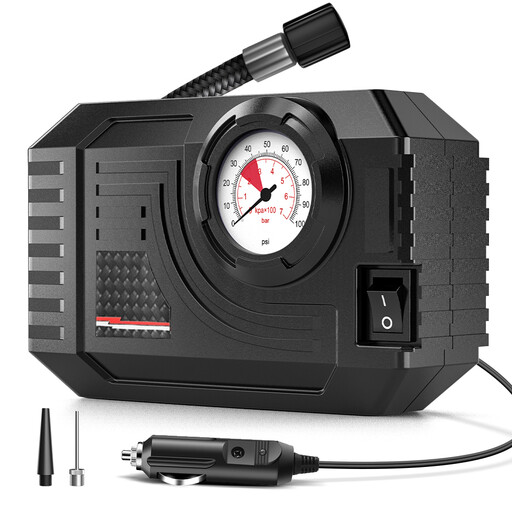
Why This Fits Their Persona: Its wired design suits drivers who want a straightforward pump for occasional car, motorcycle or bicycle use without managing a rechargeable battery.
The instructions clearly identify the 12V socket requirement and advise running the engine for car or motorcycle use, helping prevent unexpected battery drain.
Portable format; compatible with car, motorcycle and bicycle tyres. A Presta adapter may be required for some bicycles.

Why This Fits Their Persona: Drivers wanting a compact cordless unit with preset modes, a display and emergency-oriented features may find its specification suitable for keeping in the car.
The product information states a 4000mAh battery, auto-off function and a 3–150 PSI custom range. It also specifies that it is not intended for off-road vehicles, RVs, trucks or trailers.
150 PSI maximum pressure; four pressure units; five inflation modes; LED lighting and USB input/output ports.

Why This Fits Their Persona: This option is aimed at users who may inflate several vehicle tyres, bicycle tyres or sports balls and want a larger rechargeable battery.
Its stated 7500mAh battery and 35L/min airflow provide more context than the 160 PSI headline alone. It still requires charging and uses Schrader valves unless a separate Presta adapter is available.
160 PSI maximum pressure; 35L/min airflow; four preset modes; auto shut-off; USB-C charging and power-bank function.
We have compiled a complete, real-time list of products that fully satisfy these strict selection criteria and UK safety regulations.
For many UK drivers, a compact inflator is a practical emergency car accessory for correcting low pressure before reaching a garage or dealing with a slow leak. It should complement, not replace, a spare wheel or approved puncture equipment where supplied.
Battery life varies by model, tyre size, starting pressure and usage. Product specifications may quote a number of tyres or minutes, but these figures are conditions-based. Recharge the unit before long trips and avoid leaving it unused for extended periods with a flat battery.
Some models include car, motorcycle, bicycle and ball modes, but compatibility depends on the valve connectors and the pump’s intended duty cycle. Check whether the package includes Schrader, Presta and needle adapters. A mini motorcycle tyre pump or bicycle pump may not have the airflow or battery capacity needed for regular car tyres.